TheNextGeneration

  • Subscribe to our RSS feed.
  • Twitter
  • StumbleUpon
  • Reddit
  • Facebook
  • Digg

Thursday, May 2, 2013

NSIDC: Earliest satellite maps of Antarctic and Arctic sea ice
Posted on 11:58 AM by Unknown

Earliest satellite maps of Antarctic and Arctic sea ice

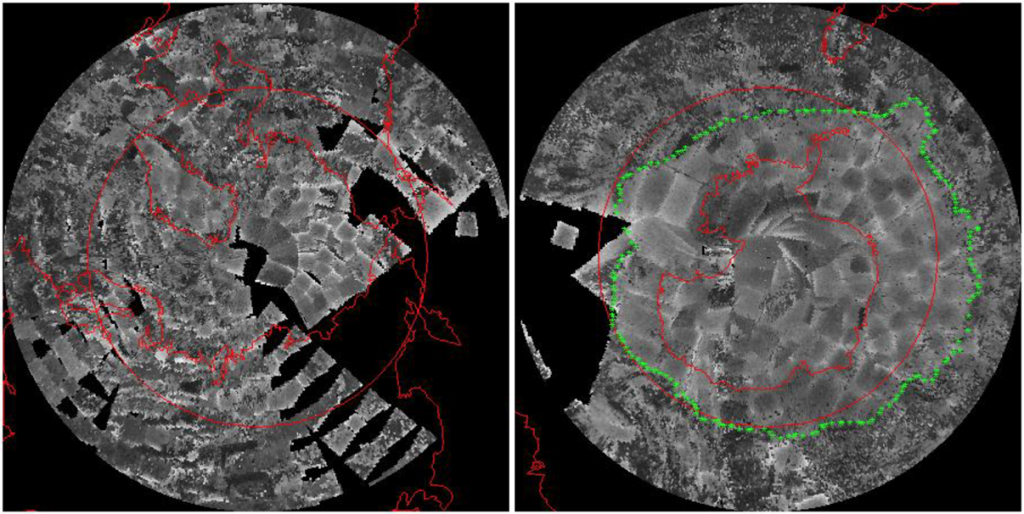
Figure 5. The National Snow and Ice Data Center scanned close to 40,000 images from Nimbus 1 satellite data to produce the earliest satellite images of Arctic and Antarctic satellite extent. The left image is a composite of the Arctic and the right image is a composite of the Antarctic. 
Credit: NSIDC. High-resolution image
While the modern satellite data record for sea ice begins in late 1978, some data are available from earlier satellite programs. NSIDC has been involved in a project to map sea ice extent using visible and infrared band data from NASA’s Nimbus 1, 2, and 3 spacecraft, which were launched in 1964, 1966, and 1969. Analysis of the Nimbus data has revealed Antarctic sea ice extents that are significantly larger and smaller than seen in the modern 1979–2012 satellite passive microwave record. The September 1964 average ice extent for the Antarctic is 19.7 ± 0.3 million square kilometers (7.6 million ± 0.1 square miles. This is more than 250,000 square kilometers (97,000 square miles) greater than the 19.44 million square kilometers (7.51 million square miles) seen in 2012, the record maximum in the modern data record. However, in August 1966 the maximum sea ice extent fell to 15.9 ± 0.3 million square kilometers (6.1 ± 0.1 million square miles). This is more than 1.5 million square kilometers (579,000 square miles) below the passive microwave record low September of 17.5 million square kilometers (6.76 million square miles) set in 1986.
The early satellite data also reveal that September sea ice extent in the Arctic was broadly similar to the 1979 to 2000 average, at 6.9 million square kilometers (2.7 million square miles) versus the average of 7.04 million square kilometers (2.72 million square miles).

In memoriam

We dedicate this post to Dr. Katharine Giles, who was tragically killed cycling to work on 8 April 2013. Together with Dr. Laxon, Katherine Giles worked to retrieve sea ice thickness from satellite radar altimeter data. In 2007 she was the first to show that this data could also be used to show how winds affect the newly exposed Arctic Ocean. Since Dr. Laxon’s death earlier this year, Katharine worked hard to continue his legacy and supervise his students. We have lost yet another talented scientist and a great friend.

Reference

Meier, W. N., D. Gallaher, and G. C. Campbell. 2013. New estimates of Arctic and Antarctic sea ice extent during September 1964 from recovered Nimbus I satellite imagery. The Cryosphere, 7, 699–705; doi:10.5194/tc-7-699-2013.
http://nsidc.org/arcticseaicenews/
Read More
Posted in | No comments

Tuesday, April 30, 2013

EU restricts neonicotinoid pesticide use to help save bees

Posted on 9:55 AM by Unknown

EU aims to better protect bees from pesticides

APR 29, 2013  |  RAF CASERT FOR THE ASSOCIATED PRESS
EU aims to better protect bees from pesticides
Credit: The Associated Press

EU says it will push through better bee protections after members disagree over pesticides

BRUSSELS (AP) — The European Union plans to restrict the use of three pesticides to better protect dwindling bee populations.

The announcement Monday was cheered by environmentalists, disappointed chemical companies and came after the bloc's 27 nations failed to agree on a common stand.

EU Consumer Commissioner Tonio Borg said his agency will override the deadlock and move "in the coming weeks" to restrict three neonicotinoid pesticides on plants and cereals that attract bees. The measure takes effect Dec. 1 for two years unless decisive new information becomes available.

Beekeepers have reported an unusual decline in bees over the past decade, particularly in Western Europe, according to the European Food Safety Authority. It says bees are critically important to the environment, sustaining biodiversity by providing pollination for a wide range of crops and wild plants — including most of the food crops in Europe.

Borg said bees contribute over 22 billion euros ($29 billion) a year to European agriculture.
In all, 15 EU nations were for the restrictions, eight were against and four abstained. Borg said he still felt confident in moving ahead because "a majority of member states now support our proposal."

Environmentalists welcomed the move.

"Today's pesticide ban throws Europe's bees a vital lifeline," said Iain Keith of the Avaaz environmental group. "Europe is taking science seriously and must now put the full ban in place to give bees the breathing space they need."

But major chemical companies, which were against Borg's proposals, have questioned the scientific evidence for such a ban.

The head of the EU Parliament's environmental committee acknowledged that "precise data is still lacking" but applauded the consumer agency's action.

"We shall now try to understand how exactly neonicotinoids affect the behavior of bees," said Matthias Groote.

http://www.newsdaily.com/article/9da497705b8ff3a1932ea60b4e80736e/eu-aims-to-better-protect-bees-from-pesticides
Read More
Posted in bees, neonicotinoid pesticide | No comments

Saturday, April 27, 2013

R L Miller, DailyKos: Brian Schweitzer: bold progressive or just another fossil-fueled politician? [we need Denise Juneau]

Posted on 12:52 PM by Unknown

Brian Schweitzer: a bold progressive or just another fossil fueled politician?

byRLMillerFollowforClimate Hawks, April 27, 2013 
FILE - In this Sept. 6, 2012, file photo, then-Montana Gov. Brian Schweitzer addresses the Democratic National Convention in Charlotte, N.C. In February 2013, the former governor is partnering with a New York hedge fund to launch a proxy battle for contro
AP via DailyKos image library
The DailyKos community has just concluded its a series of blogs opposing the Keystone pipeline, that piece of infrastructure that would carry planet-cooking tar sands from the Canadian border to the Gulf of Mexico. Separately, the DailyKos editorial board is running a campaign to draft a vocal supporter of the Keystone pipeline who’s so confident that the pipeline will be built that he’ll bet the $100 burning a hole in his pocket. “It’s got to be built,” he says, criticizing the "jackasses that are complaining."
Schweitzer isn’t only a friend to Canadian tarsands. He’s also a big booster of Powder River Basin coal shared between Wyoming and Montana. "60 Minutes" has dubbed him the coal cowboy: “He says flat out that his plan will change the world, and that the key to the country's energy future is buried in the grassy plains of eastern Montana.” Proponents of Schweitzer’s “clean coal” proposal trumpet its ability to free the United States from foreign oil; scientists respond: “What they’re proposing is simply not allowable if we want to avoid the perils of unconstrained anthropogenic climate change,” said Pushker Karecha of NASA’s Goddard Institute for Space Studies. “The bottom line is that there’s one fatal flaw in their proposed [coal-to-liquids] process from a climate protection standpoint. It would allow liquid fuel CO2 emissions to continue increasing indefinitely.”
When it’s disclosed that Mark Zuckerberg funds pro-Keystone XL ads, the denouncement is swift --  a CREDO petition asking his group to stop running ads supporting fossil fuels already has 13,000 signatures. But when Brian Schweitzer does the same? Crickets. Instead, Progressive Change Campaign Committee gets 15,000 signatures on a petition to draft him.
Why are progressives so willing to overlook Schweitzer’s pro-Keystone, pro-coal stands?
Myth: “There are no other viable Democratic politicians in MT. If we don’t run Schweitzer the Democrats will lose a seat.” Fact: This Great Falls Tribune story lays out all the potential candidates, including Denise Juneau and Stephanie Schriock.
Juneau, the first Native American woman elected to statewide office, is particularly intriguing - she was the sole no vote on expanding the Otter Creek coal mine (Schweitzer voted yes). “We could sell every parcel of state land and log every tree on state lands, but we don’t,” said Juneau at the Otter Creek hearing. “We don’t because we want to sustain Montana’s lands for future beneficial use … Of course there is [monetary] value in mining the coal. But there is also value in keeping Montana ‘Montana.’” She spoke to the Democratic National Convention on the value of education: 
Schriock is the president of EMILY’s List, ran campaigns for Jon Tester and Al Franken, and thus brings a formidable campaign presence. A PPP poll on the Montana Senate race in February, when Baucus was in the picture, found that Schweitzer was competitive, Nancy Keenan of NARAL less so, but didn’t poll any other Democrats. Schweitzer may be the front runner, but the state has many other Democrats along with a strong populist tradition not limited to Schweitzer.
Climate change protesters in Kalispell, Montana.
photo credit via Ojibwa at the Forward on Climate rally
Myth: “Montana is a coal state, so we can excuse him.” Fact: Montana is a state dependent on a lot of industries -- mining jobs are far less than jobs in the tourism industry. Some ranchers line up to oppose coal, wary of turning the state into an Asian resource colony. Montana also has good-to-excellent wind resources (which Schweitzer, to his credit, does promote). In short, the state is not just a coal state, and a truly forward-looking leader will move the state away from a poisonous resource instead of maintaining its dependence.
Myth: “Schweitzer is so good on other issues that it trumps his pro-coal positions.” Yes, he favors single-payer health care, as if that has a chance of becoming law any time soon. Yes, he’s as good on banking reform as Elizabeth Warren and Sherrod Brown. Fact: those positions pale in comparison to what James Hansen has famously called “game over for the planet.”
Simply put, it’s time to stop giving Democratic candidates a pass on dirty fossil fuels. Big Oil and the coal barons have a business plan to change the chemical composition of the atmosphere in the name of their profit. It’s time for Democrats to stop enabling them.
http://www.dailykos.com/story/2013/04/27/1205266/-Brian-Schweitzer-a-bold-progressive-or-just-another-fossil-fueled-politician
Read More
Posted in Big Oil Big Coal | No comments

Ted Glick, GRIST: Brian Eister's 27th day on hunger strike in front of the American Petroleum Institute

Posted on 12:38 PM by Unknown

Hunger Strike on 27th Day

by Ted Glick
Grist guest contributor, GRIST, April 27, 2013
As I write this Brian Eister is on the 27th day of a water-only climate hunger strike outside the American Petroleum Institute in Washington, D.C. The only thing he has consumed since April 1st is water, sodium and potassium.
Brian’s latest posts on his website, http://www.1future.net, report on both his continuing resolve but also the hunger and physical difficulties he is experiencing. On the 26th day he wrote, “The days are dragging on and hunger has become quite intense, but the sacrifice I am making here is modest. . .”
I know what he is going through. I have done three long hunger strikes of 25 or more days on water only. On the last two, one in 1992 and one in 2007, it was right around that time that my body began telling me that I needed to do one of two things if I was not to put myself at greater risk: slow down and use even less energy than I’d been using up to that point, or consume something that had calories.
On the 1992 one I slowed down and stayed on water-only, ending the fast with about a dozen others after 42 days. The purpose of it was to call attention to the need for US society to finally turn away from what Christopher Columbus set in motion 500 years before–the destruction of the ecosystem and the decimation of the Indigenous peoples of what is now called the Americas.
On the 2007 one, a climate emergency fast similar to Brian’s, I decided to go onto liquids after 25 days and, for the next 82 days, consumed fruit and vegetable juices and liquid-only soups and broths.
When I heard about Brian’s planned hunger strike several months ago, I seriously considered joining it but ending up deciding that it wasn’t the right thing for me to do at this time. But I support Brian and know that what he is doing is an important contribution to the process of building the kind of climate movement that has a fighting chance of making a renewable energy revolution in enough time to prevent runaway climate catastrophe.
“I am on hunger strike,” Brian writes, “because I can think of no action which could adequately express the urgency of humanity’s present situation. There are more than a few trends which, left unchecked, are likely to make life impossibly difficult for future generations. Global Warming, of course, seems to be the one that we have the least time to fix. Given the urgency of what is coming, every one of our lives should, first and foremost, be dedicated to preventing this coming catastrophe.”
I’ve recently read Proof of Heaven, a book which has been at the top of the New York Times Best Seller list for 25 weeks. It is written by a prominent, formerly non-religious brain surgeon, Eben Alexander, who nearly died in 2008 of an acute form of meningitis. During his seven days in a coma, he experienced what can only be described as an other-worldly, Heaven experience, and it changed his life.
In the book Alexander has an incisive quote which, I would say, helps to place what Brian is doing in its proper context:
“For all of the successes of Western civilization, the world has paid a dear price in terms of the most crucial component of existence—our human spirit. The shadow side of high technology—modern warfare and thoughtless homicide and suicide, urban blight, ecological mayhem, cataclysmic climate change, polarization of economic resources—is bad enough. Much worse, our focus on exponential progress in science and technology has left many of us relatively bereft in the realm of meaning and joy, and of knowing how our lives fit into the grand scheme of existence for all eternity.”
Fasting for more than a few days is one of the most effective ways, from my experience, to connect with what is most important in this world, and it definitely isn’t money and power. It is a way to develop one’s spiritual resources and resolve in the face of what often seem like very long odds.
Each of us as individuals will be strengthened if we take time to think about Brian’s sacrifice. We should reflect upon how we can speak up and take action beyond our current comfort level, at a level commensurate with the seriousness of the climate crisis.
Ted Glick has been a climate activist since 2004 and a progressive activist since 1968. Past writings and more information can be found at http://tedglick.com.
http://grist.org/article/hunger-strike-on-27th-day/
Read More
Posted in Brian Eister | No comments

Friday, April 26, 2013

Climate hero Brian Eister on day 26 of hunger strike at American Petroleum Institute in Washington, DC

Posted on 2:09 PM by Unknown
This is a call out to all readers. Please help Brian in any way you can. Post his story on facebook, spread the word on twitter, +Google it, write about it on your own blog, and send him words of support. Few people have this type of courage. Lord knows I do not.  He is doing what we all wish we had the courage to do.
Contact:  Brian Eister
Phone:  702-556-9674
e-mail:  planetaryspring@gmail.com
Twitter: @hungry4afuture
Hashtag:  #climatehungerstrike
His blog:  http://www.1future.net/

From Day 24, he writes:
I have not been posting here as consistently as I would like.
Undertaking an extended hunger strike while doing your own press work presents unique challenges, and I am doing my best to balance all of them.
The days are dragging on and hunger has become quite intense, but the sacrifice I am making here is modest compared with the gravity and magnitude of humanity’s situation.
We go about our day-to-day lives as though things are okay. In our minds, we imagine that somehow, someway, this problem will be solved: how, after all, could a world full of responsible adults allow all of our children’s lives (and their children’s lives) to be ruined?
The fact is, the kind of change that is necessary for all future generations not to suffer immensely is nearly impossible under present circumstances.
If all of us get off of the sidelines and dedicate our lives to saving this world and its ability to sustain human life as it does today we have a chance: but if we continue to expect that others will solve the problem we will be in for a very sore surprise.
I am now 24 days into this hunger strike to demonstrate a fraction of the dedication that is necessary to overcome the power of the trillions of dollars of fossil fuel wealth that still sits in the ground, counted on balance sheets and leveraged by the carrots and sticks of campaign finance.
The truth is, I’m not doing enough.
In the name of love, in the name of the care that we have for others, and in the name of our sacred obligation to care for our children, we all have to do more.
http://www.1future.net/
Read More
Posted in Big Oil Big Coal, Brian Eister, Climate Patriots | No comments

A Man For All Seasons: James Hansen Wins The Ridenhour Courage Prize

Posted on 9:57 AM by Unknown
by Joe Romm, Climate Progress, April 24, 2013

James Hansen was awarded the Ridenhour Courage Prize today.

The Prize is “presented to an individual in recognition of his or her courageous and life-long defense of the public interest and passionate commitment to social justice.”

I was given the great privilege of introducing Hansen. This is what I prepared:


Dr. James Hansen is being honored today in part because he told Congress: “The global warming now is large enough that we can ascribe with a high degree of confidence a cause-and-effect relationship to the greenhouse effect.”

The courageous part isn’t what he said, it’s when he said it — 25 years ago, during the sweltering summer of 1988. It was the first high-profile public statement by a US government scientist alerting the country to this grave threat.

Jim embodies the Ridenhour Courage Prize. When he was still NASA’s top climate scientist, he blew the whistle on government efforts to silence him — and others — on climate change.
Jim is a modern day Paul Revere … if Paul Revere’s midnight ride had taken place in 1750 and the message was, “The British are coming, The British are coming — in 25 years.”

Yes, climate change is a challenging story to tell. And Jim has actually been telling it publicly since 1981, when he published his first warning that led to a major New York Times story, headlined, “Study Finds Warming Trend That Could Raise Sea Levels.”

And yet carbon pollution has kept rising. We live in a spineless world, where being scientifically right for over 30 years gives you no more credit with the national media than being a professional disinformer funded by the fossil fuel industry.

How spineless is this world? If a doctor used the best science to diagnose a smoker as having early-stage emphysema and the doctor did NOT urge the patient to start quitting cigarettes, he’d be charged with malpractice.

But if a climatologist uses the best science to diagnose an entire planet as having early-stage climate change, and he urges the world to start quitting fossil fuels, well, then he is labeled an alarmist or an extremist by industry-backed groups.

The truth is we all should be alarmed by the great moral crisis of our time. By destroying a livable climate we are stealing the future from our children and grandchildren and countless future generations.

To save this spineless world from itself, supplying the truth isn’t enough. You need to supply the spine, too. You need to be courageous. And so Jim has been forced by the times — and by his moral convictions — to become an activist.

There is a saying that applies to Jim, “One man with courage is a majority.”

How many scientists have spawned an entire movement?

Five years ago Jim explained that “If humanity wishes to preserve a planet similar to that on which civilization developed and to which life on Earth is adapted,” we need to return carbon dioxide levels back to 350 parts per million. That led to Bill McKibben founding the group 350.org.

Then Jim said burning the tar sands would be “game over for the climate” — and that led to the fight against the Keystone XL pipeline — and the biggest protests and civil disobedience the climate movement had ever seen.

And because Jim has the courage of his convictions he has had the courage to be convicted himself — he’s been arrested 5 times during peaceful protests.

Fifty years ago this month, another great moral crusader was arrested for protesting — and he wrote a letter from his jail cell in Birmingham explaining why. “Injustice anywhere is a threat to justice everywhere,” wrote Martin Luther King Jr. on April 16, 1963. “We are caught in an inescapable network of mutuality, tied in a single garment of destiny.”

Now more than ever, we are “tied in a single garment of destiny,” cloaked as a species in a protective climate that we are in the process of unraveling. And so the need for activism, the need for courage, the need to speak out, is as great as ever.

As King put it, “We will have to repent in this generation not merely for the vitriolic words and actions of the bad people but for the appalling silence of the good people.”

It is my singular honor to give you a man who will not have to repent, a man for all seasons, literally — the winner of the 2013 Ridenhour Courage Prize, Dr. James Hansen.

http://thinkprogress.org/climate/2013/04/24/1899981/a-man-for-all-seasons-james-hansen-wins-the-ridenhour-courage-prize/?mobile=nc
Read More
Posted in James Hansen, Joseph Romm | No comments

RealClimate: The answer is blowing in the wind: The warming went into the deep end [of the oceans]

Posted on 8:53 AM by Unknown
by rasmus, RealClimate, April 26, 2013
 
There has been an unusual surge of interest in the climate sensitivity based on the last decade’s worth of temperature measurements, and a lengthy story in the Economist tries to argue that the climate sensitivity may be lower than previously estimated. I think its conclusion is somewhat misguided because it missed some important pieces of information (also see Skeptical Science’s take on this story here).

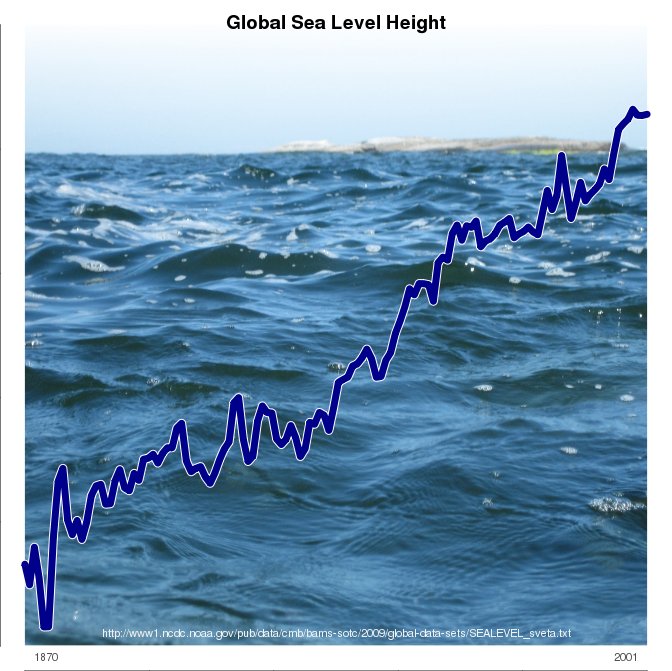
The ocean heat content and the global mean sea level height have marched on.
 
While the Economist referred to some unpublished work, it missed a new paper by Balmaseda et al. (2013) which provides a more in-depth insight. Balmaseda et al. suggest that recent years may not have much effect on the climate sensitivity after all, and according to their analysis, it is the winds blowing over the oceans that may be responsible for the ‘slow-down’ presented in the Economist.

It is well-known that changes in temperature on decadal time scales are strongly influenced by natural and internal variations, and should not be confused with a long-term trend (Easterling & Wehner 2009, Foster & Rahmstorf 2011).

An intensification of the trades has affected surface ocean currents called the subtropical gyres, and these changes have resulted in a predominance of the La Nina state. The La Nina phase is associated with a lower global mean temperature than usual.

Balmaseda et al.’s results also suggested that a negative phase of the Pacific Decadal Oscillation (PDO) may have made an imprint on the most recent years. In addition, they found that the deep ocean has warmed over the recent years, while the upper 300 m of the oceans have ‘stabilised.’ 
 
The oceans can be compared to a battery that needs to be recharged after going flat. After the powerful 1997-98 El Nino, heat flowed out of the tropical oceans in order to heat the atmosphere (evaporative cooling) and the higher latitudes. The warming resumed after the ‘deflation,’ but something happened after 1998: since then, the warming has involved the deep ocean to a much greater extent. A weakening of the Atlantic Meridional Overturning Circulation (MOC) may have played a role in the deep ocean warming.

The recent changes in these decade-scale variations appear to have masked the real accumulation of heat on Earth.

The new knowledge from this paper, the way I read it, is the revelation of the role of winds for vertical mixing/diffusion of heat in a new analysis of the world oceans. Their results were derived through a set of different experiments testing the sensitivity to various assumptions and choices made for data inclusion and the ocean model assimilation set-up.

The analysis involved a brand new ocean analysis (ORAS4, Balmaseda et al. 2013) based on an optimal use of observations, data assimilation, and an ocean model forced with state-of-the-art description of the atmosphere (reanalyses).

By running a set of different experiments with the ocean model, including different conditions, such as surface winds and different types of data, they explored which influence the different conditions have on their final conclusion.

The finding that the winds play a role for the state of the warming may not be surprising to oceanographers, although it may not necessarily be the first thing a meteorologist may consider.

http://www.realclimate.org/index.php/archives/2013/04/the-answer-is-blowing-in-the-wind-the-warming-went-into-the-deep-end/#more-15062
Read More
Posted in Atlantic Meridional Overturning Circulation - AMOC, ENSO, ocean heat content, PDO - Pacific Decadal Oscillation, Stefan Rahmstorf | No comments
Newer Posts Older Posts Home
Subscribe to: Posts (Atom)

Popular Posts

  • James Hansen: Tar Sands and Dirty Tricks
    by James Hansen, September 13, 2013 The New Yorker just published (16 September issue) an excellent article "The President and the Pip...
  • Andrew Glikson: Another link between CO2 and mass extinctions of species
    by Andrew Glikson , The Conversation , March 22, 2013 It’s long been known that massive increases in emission of CO 2 from volcanoes, assoc...
  • Bombshell: Recent Warming Is ‘Amazing And Atypical’ And Poised To Destroy Stable Climate That Enabled Civilization
    by Joe Romm , Climate Progress , March 8, 2013 New Science Study Confirms ‘Hockey Stick’: The Rate Of Warming Since 1900 Is 50 Times Greater...
  • Real Pragmatism for Real Climate Change: Interview with Dr. John Abraham
    by John Stafford, OilPrice.com, March 26, 2013 At a time when extreme weather incidents are causing billions in damages, businesses, governm...
  • Steve Horn: State Dept Keystone XL Enironmental Reviewer Claimed Delaware Tar Sands Refinery Made Air Cleaner
    by Steve Horn, DeSmogBlog, July 18, 2013 A  DeSmogBlog  investigation reveals  Environmental Resources Management, Inc. (ERM Group) , the co...
  • James Hansen interview (video) of why he retired from NASA to be more active in climate actions
    by Climate Science Watch, April 12, 2013 Sustainability Media Lab shot this video interview on April 10, 2013, with James Hansen on why he l...
  • Steve Horn: State Department's out-sourced Keystone XL environmental impact evaluation performed without knowing pipeline's route!!!
    by Steve Horn, DeSmogBlog, July 8, 2013 The State Department's decision to hand over control to the oil industry to evaluate its own ...
  • Justin Gillis, NYT: Maverick climate scientist James Hansen retiring from NASA, can now take a more active role in lawsuits challenging states and the federal government over their failure to limit CO2 emissions
    Climate Maverick to Quit NASA by  JUSTIN GILLIS , The New York Times , April 1, 2012 James E. Hansen , the climate scientist who issued the ...
  • Exxon acting like national guard under martial law in Mayflower, Arkansas, Pegasus tar sands dilbit spill cleanup
    Arkansas town in lockdown after oil spill nightmare by  Suzi Parker , Grist, April 5, 2013 REUTERS / Jacob Slaton There’s one Exxon gas stat...
  • Steve Horn: The Flip Side of Obama’s Keystone XL Delay
    Even as President Obama cast a veneer of caution over the Keystone pipeline’s northern half, he quietly expedited dozens of similar projec...

Categories

  • 2012 temperatures (3)
  • 2013 temperatures (6)
  • acidizing (1)
  • Adam Siegel (1)
  • Adaptation (1)
  • Aerosols (7)
  • Africa (2)
  • Al Gore (1)
  • Alaska (6)
  • albedo (2)
  • albedo flip (5)
  • ALEC (8)
  • Alun Hubbard (2)
  • Amazon rainforest (1)
  • Andrew C. Revkin (2)
  • Andrew Freedman (1)
  • Andrew Glikson (1)
  • Andrew J. Weaver (1)
  • Antarctic bottom water (2)
  • Antarctic Circumpolar Winds (1)
  • Antarctic Ice Sheet -- Western (WAIS) (4)
  • Antarctic Oscillation - AAO (1)
  • Antarctic warming (1)
  • Anthony R Ingraffea (1)
  • Anthony Watts (1)
  • Arctic amplification (7)
  • Arctic melt season (1)
  • Arctic Methane Emergency Group (7)
  • Arctic Ocean (5)
  • Arctic Oscillation (5)
  • Arctic sea ice mean speed (4)
  • Arctic sea ice volume (24)
  • Argo (1)
  • Atlantic Meridional Overturning Circulation - AMOC (2)
  • Atmospheric CO2 (8)
  • Australia (6)
  • Barry Bickmore (1)
  • bees (9)
  • Benjamin Santer (4)
  • Bidder 70 (1)
  • Big Oil Big Coal (89)
  • Bill McKibben (11)
  • Black carbon (2)
  • BOEMRE (2)
  • Brad Johnson (1)
  • Brazil (2)
  • Brian Eister (2)
  • Canada (24)
  • Carbon sinks (2)
  • Catastrophic climate change (1)
  • Charles Monnett (3)
  • China (15)
  • Chris Mooney (1)
  • Civil resistance (33)
  • Climate Change Criminals (24)
  • Climate Denial Machine (47)
  • Climate modelling (5)
  • Climate Patriots (2)
  • Climate sensitivity (1)
  • CO2 draw-down (1)
  • Consequences to infrastructure (1)
  • contrails (1)
  • coral reefs (1)
  • Corexit (1)
  • corrupt officials (60)
  • Coupled ice-ocean model (3)
  • Coupled ocean–atmosphere model (2)
  • crop yields (9)
  • CRU e-mails (2)
  • CryoSat-2 (1)
  • cyclones (2)
  • Dana Nuccitelli (9)
  • Dansgaard–Oeschger event (1)
  • David Roberts (2)
  • David Spratt (2)
  • Deforestation (2)
  • deglaciation (1)
  • Denial psychology (9)
  • divestment (11)
  • Donors Trust (2)
  • Drought (9)
  • dust (1)
  • earthquakes (3)
  • East Siberian Arctic Shelf (1)
  • Eastern Siberian Arctic Shelf -- ESAS (2)
  • Eemian (3)
  • Eli Rabett (5)
  • Elizabeth Kolbert (1)
  • Ellesmere (1)
  • ENSO (11)
  • Eric Rignot (1)
  • Extreme weather events (15)
  • Ferrel cells (1)
  • First Nations (9)
  • Flooding (7)
  • floods (1)
  • Forest fires (3)
  • fracking (47)
  • Fred Singer (1)
  • freshwater lens (1)
  • fugitive emissions (2)
  • Gareth Renowden (2)
  • Gavin Schmidt (3)
  • Geoengineering (1)
  • George Monbiot (2)
  • Gerald Meehl (2)
  • glacial runoff (1)
  • Global dimming (1)
  • glyphosate (1)
  • Graham Readfearn (9)
  • Greenland ice melt (21)
  • Greenpeace (3)
  • Greg Laden (3)
  • GrIS (9)
  • Hadley cells (2)
  • Hadley circulation (2)
  • Hans Joachim Schellnhuber (1)
  • Harrison Loony Tool Schmitt (1)
  • Heartland Institute (14)
  • heat dome (3)
  • Heat waves (13)
  • hockey stick (10)
  • Holocene thermal maximum (2)
  • hurricanes (1)
  • IceSat (2)
  • Igor Semiletov (4)
  • Inhofe (2)
  • Insurers (2)
  • Intertropical Convergence Zone - ICZ (2)
  • Jakobshavn Isbræ (1)
  • James Hansen (15)
  • Jason Box (10)
  • Jeff Masters (6)
  • Jennifer Francis (7)
  • Jeremy Grantham (1)
  • Jet stream (4)
  • John Abraham (15)
  • John Christy (1)
  • John Cook (2)
  • John Kerry (2)
  • Joseph Romm (12)
  • Josh Willis (2)
  • Judith Curry (1)
  • Julie Brigham-Grette (1)
  • Justin Gillis (3)
  • Katharine Hayhoe (2)
  • Kerry Emanuel (2)
  • Kevin Grandia (1)
  • Kevin Trenberth (14)
  • Keystone Principle (14)
  • Keystone XL (57)
  • Koch Industries (13)
  • Konrad Steffen (2)
  • Lake El'gygytgyn (1)
  • Leo Hickman (2)
  • Marc Morano (3)
  • Mark Boslough (1)
  • Mark Hertsgaard (1)
  • Mark Serreze (1)
  • Mass extinctions (1)
  • Mauri Pelto (1)
  • Medieval Climate Anomaly (2)
  • Meridonal heat transport - MHT (1)
  • Methane (2)
  • Methane Gun hypothesis (9)
  • Methane hydrates (11)
  • Michael Mann (20)
  • Michael Oppenheimer (2)
  • Michael Tobis (2)
  • Milne Ice Shelf (1)
  • Mitigation (1)
  • Monckton (6)
  • Monsanto (3)
  • Myles Allen (1)
  • Naomi Klein (1)
  • Natalia Shakhova (4)
  • national security (3)
  • Neela Banerjee (1)
  • neonicotinoid pesticide (9)
  • Nitrous oxide (1)
  • North Atlantic meridional overturning circulation (1)
  • North Atlantic Oscillation (2)
  • Obama (1)
  • OccupyWallStreet (5)
  • ocean acidification (2)
  • Ocean chemistry (1)
  • ocean heat content (15)
  • Ocean salinity (2)
  • Ocean temperatures (4)
  • ozone levels (1)
  • paleo-climate (4)
  • Paleo-CO2 (2)
  • Patrick Michaels (1)
  • Paul Douglas (1)
  • PDO - Pacific Decadal Oscillation (4)
  • Peak food (10)
  • Peak oil (1)
  • Peak Water (3)
  • Permafrost (1)
  • Permafrost - subsea (2)
  • Permian mass extinction (1)
  • Peter Gleick (3)
  • Peter Sinclair (13)
  • Peter Wadhams (4)
  • Petermann Glacier (1)
  • Phil Jones (1)
  • Pinatubo rebound effect (2)
  • pine beetles (1)
  • Pine Island Glacier (1)
  • PIOMAS (3)
  • polar bears (5)
  • Polar jet stream (8)
  • Polar vortex (2)
  • Positive feedbacks (1)
  • Precipitation extremes (4)
  • radiative forcing (2)
  • Ray Weymann (1)
  • Raypierre (1)
  • resilience (1)
  • resource scarcity (3)
  • Richard Alley (3)
  • Richard Somerville (1)
  • Rick Piltz (2)
  • Robert Corell (1)
  • Roger Pielke Jr. (1)
  • Rossby waves (2)
  • Russia (1)
  • saltwater intrusion (1)
  • Scott Mandia (1)
  • Sea level rise (13)
  • sea surface temperature anomalies (1)
  • Sediment cores (2)
  • Shell Oil (4)
  • snow cover (3)
  • Snowden (1)
  • Solar activity (1)
  • solar radiation (1)
  • Soot (3)
  • Stefan Rahmstorf (5)
  • Steve Horn (13)
  • Storm intensity (1)
  • Storm tracks diverted polewards (1)
  • Stratospheric Sudden Warmings (3)
  • sulfoxaflor (1)
  • Tamino (1)
  • tar sands (57)
  • Ted Scambos (1)
  • Terracide (1)
  • These people are completely insane (7)
  • Thomas L. Friedman (2)
  • threat multiplier (1)
  • Threat to our democracy (49)
  • Tim DeChristopher (1)
  • Tipping elements (1)
  • Tom Steyer (1)
  • Tornado statistics (2)
  • TransCanada (3)
  • trees (1)
  • tropospheric water vapor (1)
  • Typhoon Yasi (1)
  • Van Jones (2)
  • volcanism (1)
  • WAIS (1)
  • Waleed Abdalati (1)
  • Walker circulation (2)
  • Walt Meier (1)
  • Water shortage (2)
  • William Krabill (1)
  • Willie Soon (1)
  • Wind pattern changes (2)
  • Wind power (2)

Blog Archive

  • ▼  2013 (500)
    • ▼  September (27)
      • James Hansen: Tar Sands and Dirty Tricks
      • Summer 2013 weather extremes tied to extraordinari...
      • Court rulings show judges accept climate science
      • DC judge denies another effort to derail Michael M...
      • Scientist Michael Mann named in top 10 influential...
      • Justin Gillis, NYT: A Climate Alarm, Too Muted for...
      • Top Obama aide Heather Zichal worked the Pavillion...
      • Call Sacramento. Vote NO on SB4
      • Graham Readfearn: The undiscerning climate bookshelf
      • Graham Readfearn: Australia's Department of Defenc...
      • Top Occupy Wall Street Cartoons
      • URGENT: phone your CA rep to prevent industry amen...
      • Tom Steyer, NexGen: Keystone XL bad economics for ...
      • Daily Mail Lies! No 60% recovery in Arctic sea ice...
      • Steve Horn: The Flip Side of Obama’s Keystone XL D...
      • Joseph E. Stiglizt, NYT: Why Janet Yellen, Not Lar...
      • "Global crop exposure to critical high temperature...
      • Naomi Klein: Green groups may be more damaging th...
      • Margaret Heffernan: Dare to Disagree
      • "Spring snow cover extent reductions in the 2008-2...
      • U.S. Becomes Largest Wood Pellet Exporter,Enviva, ...
      • Rebuttal to Michael Tobis' unsubstantiated attacks...
      • Why trust climate models? It’s a matter of simple ...
      • Steve Horn: "Frackademia" By Law: Section 999 of t...
      • MUST SEE, Peter Sinclair: No Slowdown in Global Wa...
      • Dana Nuccitelli: The Pacific Ocean fills in anothe...
      • Posts from August 2013
    • ►  August (78)
    • ►  July (74)
    • ►  June (56)
    • ►  May (62)
    • ►  April (105)
    • ►  March (98)
Powered by Blogger.

About Me

Unknown
View my complete profile