TheNextGeneration

  • Subscribe to our RSS feed.
  • Twitter
  • StumbleUpon
  • Reddit
  • Facebook
  • Digg
Showing posts with label Arctic Methane Emergency Group. Show all posts

Wednesday, July 31, 2013

Methane hydrates: a volatile time bomb in the Arctic

Posted on 7:52 AM by Unknown

Gpkgyj67-1349405231Methane locked under the Arctic ice could take climate change to a whole new level. Antonio Delgado Huertas 

by Antonio Delgado Huertas, The Conversation, October 17, 2012

The risk with climate change is not with the direct effect of humans on the greenhouse capacity of Earth’s atmosphere. The major risk is that the relatively modest human perturbation will unleash much greater forces. The likelihood of this risk is intimately tied to the developments over the next decade in the Arctic. Accelerating ice loss and warming of the Arctic is disturbing evidence that dangerous climate change is already with us. As I have argued earlier, now that we have realised this our efforts should be directed at managing the situation in the Arctic and avoiding the spread of dangerous climate change elsewhere.


The Arctic is a core component of the earth system. Six of the 14 climate change tipping points of the earth system are located in the Arctic region.
Whereas the term tipping point was initially introduced to the climate change debate in a metaphoric manner, it has since been formalised and introduced in the context of systems exhibiting rapid, climate-driven change, such as the Arctic. Tipping points have been defined in the context of earth system science as the critical point in forcing at which the future state of the system is qualitatively altered.
Tipping elements are defined, accordingly, as the structural components of the system directly responsible for triggering abrupt changes once a tipping point is passed. This is because they can be switched into a qualitatively different state by small perturbations.


Of the many tipping elements in the Arctic, that with potentially greatest consequences if perturbed is the vast methane deposit. Methane is a greenhouse gas. A molecule of methane has 20 times the greenhouse effect of a CO₂ molecule, and the release of methane has been linked to climatic transitions along the history of planet Earth.
The Arctic contains vast reserves of methane stored as methane hydrate, a gel-like substance formed by methane molecules trapped in frozen water. The methane hydrate deposits are estimated at between 1,000 and 10,000 Gigatons (109 tons) of CO₂-equivalents as methane, much of which is present in the shallow sediments of the extensive Arctic shelves. This amount of greenhouse gas is several times the total CO₂ release since the industrial revolution.
Even moderate (a few degrees C) warming of the overlying waters may change the state of methane from hydrates to methane gas, which would be released to the atmosphere. If this release is gradual, methane will add a greenhouse effect to the atmosphere. This will only be temporary, as it will be oxidised to CO₂, with a decline in the greenhouse effect of 20-fold per unit carbon.
However, if the state shift is abrupt it may lead to a massive release of methane to the atmosphere, which could cause a climatic jump several-fold greater than the accumulated effect of anthropogenic activity.

Data collected on a recent cruise confirm methane is being emitted. Antonio Delgado Huertas

Recent assessments have found bubbling of methane on the Siberian shelf. Models suggest that global warming of 3 °C could release between 35 and 94 Gt C of methane, which could add up to an additional 0.5 °C of global warming. Moreover, frozen soils and sediments contain large amounts of methane hydrates that can be released to the atmosphere. Indeed, rapid thawing of the Arctic permaforst has been reported to lead to the release of large amounts of methane.
In our most recent cruise this summer (June 2012) along the Fram Strait and Svalbard Islands we found concentrations of methane in the atmosphere of about 1.65 ppm. However our equilibrium experiments (air atmospheric with Arctic surface water) reached values that were generally between 2.5 ppm and 10 ppm, with maximum values up to 35 ppm. These results confirm that this area of the planet is emitting large amounts of methane into the atmosphere.
Understanding and forecasting the response of Arctic methane hydrate deposits to rapid warming and thawing in the Arctic is of the utmost importance.
Provided the magnitude of these risks, and those associated with other tipping elements in the Arctic, our collective response to climate change appears to be a careless walk on the razor edge.
https://theconversation.com/methane-hydrates-a-volatile-time-bomb-in-the-arctic-9891
Read More
Posted in Arctic Methane Emergency Group, Methane Gun hypothesis, Methane hydrates | No comments

Saturday, July 27, 2013

RL Miller: The Truth Behind That $60 Trillion Climate Change Price Tag

Posted on 3:49 PM by Unknown
The fallout from a recently-published article has some climate scientists questioning the validity of the numbers

Methane

An iceberg carved from a glacier floats in the Jakobshavn fjord in southwest Greenland. (Photo: Konrad Steffen / Reuters)

by R.L. Miller, TakePart, July 27, 2013

This week, news broke that if all [actually, 50 Gt is about 3.5-5.0% of the methane estimated to lie below the subsea permafrost of the Eastern Siberian Arctic Shelf: see article with Shakhova interview included at this link: http://thinkprogress.org/climate/2012/01/19/406762/arctic-methane-outgassing-on-the-east-siberian-shelf-primer-interview-dr-natalia-shakhova/] the methane off the East Siberian seafloor was released, the fallout would cost $60 trillion — a huge, staggering number.

For comparison’s sake, the world’s GDP is $70 trillion. The findings assume that 50 gigatons of methane would be released over the course of 10 to 20 years in a warming pulse.

Some climate scientists disagree with the underlying assumption. Gavin Schmidt has taken to Twitter to argue that 50 gigatons is an excessive estimate; prior warming periods didn’t show similarly large releases of methane.

On the other hand, climate scientist Dr. Michael Mann tells TakePart: “The precise magnitude [of methane] is an object of valid debate, but the possibility of a substantial release cannot be dismissed out of hand.” Climate modelers have underestimated Greenland sheet ice and Arctic sea ice melt, so the estimate is not outside the realm of possibility.


The authors make it clear that they’re responding to exuberant claims of $100 billion in short term benefits from a warming Arctic — if the sea ice melts, trade routes will be shortened. Neither the World Economic Forum (WEF) in its Global Risk Report, nor the International Monetary Fund in its World Economic Outlook, recognizes the potential economic threat from changes in the Arctic.
 
Very large numbers make us sit up and take notice, but they’re also hard to grasp. What is climate change currently costing even without that warming pulse? A NRDC report estimates that American taxpayers, through the federal government, paid $100 billion in 2012 — more than the cost of education or transportation. (And that doesn’t include what state and local governments, insurers, or private citizens paid.) Mann estimates the global cost at $1.4 trillion per year in coastal damage, droughts, fires, floods and hurricanes.

We know that Mayor Bloomberg’s proposal to armor New York City to protect against the next Sandy has a $20 billion price tag. No similar grand proposal has been made for other great cities of the East Coast — Boston, Washington, D.C., or Charleston. No similar proposal has been made for Midwestern cities facing floods, or Southwestern cities, where wildfire season now starts July 1 and ends June 30.

And what of Miami? It contributed $263 billion to gross domestic product in 2010, according to the Bureau of Economic Advisors. Caught between rising seas to the east and the Everglades to the west, the city is doomed to drown.

Abandoning Miami means not only moving or abandoning the businesses who create its gross domestic product, but walking away from its pricey real estate, its roads, hospitals, schools and infrastructure. The cost of relocating its people needs to be calculated both in dollars and in heartbreak. But if you ask people to estimate the cost of abandoning Miami, you get blank stares. It’s as if the language to ask the question hasn’t been invented yet.

“It is not difficult to envision much larger costs, [i.e., $60 trillion] given the potential larger and more abrupt warming [the more abrupt the warming, the more costly it is to try to adapt] that the authors calculate,” says Mann. And it’s not difficult to imagine that there are costs we haven’t even begun to imagine. And when you multiply those costs, city after city after city, suddenly $60 trillion becomes a very realistic and frightening number.

http://www.takepart.com/article/2013/07/26/methane-climate-change-arctic-60-trillion
Read More
Posted in Arctic Methane Emergency Group, Jakobshavn Isbræ, Methane Gun hypothesis, Methane hydrates | No comments

Methane gas likely spewing into the oceans through vents in sea floor

Posted on 10:07 AM by Unknown

Could speed up global warming more efficiently than carbon dioxide

by Denise Brehm, Civil and Environmental Engineering, MIT News, September 2, 2009


Scientists worry that rising global temperatures accompanied by melting permafrost in arctic regions will initiate the release of underground methane into the atmosphere. Once released, that methane gas would speed up global warming by trapping the Earth's heat radiation about 20 times more efficiently than does the better-known greenhouse gas, carbon dioxide.

An MIT paper that appeared online August 29, 2009, in the Journal of Geophysical Research elucidates how this underground methane in frozen regions would escape and also concludes that methane trapped under the ocean may already be escaping through vents in the sea floor at a much faster rate than previously believed. Some scientists have associated the release, both gradual and fast, of subsurface ocean methane with climate change of the past and future.

graphic
The image above depicts underground methane gas as it begins to invade fine-grain sediment (shown in yellow) by creating a fracture. In the image at right, the blue circles represent pore spaces where the gas has invaded. RUBEN JUANES

"The sediment conditions under which this mechanism for gas migration dominates, such as when you have a very fine-grained mud, are pervasive in much of the ocean as well as in some permafrost regions," said lead author Ruben Juanes, ARCO Assistant Professor in Energy Studies in the Department of Civil and Environmental Engineering.
ruben-juanes
Ruben Juanes, the ARCO Assistant Professor in Energy Studies. CHRIS CHURCHILL

"This indicates that we may be greatly underestimating the methane fluxes presently occurring in the ocean and from underground into Earth's atmosphere," said Juanes. "This could have implications for our understanding of the Earth's carbon cycle and global warming."

Methane, the primary component of natural gas, is more abundant in the Earth's atmosphere now than at any time during the past 400,000 years, according to a recent analysis of air bubbles trapped in ice sheets. Over the last two centuries, methane concentrations in the atmosphere have more than doubled. It is estimated that about 60 percent of global methane emissions are tied to human activities like raising livestock and coal-mining, with the rest tied to natural sources such as wetlands, decomposing forests and underground deposits known as methane hydrates.

In the hydrate phase, a methane gas molecule is locked inside a crystalline cage of frozen water molecules. These hydrates exist in a layer of underground rock or oceanic sediments called the hydrate stability zone or HSZ. Methane hydrates will remain stable as long as the external pressure remains high and the temperature low. Beneath the hydrate stability zone, where the temperatures are higher, methane is found primarily in the gas phase mixed with water and sediment.

But the stability of the hydrate stability zone is climate-dependent.

If atmospheric temperatures rise, the hydrate stability zone will shift upward, leaving in its stead a layer of methane gas that has been freed from the hydrate cages. Pressure in that new layer of free gas would build, forcing the gas to shoot up through the HSZ to the surface through existing veins and new fractures in the sediment. A grain-scale computational model developed by Juanes and recent MIT graduate Antone Jain indicates that the gas would tend to open up cornflake-shaped fractures in the sediment, and would flow quickly enough that it could not be trapped into icy hydrate cages en route.

"Previous studies did not take into account the strong interaction between the gas-water surface tension and the sediment mechanics. Our model explains recent experiments of sediment fracturing during gas flow, and predicts that large amounts of free methane gas can bypass the HSZ," said Juanes.

Using their model, as well as seismic data and core samples from a hydrate-bearing area of ocean floor (Hydrate Ridge, off the coast of Oregon), Juanes and Jain found that methane gas is very likely spewing out of vents in the sea floor at flow rates up to 1 million times faster than if it were migrating as a dissolved substance in water making its way through the oceanic sediment - a process previously thought to dominate methane transport.

"Our model provides a physical explanation for the recent striking discovery by the National Oceanic and Atmospheric Administration of a plume 1,400 meters high at the seafloor off the Northern California Margin," said Juanes. This plume, which was recorded for five minutes before disappearing, is believed not to be hydrothermal vent, but a plume of methane gas bubbles coated with methane hydrate.

The Jain and Juanes paper in the Journal of Geophysical Research also explains the short-term consequences of injecting carbon dioxide into the ocean's subsurface, a method proposed by some researchers for reducing atmospheric greenhouse gas. Juanes found that while some of the CO2 would remain trapped as a hydrate, much would likely spew up through fractures just as methane does.

"It is important to keep both methane and carbon dioxide either in the pipeline or underground, because the consequences of escape can be quite dangerous over time," said Juanes.

This research was funded by the U.S. Department of Energy.

http://web.mit.edu/newsoffice/2009/methane-0902.html

Ruben Juanes

ARCO Associate Professor in Energy Studies

I am a geoscientist with a strong interest in the physics of multiphase flow in porous media.

My research focuses on advancing our fundamental understanding and predictive capabilities of the simultaneous flow of two or more fluids through rocks, soils and other porous materials.

Research in my group combines theory, simulation and experiments that elucidate fundamental aspects of multi-fluid flow, which we then apply for prediction of large-scale Earth science problems in the areas of energy and the environment, including geological carbon sequestration, methane hydrates, and ecohydrology of arid environments.
Loosely speaking, our research areas are:
  • Methane: methane hydrates in nature; methane venting from freshwater sediments
  • CO2: Geological carbon sequestration; capillary and solubility trapping; geomechanics
  • Oil: Enhanced oil recovery; flow instabilities; mixing; flow through fractured media
  • Water: Water infiltration; gravity fingering; ecohydrology of arid environments
I teach courses in soil mechanics (undergraduate), groundwater hydrology (graduate) and computational methods for flow in porous media (advanced graduate). My current teaching schedule is:
  • Spring 2013:
    • 1.723: Computational Methods for Flow in Porous Media (stellar website)
  • Previous semesters:
    • 1.035: Structural and Soil Mechanics (stellar website)
    • 1.72: Groundwater Hydrology (stellar website)
  • Courses at other institutions
    • PGE383: Computational Geomechanics (UT Austin)
    • PE120: Fundamentals of Petroleum Engineering (Stanford)
    • PE224: Advanced Topics in Reservoir Simulation (Stanford)
    • PE260: Environmental Aspects of Petroleum Engineering (Stanford)
    • PE281: Applied Mathematics in Reservoir Engineering (Stanford)
    • E77: Introduction to Computer Programming for Scientists and Engineers (UC Berkeley)
    • CE100: Elementary Fluid Mechanics (UC Berkeley)
For other academic activities and a complete list of publications, see my complete CV.
http://juanesgroup.mit.edu/juanes
Read More
Posted in Arctic Methane Emergency Group, Methane Gun hypothesis, Methane hydrates | No comments

"Preferential mode of gas invasion in sediments: Grain-scale mechanistic model of couple multiphase fluid flow and sediment mechanics," by A. K. Jain & R. Juanes, JGR 114 (2009); doi: 10.1029/2008JB006002

Posted on 10:04 AM by Unknown
Journal of Geophysical Research: Solid Earth, Vol. 114, No. B8, 29 August 2009; doi: 10.1029/2008JB006002

Preferential mode of gas invasion in sediments: Grain-scale mechanistic model of couple multiphase fluid flow and sediment mechanics

A. K. Jain and R. Juanes

Abstract


[1] We present a discrete element model for simulating, at the grain scale, gas migration in brine-saturated deformable media. We rigorously account for the presence of two fluids in the pore space by incorporating forces on grains due to pore fluid pressures and surface tension between fluids. This model, which couples multiphase fluid flow with sediment mechanics, permits investigation of the upward migration of gas through a brine-filled sediment column. We elucidate the ways in which gas migration may take place: (1) by capillary invasion in a rigid-like medium and (2) by initiation and propagation of a fracture. We find that grain size is the main factor controlling the mode of gas transport in the sediment, and we show that coarse-grain sediments favor capillary invasion, whereas fracturing dominates in fine-grain media. The results have important implications for understanding vent sites and pockmarks in the ocean floor, deep subseabed storage of carbon dioxide, and gas hydrate accumulations in ocean sediments and permafrost regions. Our results predict that in fine sediments, hydrate will likely form in veins following a fracture network pattern, and the hydrate concentration will likely be quite low. In coarse sediments, the buoyant methane gas is likely to invade the pore space more uniformly, in a process akin to invasion percolation, and the overall pore occupancy is likely to be much higher than for a fracture-dominated regime. These implications are consistent with laboratory experiments and field observations of methane hydrates in natural systems.

http://onlinelibrary.wiley.com/doi/10.1029/2008JB006002/abstract

Read More
Posted in Arctic Methane Emergency Group, Methane Gun hypothesis, Methane hydrates | No comments

Thursday, July 25, 2013

Huge methane belch in Arctic could cost $60 trillion

Posted on 10:59 AM by Unknown
by Fred Pearce, NewScientist, July 25, 2013

A sudden methane burp in the Arctic could set the world back a colossal $60 trillion.
Billions of tonnes of the greenhouse gas methane are trapped just below the surface of the East Siberian Arctic shelf. Melting means the area is poised to deliver a giant gaseous belch at any moment -- one that could bring global warming forward 35 years and cost the equivalent of almost a year's global GDP.
These are the conclusions of the first systematic analysis of the economic cost of Arctic melting, which delivers a sobering antidote to other, more upbeat assessments that say melting in this area would improve access to minerals on the ocean bed, increase fishing and create ice-free shipping lanes.
Previous work has estimated that more than a trillion tonnes of methane lie under the shelf, trapped inside lattices of ice known as hydrates, at depths as shallow as 20 metres. Concern about a possible eruption has grown since 2010, when research cruises over the shelf by Natalia Shakhova and Igor Semiletov, both now at the University of Alaska at Fairbanks, found plumes of methane as much as a kilometre wide bubbling to the surface.
The pair calculated that a release of 50 billion tonnes would be possible within a decade, through known areas of melting and geological faults. Since methane is a greenhouse gas 25 times as potent as carbon dioxide, such a scenario would trigger a "climate catastrophe", they say, increasing the methane content of the planet's atmosphere twelve-fold, and raising temperatures by 1.3 ˚C.
Now, environmental economist Chris Hope and Arctic Ocean specialist Peter Wadhams, both at the University of Cambridge, together with climate policy analyst Gail Whiteman of Erasmus University in Rotterdam, the Netherlands, have analysed the likely consequences of such a release occurring between 2015 and 2025. They did so by adding the extra emissions to an existing model used in the UK government's 2006 Stern Review, designed to assess the economic cost of coping with climate change between now and 2200.

Economic time bomb

"The global impact of a warming Arctic is an economic time bomb," says Whiteman. A release of 50 billion tonnes of methane would bring forward by 15 to 35 years the date at which global temperature rise exceeds 2 ˚C above pre-industrial levels, the model shows, with most of the damage in the poorer parts of Africa, Asia and South America. The largest costs envisaged include loss of crops to heat and drought, coping with sea level rise and worsening tropical storms.
So how likely is a giant belch? An abrupt release of 50 billion tonnes is "highly possible at any time," Shakhova says.
Around 10 million tonnes of methane a year are already leaking from the shelf, according to Shakhova's calculations. However, it is not clear whether this is a new phenomenon, or even whether human activity is to blame. Shakhova says it may have been going on since the frozen shelf was inundated by seawater at the end of the last ice age.
Journal reference: Nature, Vol. 499, p. 401.
This article appeared in print under the headline "Vast methane belch possible at any time"
http://www.newscientist.com/article/dn23923-huge-methane-belch-in-arctic-could-cost-60-trillion.html
Read More
Posted in Arctic Methane Emergency Group, Eastern Siberian Arctic Shelf -- ESAS, Igor Semiletov, Methane Gun hypothesis, Methane hydrates, Natalia Shakhova, Peter Wadhams | No comments

Friday, May 3, 2013

White House warned on imminent Arctic ice death spiral

Posted on 2:27 AM by Unknown
National security officials worried by rapid loss of Arctic summer sea ice overlook threat of permanent global food shortages


Why is the sea ice in the Arctic melting?
The melting of sea ice in the Arctic has caught the eye of the US Department of Homeland Security and the Pentagon. Photograph: John McConnico/AP
Senior US government officials are to be briefed at the White House this week on the danger of an ice-free Arctic in the summer within two years.
The meeting is bringing together NASA's acting chief scientist, Gale Allen, the director of the US National Science Foundation, Cora Marett, as well as representatives from the US Department of Homeland Security and the Pentagon.
This is the latest indication that US officials are increasingly concerned about the international and domestic security implications of climate change.
Senior scientists advising the US government at the meeting include 10 Arctic specialists, including marine scientist Prof Carlos Duarte, director of the Oceans Institute at the University of Western Australia.
In early April, Duarte warned that the Arctic summer sea ice was melting at a rate faster than predicted by conventional climate models, and could be ice free as early as 2015 – rather than toward the end of the century, as the UN Intergovernmental Panel on Climate Change (IPCC) projected in 2007. He said:
"The Arctic situation is snowballing: dangerous changes in the Arctic derived from accumulated anthropogenic green house gases lead to more activities conducive to further greenhouse gas emissions. This situation has the momentum of a runaway train."
Duarte is lead author of a paper published last year in Nature Climate Change documenting how "tipping elements" in the Arctic ecosystems leading to "abrupt changes" that would dramatically impact "the global earth system" had "already started up." Duarte and his team concluded: "We are facing the first clear evidence of dangerous climate change."
New NASA satellite imagery from March 2013 reveals massive cracks in ice connecting Beaufort Gyre region to Alaska
New research suggests that the Arctic summer sea ice loss is linked to extreme weather. Rutgers University climate scientist Jennifer Francis points to the phenomenon of "Arctic amplification," where:
"The loss of Arctic summer sea ice and the rapid warming of the Far North are altering the jet stream over North America, Europe, and Russia. Scientists are now just beginning to understand how these profound shifts may be increasing the likelihood of more persistent and extreme weather."
Extreme weather events over the last few years apparently driven by the accelerating Arctic melt process – including unprecedented heatwaves and droughts in the US and Russia, along with snowstorms and cold weather in northern Europe – have undermined harvests, dramatically impacting global food production and contributing to civil unrest.
US national security officials have taken an increasing interest in the destabilising impact of climate change. In February this year, the US Department of Defense (DoD) released its new Climate Change Adaptation Roadmap, which noted that global warming will have:
"... significant geopolitical impacts around the world, contributing to greater competition for more limited and critical life-sustaining resources like food and water."
The effects of climate change may:
"Act as accelerants of instability or conflict in parts of the world... [and] may also lead to increased demands for defense support to civil authorities for humanitarian assistance or disaster response, both within the United States and overseas … DoD will need to adjust to the impacts of climate change on its facilities, infrastructure, training and testing activities, and military capabilities."
The primary goal of adaptation is to ensure that the US armed forces are "better prepared to effectively respond to climate change" as it happens, and "to ensure continued mission success" in military operations – rather than to prevent or mitigate climate change.
While the DoD is also concerned about the Arctic, the focus is less on risks than on opportunities:
"The Department is developing cooperative partnerships with interagency and international Arctic stakeholders to collaboratively address future opportunities and potential challenges inherent in the projected opening of the Arctic."
Arctic "stakeholders" include US, Russian, Canadian, Norwegian and Danish energy firms, which are scrambling to exploit the northern polar region's untapped natural wealth. The region is estimated to hold a quarter of the world's remaining undiscovered oil and gas reserves, sparking concerted efforts by these countries to expand their Arctic military presence.
The US Homeland Security Department's Climate Change Roadmapreleased last year raised similar issues, warning that climate change "could directly affect the Nation's critical infrastructure," as well as aggravating "conditions that could enable terrorist activity, violence, and mass migration."
On the Arctic, the report highlights the imperative to protect US resource interests by increasing regional military penetration:
"Melting sea ice in the Arctic may lead to new opportunities for shipping, tourism, and resource exploration, but the increase in human activity may require a significant increase in operational capabilities in the region in order to safeguard lawful trade and travel and to prevent exploitation of new routes for smuggling and trafficking."
A public statement in response to news of the White House's Arctic briefing released on Tuesday by the UK-based Arctic Methane Emergency Group (AMEG) – a group of international climate scientists – called on governments to recognise that the dramatic loss of summer sea ice in the Arctic would amplify the types of extreme weather events that have already affected the world's major food basket regions, undermining global food production for the foreseeable future with serious consequences for international security.
The group, which includes among its founding members leading Arctic specialists such as Prof Peter Wadhams, head of the Polar Ocean Physics Group at Cambridge University, stated that:
"The weather extremes from last year are causing real problems for farmers, not only in the UK, but in the US and many grain-producing countries. World food production can be expected to decline, with mass starvation inevitable. The price of food will rise inexorably, producing global unrest and making food security even more of an issue."
The AMEG statement adds that governments should consider geoengineering techniques – large-scale technological interventions in the climate system – to "cool the Arctic and save the sea ice" in order to avert catastrophe. Critics point out, however, that untested geoengineering technologies could have damaging unintended impacts on ecosystems, and that a regulatory framework is needed before embarking on major projects.
Dr Nafeez Ahmed is director of the Institute for Policy Research & Development and author of A User's Guide to the Crisis of Civilisation: And How to Save It.
http://www.guardian.co.uk/environment/earth-insight/2013/may/02/white-house-arctic-ice-death-spiral
Read More
Posted in Arctic amplification, Arctic Methane Emergency Group, Arctic sea ice volume, crop yields, Extreme weather events, Geoengineering, Jennifer Francis, Peak food, Peter Wadhams | No comments

Sunday, March 3, 2013

Angry Bear: Updates on atmospheric methane and volume measurements of Arctic sea ice

Posted on 12:51 PM by Unknown

by Dan Crawford (Rdan), Angry Bear blog, February 18, 2013


Here is a link-filled update on the rise of atmospheric methane and a decrease in volume of Arctic sea ice from reader rjs.

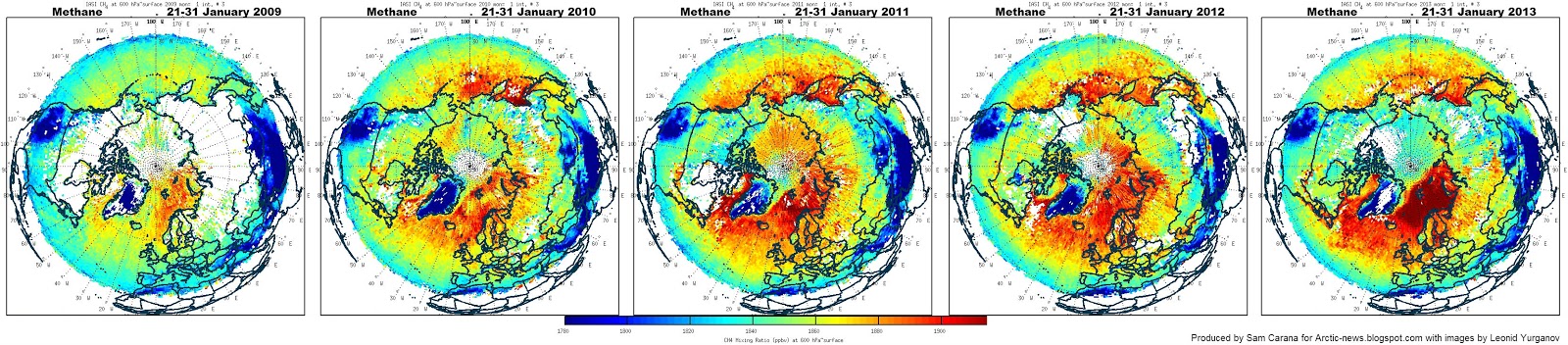
Today we’d like to make note of an interesting development in the arctic     during January. Below we have 3 images of methane concentrations above the Arctic Ocean from 3 ten day periods in january (January 1-10, January 11-20, and January 21-31, 2013) from Russian physicist Dr. Leonid Yurganov. The methane concentration scale, with darker reds being the highest, can be viewed by clicking on the image to enlarge it.


Quite obviously, there's been a sudden increase in atmospheric methane in an area of the arctic ocean north of eastern Europe and western Asia. As shown in the post about this at Arctic News, that area where the methane concentrations are highest coincides with the area of the arctic ocean that is still relatively ice-free. 


This dramatic increase in atmospheric methane seems to be similar to an arctic event that we covered a little over a year ago that occurred in November 2011. At that time Russian scientists [Shakhova & Semiletov] had observed vast plumes of methane bubbling to the surface of the arctic ocean off the coast of eastern Siberia [and again, even more pervasive, in late 2012], which they described as "powerful and impressive seeping structures more than 1,000 metres in diameter."

Back then we figured that since that eastern Siberian area was one of the shallowest areas of the arctic, it had warmed enough during a period of unusual atmospheric circulation that fall to thaw the extensive amounts of frozen methane hydrates known to be locked up by high pressure and cold temperatures on the ocean floor, and they were melting and rising to the surface. In this case it appears that a branch of the warm gulf stream current is causing enough warming to destabilize the frozen methane on the ocean floor in the areas between Norway and Svalbard and points east. This is similar to a scenario that was warned about in a study in the journal Nature in October.

What happens next is anyone's guess, but Dr Yurganov's records indicate that higher levels of arctic methane emissions have been increasing over time. (US scientists must now rely on Canadian and European monitoring of greenhouse gas emissions because NOAA’s monitoring of Arctic methane and CO2 was halted last week by budget cuts.) We've pointed out before that atmospheric methane hit a new high of about 1,813 parts per billion (ppb) in 2011, which was at 259% of the pre-industrial level, and that 40% of the increase was coming from natural sources such as this. 


Methane is 25 times as potent a heat-trapping gas as CO2 over a 100-year time horizon, but 72 times as potent over 20 years, and methane's global heat trapping effect is now roughly one-third that of CO2. Further thoughts on the potential impact of large abrupt release of methane in the Arctic are here. Suffice it to say that if all the ancient carbon were to be released from the arctic it would be enough to raise global temperatures 3 C on top of the 4 C temperature rise from human activities predicted by the recent World Bank study…

Our awareness of this comes the same week that the European Space Agency’s CryoSat-2 probe has confirmed the conclusion of the Pan-Arctic Ice Ocean Modeling and Assimilation System (PIOMAS) at the University of Washington’s Polar Science Center that not only is the extent of the Arctic ice receding, but its thickness has diminished considerably as well. The combined result has been a collapse in total arctic ice volume to one-fifth of what was the minimum ice volume as recently as 1980. With the associated warming in the Arctic, we can only expect the frequency and range of such Arctic methane releases to increase, from both the seabed and the permafrost.


4 comments
  1. AbyNormal Feb 19, 2013, 6:04:00 AM
    Methane is 25 times as potent a heat-trapping gas as CO2 over a 100 year time horizon, but 72 times as potent over 20 years...about 110 times as potent over 10 years too = STEALTH SPEED

    http://www.angrybearblog.com/2013/02/updates-on-atmospheric-methane-and.html
Read More
Posted in Arctic Methane Emergency Group, Methane, Permafrost, Permafrost - subsea, PIOMAS | No comments
Older Posts Home
Subscribe to: Posts (Atom)

Popular Posts

  • James Hansen: Tar Sands and Dirty Tricks
    by James Hansen, September 13, 2013 The New Yorker just published (16 September issue) an excellent article "The President and the Pip...
  • Andrew Glikson: Another link between CO2 and mass extinctions of species
    by Andrew Glikson , The Conversation , March 22, 2013 It’s long been known that massive increases in emission of CO 2 from volcanoes, assoc...
  • Bombshell: Recent Warming Is ‘Amazing And Atypical’ And Poised To Destroy Stable Climate That Enabled Civilization
    by Joe Romm , Climate Progress , March 8, 2013 New Science Study Confirms ‘Hockey Stick’: The Rate Of Warming Since 1900 Is 50 Times Greater...
  • Real Pragmatism for Real Climate Change: Interview with Dr. John Abraham
    by John Stafford, OilPrice.com, March 26, 2013 At a time when extreme weather incidents are causing billions in damages, businesses, governm...
  • Exxon acting like national guard under martial law in Mayflower, Arkansas, Pegasus tar sands dilbit spill cleanup
    Arkansas town in lockdown after oil spill nightmare by  Suzi Parker , Grist, April 5, 2013 REUTERS / Jacob Slaton There’s one Exxon gas stat...
  • James Hansen interview (video) of why he retired from NASA to be more active in climate actions
    by Climate Science Watch, April 12, 2013 Sustainability Media Lab shot this video interview on April 10, 2013, with James Hansen on why he l...
  • Steve Horn: State Dept Keystone XL Enironmental Reviewer Claimed Delaware Tar Sands Refinery Made Air Cleaner
    by Steve Horn, DeSmogBlog, July 18, 2013 A  DeSmogBlog  investigation reveals  Environmental Resources Management, Inc. (ERM Group) , the co...
  • Steve Horn: State Department's out-sourced Keystone XL environmental impact evaluation performed without knowing pipeline's route!!!
    by Steve Horn, DeSmogBlog, July 8, 2013 The State Department's decision to hand over control to the oil industry to evaluate its own ...
  • "A Reconstruction of Regional and Global Temperature for the Past 11,300 Years," by S. A. Marcott et al., Science, 339 (2013); doi: 10.1126/science.1228026
    Science  (8 March 2013),  Vol. 339, N o. 6124,  pp. 1198-1201  DOI:  10.1126/science.1228026 REPORT A Reconstruction of Regional and Global ...
  • Steve Horn: The Flip Side of Obama’s Keystone XL Delay
    Even as President Obama cast a veneer of caution over the Keystone pipeline’s northern half, he quietly expedited dozens of similar projec...

Categories

  • 2012 temperatures (3)
  • 2013 temperatures (6)
  • acidizing (1)
  • Adam Siegel (1)
  • Adaptation (1)
  • Aerosols (7)
  • Africa (2)
  • Al Gore (1)
  • Alaska (6)
  • albedo (2)
  • albedo flip (5)
  • ALEC (8)
  • Alun Hubbard (2)
  • Amazon rainforest (1)
  • Andrew C. Revkin (2)
  • Andrew Freedman (1)
  • Andrew Glikson (1)
  • Andrew J. Weaver (1)
  • Antarctic bottom water (2)
  • Antarctic Circumpolar Winds (1)
  • Antarctic Ice Sheet -- Western (WAIS) (4)
  • Antarctic Oscillation - AAO (1)
  • Antarctic warming (1)
  • Anthony R Ingraffea (1)
  • Anthony Watts (1)
  • Arctic amplification (7)
  • Arctic melt season (1)
  • Arctic Methane Emergency Group (7)
  • Arctic Ocean (5)
  • Arctic Oscillation (5)
  • Arctic sea ice mean speed (4)
  • Arctic sea ice volume (24)
  • Argo (1)
  • Atlantic Meridional Overturning Circulation - AMOC (2)
  • Atmospheric CO2 (8)
  • Australia (6)
  • Barry Bickmore (1)
  • bees (9)
  • Benjamin Santer (4)
  • Bidder 70 (1)
  • Big Oil Big Coal (89)
  • Bill McKibben (11)
  • Black carbon (2)
  • BOEMRE (2)
  • Brad Johnson (1)
  • Brazil (2)
  • Brian Eister (2)
  • Canada (24)
  • Carbon sinks (2)
  • Catastrophic climate change (1)
  • Charles Monnett (3)
  • China (15)
  • Chris Mooney (1)
  • Civil resistance (33)
  • Climate Change Criminals (24)
  • Climate Denial Machine (47)
  • Climate modelling (5)
  • Climate Patriots (2)
  • Climate sensitivity (1)
  • CO2 draw-down (1)
  • Consequences to infrastructure (1)
  • contrails (1)
  • coral reefs (1)
  • Corexit (1)
  • corrupt officials (60)
  • Coupled ice-ocean model (3)
  • Coupled ocean–atmosphere model (2)
  • crop yields (9)
  • CRU e-mails (2)
  • CryoSat-2 (1)
  • cyclones (2)
  • Dana Nuccitelli (9)
  • Dansgaard–Oeschger event (1)
  • David Roberts (2)
  • David Spratt (2)
  • Deforestation (2)
  • deglaciation (1)
  • Denial psychology (9)
  • divestment (11)
  • Donors Trust (2)
  • Drought (9)
  • dust (1)
  • earthquakes (3)
  • East Siberian Arctic Shelf (1)
  • Eastern Siberian Arctic Shelf -- ESAS (2)
  • Eemian (3)
  • Eli Rabett (5)
  • Elizabeth Kolbert (1)
  • Ellesmere (1)
  • ENSO (11)
  • Eric Rignot (1)
  • Extreme weather events (15)
  • Ferrel cells (1)
  • First Nations (9)
  • Flooding (7)
  • floods (1)
  • Forest fires (3)
  • fracking (47)
  • Fred Singer (1)
  • freshwater lens (1)
  • fugitive emissions (2)
  • Gareth Renowden (2)
  • Gavin Schmidt (3)
  • Geoengineering (1)
  • George Monbiot (2)
  • Gerald Meehl (2)
  • glacial runoff (1)
  • Global dimming (1)
  • glyphosate (1)
  • Graham Readfearn (9)
  • Greenland ice melt (21)
  • Greenpeace (3)
  • Greg Laden (3)
  • GrIS (9)
  • Hadley cells (2)
  • Hadley circulation (2)
  • Hans Joachim Schellnhuber (1)
  • Harrison Loony Tool Schmitt (1)
  • Heartland Institute (14)
  • heat dome (3)
  • Heat waves (13)
  • hockey stick (10)
  • Holocene thermal maximum (2)
  • hurricanes (1)
  • IceSat (2)
  • Igor Semiletov (4)
  • Inhofe (2)
  • Insurers (2)
  • Intertropical Convergence Zone - ICZ (2)
  • Jakobshavn Isbræ (1)
  • James Hansen (15)
  • Jason Box (10)
  • Jeff Masters (6)
  • Jennifer Francis (7)
  • Jeremy Grantham (1)
  • Jet stream (4)
  • John Abraham (15)
  • John Christy (1)
  • John Cook (2)
  • John Kerry (2)
  • Joseph Romm (12)
  • Josh Willis (2)
  • Judith Curry (1)
  • Julie Brigham-Grette (1)
  • Justin Gillis (3)
  • Katharine Hayhoe (2)
  • Kerry Emanuel (2)
  • Kevin Grandia (1)
  • Kevin Trenberth (14)
  • Keystone Principle (14)
  • Keystone XL (57)
  • Koch Industries (13)
  • Konrad Steffen (2)
  • Lake El'gygytgyn (1)
  • Leo Hickman (2)
  • Marc Morano (3)
  • Mark Boslough (1)
  • Mark Hertsgaard (1)
  • Mark Serreze (1)
  • Mass extinctions (1)
  • Mauri Pelto (1)
  • Medieval Climate Anomaly (2)
  • Meridonal heat transport - MHT (1)
  • Methane (2)
  • Methane Gun hypothesis (9)
  • Methane hydrates (11)
  • Michael Mann (20)
  • Michael Oppenheimer (2)
  • Michael Tobis (2)
  • Milne Ice Shelf (1)
  • Mitigation (1)
  • Monckton (6)
  • Monsanto (3)
  • Myles Allen (1)
  • Naomi Klein (1)
  • Natalia Shakhova (4)
  • national security (3)
  • Neela Banerjee (1)
  • neonicotinoid pesticide (9)
  • Nitrous oxide (1)
  • North Atlantic meridional overturning circulation (1)
  • North Atlantic Oscillation (2)
  • Obama (1)
  • OccupyWallStreet (5)
  • ocean acidification (2)
  • Ocean chemistry (1)
  • ocean heat content (15)
  • Ocean salinity (2)
  • Ocean temperatures (4)
  • ozone levels (1)
  • paleo-climate (4)
  • Paleo-CO2 (2)
  • Patrick Michaels (1)
  • Paul Douglas (1)
  • PDO - Pacific Decadal Oscillation (4)
  • Peak food (10)
  • Peak oil (1)
  • Peak Water (3)
  • Permafrost (1)
  • Permafrost - subsea (2)
  • Permian mass extinction (1)
  • Peter Gleick (3)
  • Peter Sinclair (13)
  • Peter Wadhams (4)
  • Petermann Glacier (1)
  • Phil Jones (1)
  • Pinatubo rebound effect (2)
  • pine beetles (1)
  • Pine Island Glacier (1)
  • PIOMAS (3)
  • polar bears (5)
  • Polar jet stream (8)
  • Polar vortex (2)
  • Positive feedbacks (1)
  • Precipitation extremes (4)
  • radiative forcing (2)
  • Ray Weymann (1)
  • Raypierre (1)
  • resilience (1)
  • resource scarcity (3)
  • Richard Alley (3)
  • Richard Somerville (1)
  • Rick Piltz (2)
  • Robert Corell (1)
  • Roger Pielke Jr. (1)
  • Rossby waves (2)
  • Russia (1)
  • saltwater intrusion (1)
  • Scott Mandia (1)
  • Sea level rise (13)
  • sea surface temperature anomalies (1)
  • Sediment cores (2)
  • Shell Oil (4)
  • snow cover (3)
  • Snowden (1)
  • Solar activity (1)
  • solar radiation (1)
  • Soot (3)
  • Stefan Rahmstorf (5)
  • Steve Horn (13)
  • Storm intensity (1)
  • Storm tracks diverted polewards (1)
  • Stratospheric Sudden Warmings (3)
  • sulfoxaflor (1)
  • Tamino (1)
  • tar sands (57)
  • Ted Scambos (1)
  • Terracide (1)
  • These people are completely insane (7)
  • Thomas L. Friedman (2)
  • threat multiplier (1)
  • Threat to our democracy (49)
  • Tim DeChristopher (1)
  • Tipping elements (1)
  • Tom Steyer (1)
  • Tornado statistics (2)
  • TransCanada (3)
  • trees (1)
  • tropospheric water vapor (1)
  • Typhoon Yasi (1)
  • Van Jones (2)
  • volcanism (1)
  • WAIS (1)
  • Waleed Abdalati (1)
  • Walker circulation (2)
  • Walt Meier (1)
  • Water shortage (2)
  • William Krabill (1)
  • Willie Soon (1)
  • Wind pattern changes (2)
  • Wind power (2)

Blog Archive

  • ▼  2013 (500)
    • ▼  September (27)
      • James Hansen: Tar Sands and Dirty Tricks
      • Summer 2013 weather extremes tied to extraordinari...
      • Court rulings show judges accept climate science
      • DC judge denies another effort to derail Michael M...
      • Scientist Michael Mann named in top 10 influential...
      • Justin Gillis, NYT: A Climate Alarm, Too Muted for...
      • Top Obama aide Heather Zichal worked the Pavillion...
      • Call Sacramento. Vote NO on SB4
      • Graham Readfearn: The undiscerning climate bookshelf
      • Graham Readfearn: Australia's Department of Defenc...
      • Top Occupy Wall Street Cartoons
      • URGENT: phone your CA rep to prevent industry amen...
      • Tom Steyer, NexGen: Keystone XL bad economics for ...
      • Daily Mail Lies! No 60% recovery in Arctic sea ice...
      • Steve Horn: The Flip Side of Obama’s Keystone XL D...
      • Joseph E. Stiglizt, NYT: Why Janet Yellen, Not Lar...
      • "Global crop exposure to critical high temperature...
      • Naomi Klein: Green groups may be more damaging th...
      • Margaret Heffernan: Dare to Disagree
      • "Spring snow cover extent reductions in the 2008-2...
      • U.S. Becomes Largest Wood Pellet Exporter,Enviva, ...
      • Rebuttal to Michael Tobis' unsubstantiated attacks...
      • Why trust climate models? It’s a matter of simple ...
      • Steve Horn: "Frackademia" By Law: Section 999 of t...
      • MUST SEE, Peter Sinclair: No Slowdown in Global Wa...
      • Dana Nuccitelli: The Pacific Ocean fills in anothe...
      • Posts from August 2013
    • ►  August (78)
    • ►  July (74)
    • ►  June (56)
    • ►  May (62)
    • ►  April (105)
    • ►  March (98)
Powered by Blogger.

About Me

Unknown
View my complete profile