TheNextGeneration

  • Subscribe to our RSS feed.
  • Twitter
  • StumbleUpon
  • Reddit
  • Facebook
  • Digg
Showing posts with label Methane. Show all posts

Wednesday, May 15, 2013

Fugitive methane emissions from Los Angeles basin oil and gas drilling operations at 17%!

Posted on 12:20 PM by Unknown
EMISSIONS: Solving the case of Southern Calif.'s missing methane

by Stephanie Paige Ogburn, E&E reporter, E&E, May 15, 2013 May 15, 2013
In Southern California, scientists knew the missing methane had to be coming from somewhere. Was it dairies? Landfills? Natural seeps? Oil and gas operations?
Emissions of methane from the Los Angeles basin had been estimated in the mid-2000s as part of the state's landmark cap-and-trade bill, known as A.B. 32, which regulates emissions of the powerful greenhouse gas. But later measurements of the air in the region showed there was a lot more methane being emitted than was accounted for, more than a third as much.
Where was this "missing" methane coming from? Methane has 20 times the global warming potency of CO2. If regulators could identify the source, they could also get those methane emitters to reduce the amount of the gas they release.
NOAA's P-3
NOAA’s P-3 sniffs Los Angeles air to solve a mystery. Photo courtesy of NOAA.
Now, Jeff Peischl, an associate scientist at the National Oceanic and Atmospheric Administration's Cooperative Institute for Research in Environmental Sciences, has solved this puzzle, outlining the sources of the missing methane in a paper published yesterday in the Journal of Geophysical Research.
While methane in the Los Angeles basin comes from many sources, there are three main sectors responsible for the difference in what the state of California had estimated and what is actually being emitted.
These are leaks from pipeline distribution systems, natural seeps from areas such as the La Brea Tar Pits and emissions from oil and gas drilling operations in the area.
Peischl was able to determine where the methane came from because different sources of methane contain different ratios of compounds called alkanes, like propane and butane.
By examining the ratios of alkanes in samples collected from 16 overflights of the Los Angeles basin in 2010, using NOAA's P-3 aircraft, a flying laboratory with sensitive air-sampling equipment, Peischl learned whether methane came from a landfill, dairy or fossil fuel source.

Leaking money

In his analysis, Peischl found that the methane leak rate from Los Angeles-area oil and gas operations was 17%. This is high; leakage rates of "fugitive emissions" from oil and gas drilling operations are currently estimated at 4% by U.S. EPA (ClimateWire, April 4, 2013).
The California Air Resources Board has been working toward pinning down this leakage percentage in its own way, too. Peischl's paper cites a survey it did of oil and gas producers in which it queried them about the equipment they use. Based on those results, CARB's revised estimate for fugitive emissions from the Los Angeles basin is 12%.
While this new figure is not yet incorporated into the state's greenhouse gas inventory, Peischl was encouraged that his calculated emissions and the board's were in the same ballpark, even though they used an entirely different methodology.
Paul Wennberg, a scientist at the California Institute of Technology who did two of the previous studies in the region that showed methane emissions were much higher than the earlier inventory, was encouraged by Peischl's results. He pointed out that if the missing methane was from fossil fuel extraction, this could be a "win-win" situation. Methane, or natural gas, is valuable. Oil and gas producers would certainly benefit from reducing their leakage.
"This is an important finding that we need to follow further," Wennberg wrote in an email.
CARB is doing just that. According to Bart Croes, chief of the agency's research division, Peischl had presented his work to the agency at an earlier date, and it is continuing research in this vein.
Peischl's results were surprising, Croes said, because many people thought dairies and landfills were likely sources for the mystery methane. "There was this suspicion that they could be a major contributor, but they don't seem to be," he said.
Now that it knows the sources, the board is working to determine where exactly that methane is coming from. Staff members are driving electric vehicles equipped with sensors to measure methane leaks around Southern California and implementing a network of stationary methane monitors.
The California Energy Commission is also doing a study of homes to try to determine where residential methane leaks from the natural gas pipeline system might be occurring, Croes said.
"Once we understand what the methane emissions are, then we'll explore, through our research, options to control these emissions or reduce them somehow," he added.
Paywalled:  http://www.eenews.net/climatewire/2013/05/15/stories/1059981192
Read More
Posted in Big Oil Big Coal, fugitive emissions, Methane | No comments

Sunday, March 3, 2013

Angry Bear: Updates on atmospheric methane and volume measurements of Arctic sea ice

Posted on 12:51 PM by Unknown

by Dan Crawford (Rdan), Angry Bear blog, February 18, 2013


Here is a link-filled update on the rise of atmospheric methane and a decrease in volume of Arctic sea ice from reader rjs.

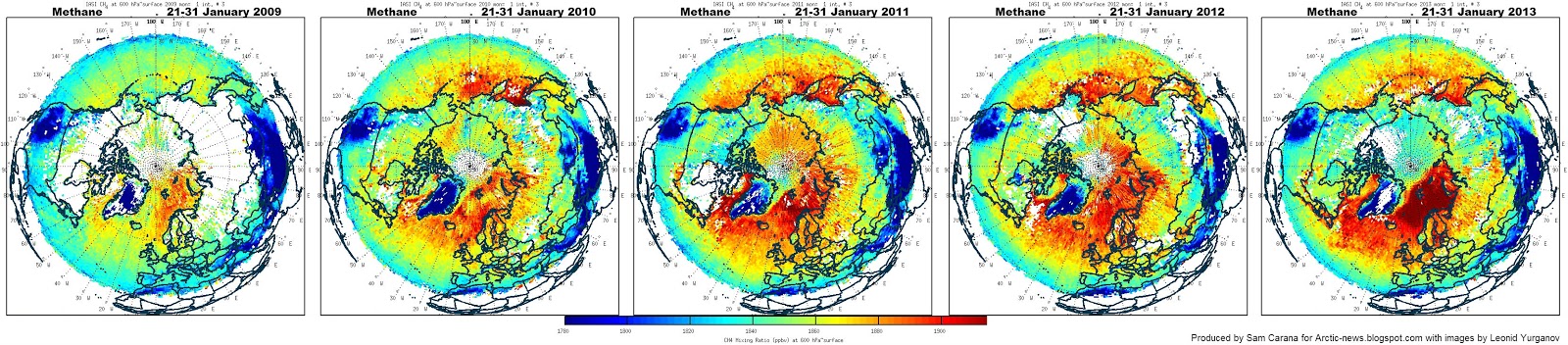
Today we’d like to make note of an interesting development in the arctic     during January. Below we have 3 images of methane concentrations above the Arctic Ocean from 3 ten day periods in january (January 1-10, January 11-20, and January 21-31, 2013) from Russian physicist Dr. Leonid Yurganov. The methane concentration scale, with darker reds being the highest, can be viewed by clicking on the image to enlarge it.


Quite obviously, there's been a sudden increase in atmospheric methane in an area of the arctic ocean north of eastern Europe and western Asia. As shown in the post about this at Arctic News, that area where the methane concentrations are highest coincides with the area of the arctic ocean that is still relatively ice-free. 


This dramatic increase in atmospheric methane seems to be similar to an arctic event that we covered a little over a year ago that occurred in November 2011. At that time Russian scientists [Shakhova & Semiletov] had observed vast plumes of methane bubbling to the surface of the arctic ocean off the coast of eastern Siberia [and again, even more pervasive, in late 2012], which they described as "powerful and impressive seeping structures more than 1,000 metres in diameter."

Back then we figured that since that eastern Siberian area was one of the shallowest areas of the arctic, it had warmed enough during a period of unusual atmospheric circulation that fall to thaw the extensive amounts of frozen methane hydrates known to be locked up by high pressure and cold temperatures on the ocean floor, and they were melting and rising to the surface. In this case it appears that a branch of the warm gulf stream current is causing enough warming to destabilize the frozen methane on the ocean floor in the areas between Norway and Svalbard and points east. This is similar to a scenario that was warned about in a study in the journal Nature in October.

What happens next is anyone's guess, but Dr Yurganov's records indicate that higher levels of arctic methane emissions have been increasing over time. (US scientists must now rely on Canadian and European monitoring of greenhouse gas emissions because NOAA’s monitoring of Arctic methane and CO2 was halted last week by budget cuts.) We've pointed out before that atmospheric methane hit a new high of about 1,813 parts per billion (ppb) in 2011, which was at 259% of the pre-industrial level, and that 40% of the increase was coming from natural sources such as this. 


Methane is 25 times as potent a heat-trapping gas as CO2 over a 100-year time horizon, but 72 times as potent over 20 years, and methane's global heat trapping effect is now roughly one-third that of CO2. Further thoughts on the potential impact of large abrupt release of methane in the Arctic are here. Suffice it to say that if all the ancient carbon were to be released from the arctic it would be enough to raise global temperatures 3 C on top of the 4 C temperature rise from human activities predicted by the recent World Bank study…

Our awareness of this comes the same week that the European Space Agency’s CryoSat-2 probe has confirmed the conclusion of the Pan-Arctic Ice Ocean Modeling and Assimilation System (PIOMAS) at the University of Washington’s Polar Science Center that not only is the extent of the Arctic ice receding, but its thickness has diminished considerably as well. The combined result has been a collapse in total arctic ice volume to one-fifth of what was the minimum ice volume as recently as 1980. With the associated warming in the Arctic, we can only expect the frequency and range of such Arctic methane releases to increase, from both the seabed and the permafrost.


4 comments
  1. AbyNormal Feb 19, 2013, 6:04:00 AM
    Methane is 25 times as potent a heat-trapping gas as CO2 over a 100 year time horizon, but 72 times as potent over 20 years...about 110 times as potent over 10 years too = STEALTH SPEED

    http://www.angrybearblog.com/2013/02/updates-on-atmospheric-methane-and.html
Read More
Posted in Arctic Methane Emergency Group, Methane, Permafrost, Permafrost - subsea, PIOMAS | No comments
Older Posts Home
Subscribe to: Posts (Atom)

Popular Posts

  • James Hansen: Tar Sands and Dirty Tricks
    by James Hansen, September 13, 2013 The New Yorker just published (16 September issue) an excellent article "The President and the Pip...
  • Andrew Glikson: Another link between CO2 and mass extinctions of species
    by Andrew Glikson , The Conversation , March 22, 2013 It’s long been known that massive increases in emission of CO 2 from volcanoes, assoc...
  • Bombshell: Recent Warming Is ‘Amazing And Atypical’ And Poised To Destroy Stable Climate That Enabled Civilization
    by Joe Romm , Climate Progress , March 8, 2013 New Science Study Confirms ‘Hockey Stick’: The Rate Of Warming Since 1900 Is 50 Times Greater...
  • Real Pragmatism for Real Climate Change: Interview with Dr. John Abraham
    by John Stafford, OilPrice.com, March 26, 2013 At a time when extreme weather incidents are causing billions in damages, businesses, governm...
  • Exxon acting like national guard under martial law in Mayflower, Arkansas, Pegasus tar sands dilbit spill cleanup
    Arkansas town in lockdown after oil spill nightmare by  Suzi Parker , Grist, April 5, 2013 REUTERS / Jacob Slaton There’s one Exxon gas stat...
  • James Hansen interview (video) of why he retired from NASA to be more active in climate actions
    by Climate Science Watch, April 12, 2013 Sustainability Media Lab shot this video interview on April 10, 2013, with James Hansen on why he l...
  • Steve Horn: State Dept Keystone XL Enironmental Reviewer Claimed Delaware Tar Sands Refinery Made Air Cleaner
    by Steve Horn, DeSmogBlog, July 18, 2013 A  DeSmogBlog  investigation reveals  Environmental Resources Management, Inc. (ERM Group) , the co...
  • Steve Horn: State Department's out-sourced Keystone XL environmental impact evaluation performed without knowing pipeline's route!!!
    by Steve Horn, DeSmogBlog, July 8, 2013 The State Department's decision to hand over control to the oil industry to evaluate its own ...
  • "A Reconstruction of Regional and Global Temperature for the Past 11,300 Years," by S. A. Marcott et al., Science, 339 (2013); doi: 10.1126/science.1228026
    Science  (8 March 2013),  Vol. 339, N o. 6124,  pp. 1198-1201  DOI:  10.1126/science.1228026 REPORT A Reconstruction of Regional and Global ...
  • Steve Horn: The Flip Side of Obama’s Keystone XL Delay
    Even as President Obama cast a veneer of caution over the Keystone pipeline’s northern half, he quietly expedited dozens of similar projec...

Categories

  • 2012 temperatures (3)
  • 2013 temperatures (6)
  • acidizing (1)
  • Adam Siegel (1)
  • Adaptation (1)
  • Aerosols (7)
  • Africa (2)
  • Al Gore (1)
  • Alaska (6)
  • albedo (2)
  • albedo flip (5)
  • ALEC (8)
  • Alun Hubbard (2)
  • Amazon rainforest (1)
  • Andrew C. Revkin (2)
  • Andrew Freedman (1)
  • Andrew Glikson (1)
  • Andrew J. Weaver (1)
  • Antarctic bottom water (2)
  • Antarctic Circumpolar Winds (1)
  • Antarctic Ice Sheet -- Western (WAIS) (4)
  • Antarctic Oscillation - AAO (1)
  • Antarctic warming (1)
  • Anthony R Ingraffea (1)
  • Anthony Watts (1)
  • Arctic amplification (7)
  • Arctic melt season (1)
  • Arctic Methane Emergency Group (7)
  • Arctic Ocean (5)
  • Arctic Oscillation (5)
  • Arctic sea ice mean speed (4)
  • Arctic sea ice volume (24)
  • Argo (1)
  • Atlantic Meridional Overturning Circulation - AMOC (2)
  • Atmospheric CO2 (8)
  • Australia (6)
  • Barry Bickmore (1)
  • bees (9)
  • Benjamin Santer (4)
  • Bidder 70 (1)
  • Big Oil Big Coal (89)
  • Bill McKibben (11)
  • Black carbon (2)
  • BOEMRE (2)
  • Brad Johnson (1)
  • Brazil (2)
  • Brian Eister (2)
  • Canada (24)
  • Carbon sinks (2)
  • Catastrophic climate change (1)
  • Charles Monnett (3)
  • China (15)
  • Chris Mooney (1)
  • Civil resistance (33)
  • Climate Change Criminals (24)
  • Climate Denial Machine (47)
  • Climate modelling (5)
  • Climate Patriots (2)
  • Climate sensitivity (1)
  • CO2 draw-down (1)
  • Consequences to infrastructure (1)
  • contrails (1)
  • coral reefs (1)
  • Corexit (1)
  • corrupt officials (60)
  • Coupled ice-ocean model (3)
  • Coupled ocean–atmosphere model (2)
  • crop yields (9)
  • CRU e-mails (2)
  • CryoSat-2 (1)
  • cyclones (2)
  • Dana Nuccitelli (9)
  • Dansgaard–Oeschger event (1)
  • David Roberts (2)
  • David Spratt (2)
  • Deforestation (2)
  • deglaciation (1)
  • Denial psychology (9)
  • divestment (11)
  • Donors Trust (2)
  • Drought (9)
  • dust (1)
  • earthquakes (3)
  • East Siberian Arctic Shelf (1)
  • Eastern Siberian Arctic Shelf -- ESAS (2)
  • Eemian (3)
  • Eli Rabett (5)
  • Elizabeth Kolbert (1)
  • Ellesmere (1)
  • ENSO (11)
  • Eric Rignot (1)
  • Extreme weather events (15)
  • Ferrel cells (1)
  • First Nations (9)
  • Flooding (7)
  • floods (1)
  • Forest fires (3)
  • fracking (47)
  • Fred Singer (1)
  • freshwater lens (1)
  • fugitive emissions (2)
  • Gareth Renowden (2)
  • Gavin Schmidt (3)
  • Geoengineering (1)
  • George Monbiot (2)
  • Gerald Meehl (2)
  • glacial runoff (1)
  • Global dimming (1)
  • glyphosate (1)
  • Graham Readfearn (9)
  • Greenland ice melt (21)
  • Greenpeace (3)
  • Greg Laden (3)
  • GrIS (9)
  • Hadley cells (2)
  • Hadley circulation (2)
  • Hans Joachim Schellnhuber (1)
  • Harrison Loony Tool Schmitt (1)
  • Heartland Institute (14)
  • heat dome (3)
  • Heat waves (13)
  • hockey stick (10)
  • Holocene thermal maximum (2)
  • hurricanes (1)
  • IceSat (2)
  • Igor Semiletov (4)
  • Inhofe (2)
  • Insurers (2)
  • Intertropical Convergence Zone - ICZ (2)
  • Jakobshavn Isbræ (1)
  • James Hansen (15)
  • Jason Box (10)
  • Jeff Masters (6)
  • Jennifer Francis (7)
  • Jeremy Grantham (1)
  • Jet stream (4)
  • John Abraham (15)
  • John Christy (1)
  • John Cook (2)
  • John Kerry (2)
  • Joseph Romm (12)
  • Josh Willis (2)
  • Judith Curry (1)
  • Julie Brigham-Grette (1)
  • Justin Gillis (3)
  • Katharine Hayhoe (2)
  • Kerry Emanuel (2)
  • Kevin Grandia (1)
  • Kevin Trenberth (14)
  • Keystone Principle (14)
  • Keystone XL (57)
  • Koch Industries (13)
  • Konrad Steffen (2)
  • Lake El'gygytgyn (1)
  • Leo Hickman (2)
  • Marc Morano (3)
  • Mark Boslough (1)
  • Mark Hertsgaard (1)
  • Mark Serreze (1)
  • Mass extinctions (1)
  • Mauri Pelto (1)
  • Medieval Climate Anomaly (2)
  • Meridonal heat transport - MHT (1)
  • Methane (2)
  • Methane Gun hypothesis (9)
  • Methane hydrates (11)
  • Michael Mann (20)
  • Michael Oppenheimer (2)
  • Michael Tobis (2)
  • Milne Ice Shelf (1)
  • Mitigation (1)
  • Monckton (6)
  • Monsanto (3)
  • Myles Allen (1)
  • Naomi Klein (1)
  • Natalia Shakhova (4)
  • national security (3)
  • Neela Banerjee (1)
  • neonicotinoid pesticide (9)
  • Nitrous oxide (1)
  • North Atlantic meridional overturning circulation (1)
  • North Atlantic Oscillation (2)
  • Obama (1)
  • OccupyWallStreet (5)
  • ocean acidification (2)
  • Ocean chemistry (1)
  • ocean heat content (15)
  • Ocean salinity (2)
  • Ocean temperatures (4)
  • ozone levels (1)
  • paleo-climate (4)
  • Paleo-CO2 (2)
  • Patrick Michaels (1)
  • Paul Douglas (1)
  • PDO - Pacific Decadal Oscillation (4)
  • Peak food (10)
  • Peak oil (1)
  • Peak Water (3)
  • Permafrost (1)
  • Permafrost - subsea (2)
  • Permian mass extinction (1)
  • Peter Gleick (3)
  • Peter Sinclair (13)
  • Peter Wadhams (4)
  • Petermann Glacier (1)
  • Phil Jones (1)
  • Pinatubo rebound effect (2)
  • pine beetles (1)
  • Pine Island Glacier (1)
  • PIOMAS (3)
  • polar bears (5)
  • Polar jet stream (8)
  • Polar vortex (2)
  • Positive feedbacks (1)
  • Precipitation extremes (4)
  • radiative forcing (2)
  • Ray Weymann (1)
  • Raypierre (1)
  • resilience (1)
  • resource scarcity (3)
  • Richard Alley (3)
  • Richard Somerville (1)
  • Rick Piltz (2)
  • Robert Corell (1)
  • Roger Pielke Jr. (1)
  • Rossby waves (2)
  • Russia (1)
  • saltwater intrusion (1)
  • Scott Mandia (1)
  • Sea level rise (13)
  • sea surface temperature anomalies (1)
  • Sediment cores (2)
  • Shell Oil (4)
  • snow cover (3)
  • Snowden (1)
  • Solar activity (1)
  • solar radiation (1)
  • Soot (3)
  • Stefan Rahmstorf (5)
  • Steve Horn (13)
  • Storm intensity (1)
  • Storm tracks diverted polewards (1)
  • Stratospheric Sudden Warmings (3)
  • sulfoxaflor (1)
  • Tamino (1)
  • tar sands (57)
  • Ted Scambos (1)
  • Terracide (1)
  • These people are completely insane (7)
  • Thomas L. Friedman (2)
  • threat multiplier (1)
  • Threat to our democracy (49)
  • Tim DeChristopher (1)
  • Tipping elements (1)
  • Tom Steyer (1)
  • Tornado statistics (2)
  • TransCanada (3)
  • trees (1)
  • tropospheric water vapor (1)
  • Typhoon Yasi (1)
  • Van Jones (2)
  • volcanism (1)
  • WAIS (1)
  • Waleed Abdalati (1)
  • Walker circulation (2)
  • Walt Meier (1)
  • Water shortage (2)
  • William Krabill (1)
  • Willie Soon (1)
  • Wind pattern changes (2)
  • Wind power (2)

Blog Archive

  • ▼  2013 (500)
    • ▼  September (27)
      • James Hansen: Tar Sands and Dirty Tricks
      • Summer 2013 weather extremes tied to extraordinari...
      • Court rulings show judges accept climate science
      • DC judge denies another effort to derail Michael M...
      • Scientist Michael Mann named in top 10 influential...
      • Justin Gillis, NYT: A Climate Alarm, Too Muted for...
      • Top Obama aide Heather Zichal worked the Pavillion...
      • Call Sacramento. Vote NO on SB4
      • Graham Readfearn: The undiscerning climate bookshelf
      • Graham Readfearn: Australia's Department of Defenc...
      • Top Occupy Wall Street Cartoons
      • URGENT: phone your CA rep to prevent industry amen...
      • Tom Steyer, NexGen: Keystone XL bad economics for ...
      • Daily Mail Lies! No 60% recovery in Arctic sea ice...
      • Steve Horn: The Flip Side of Obama’s Keystone XL D...
      • Joseph E. Stiglizt, NYT: Why Janet Yellen, Not Lar...
      • "Global crop exposure to critical high temperature...
      • Naomi Klein: Green groups may be more damaging th...
      • Margaret Heffernan: Dare to Disagree
      • "Spring snow cover extent reductions in the 2008-2...
      • U.S. Becomes Largest Wood Pellet Exporter,Enviva, ...
      • Rebuttal to Michael Tobis' unsubstantiated attacks...
      • Why trust climate models? It’s a matter of simple ...
      • Steve Horn: "Frackademia" By Law: Section 999 of t...
      • MUST SEE, Peter Sinclair: No Slowdown in Global Wa...
      • Dana Nuccitelli: The Pacific Ocean fills in anothe...
      • Posts from August 2013
    • ►  August (78)
    • ►  July (74)
    • ►  June (56)
    • ►  May (62)
    • ►  April (105)
    • ►  March (98)
Powered by Blogger.

About Me

Unknown
View my complete profile