TheNextGeneration

  • Subscribe to our RSS feed.
  • Twitter
  • StumbleUpon
  • Reddit
  • Facebook
  • Digg
Showing posts with label 2013 temperatures. Show all posts

Sunday, August 18, 2013

Robert Scribbler: China Falls Under Suspicion of Covering Up Deaths as Ocean Heat Dome Expands to Blanket Korea and Japan

Posted on 8:38 AM by Unknown

by Robert Scribbler, August 13, 2013
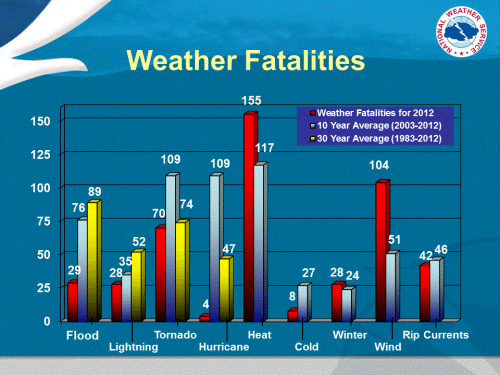
US Weather Fatalities by Type
(Image source: NOAA)
According to recent reports from NOAA and the CDC, heat is the most lethal form of weather in the United States. Death and injury rates have been on the rise as human-forced temperature increases have expanded, surging northward into major metro areas such as New York City. The CDC report showed a growing number of heat deaths and injuries for this northern region, with the New York Metro area seeing an average of 13 deaths and over 440 heat injuries each year during the period from 2000 to 2011. Nationwide, the average number of heat fatalities surged to 117 during a period from 2003 to 2011.
Heatwaves have hit the NYC region time and time again over the past decade, driving the death and injury rate inexorably higher. However, the heat impacting that area is paltry when compared to the extreme and deadly temperatures that have broiled southeastern China since late July. For more than three weeks, the Shanghai region of China has experienced almost daily temperatures in excess of 100 degrees Fahrenheit and sweltered under very high humidity for such hot conditions. This combination has pushed wet bulb temperatures (a measure that simulates the temperature of human skin) into a range of 29 to 32 degrees Celsius, very close to the lethal human limit of 35 degrees C.
On Sunday, an extreme heat pulse sent thermometers soaring to 109 degrees Fahrenheit in the city of Shengxian — its hottest temperature ever recorded and a scorching 32.3 degree wet bulb temperature. Meanwhile, on the same day, Hangzhou had hit a new all time record high temperature of 105.8 degrees Fahrenheit, the twelfth time since July 24th that Hangzhou has tied or broken its old all time temperature record which, in some cases, was set just the day before.
High heat and humidity of this kind is deadly to humans because as temperatures approach 35 degree C wet bulb readings, it is nearly impossible for the human body to carry away the excess heat it generates through evaporation. Never has a wet bulb temperature of 35 degrees C been recorded by humans. However, climate scientists such as James Hansen have asserted that it’s just a matter of time under the current regime of human-caused warming before we hit that ominous mark.
So have thousands died?
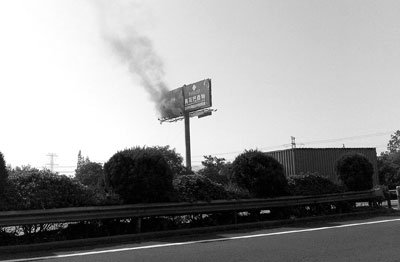
Road Sing Burns in Shanghia Region
Road Sign Burns Under Record Heat in Shanghai Region
(Image source: Shenzhen Daily)
As reports of vehicle fires and sporadically smoldering infrastructure in the massive Chinese heatwave flared, suspicions emerged that Chinese officials are covering up what are potentially thousands of heat-related deaths.
According to Chinese news agencies, the official report is that about two dozen have died so far in Shanghai’s record-shattering heatwave. But similar heat in Europe and Russia resulted in tens of thousands of deaths over the past decade. At issue is the fact that China’s current record heat and humidity are at levels never before experienced in its weather history and that this event is even more intense than the deadly heatwaves of Europe and Russia. Add to this extraordinarily dangerous event the fact that more than 400 million people live in the region of China currently being socked by record heat and the vague reports coming out of China seem highly incongruent.
Never before has such high wet bulb temperatures hit a region of so dense a population. Yet China has only continued to report the vague ‘dozens’ estimate.  It was this discrepancy thatcaused WeatherUnderground Historian Christopher Burt to speculate that China may be covering up a catastrophic rash of fatalities:
Eastern China, where about 30% of the population of the country and 5% of the global population reside (approximately 400 million people) has undergone a heat wave unprecedented in its history. No one really knows how many have died as a result of the heat wave (Chinese news sources claim ‘about two dozen’), but statistically it is almost certain that many thousands must have perished as the result of the heat over the past month.
If Christopher Burt’s, quite rational, analysis ends up proving true, we can expect reports of fatalities to begin to slowly trickle out of China. Misreporting and under-reporting of Chinese heatwave casualties would also be yet one more instance of government officials and mainstream media downplaying and under-reporting the effects of catastrophic events related to human-caused climate change. Such under-reporting is yet one more manifestation of a dangerous and paralyzing denial that has so hampered an effective response to these increasingly dangerous and self-inflicted events.
Making such a call, however, is possibly premature as residents of this region are more acclimated to excessive heat than Europeans or Russians. As Burt notes:
One thing to keep in mind, however, is that it is ALWAYS hot and humid in eastern China during the summer (unlike Russia and Western Europe), so perhaps the population has learned to adapt to extreme heat.
The Ocean Heat Dome Expands to Cover Korea and Japan
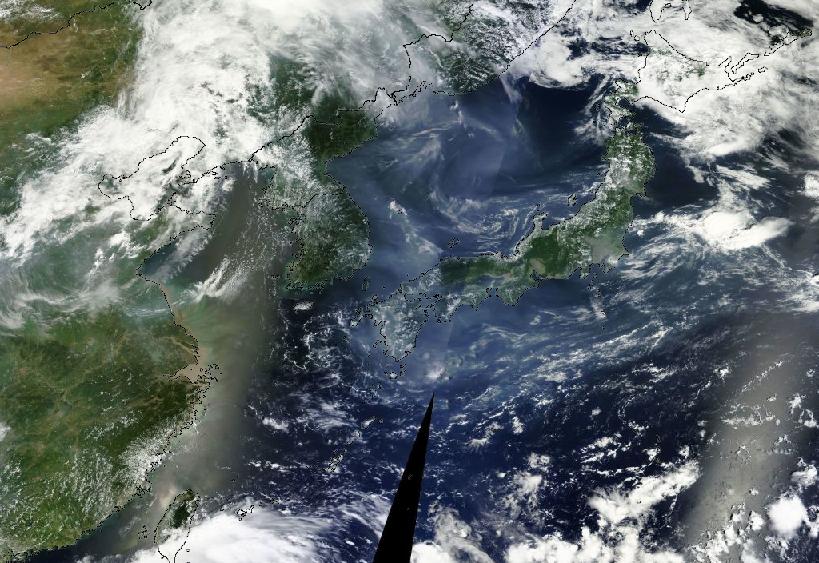
Ocean Heat Dome
Ocean Heat Dome Over China, Korea and Japan
(Image source: NASA/Lance-Modis)
A sprawling heat dome high pressure system that has scorched a region stretching from coastal China to a large expanse of the Pacific Ocean shifted eastward into Korea and Japan over the weekend. Southern Japan saw temperatures surge into the 100s with Shimanto recording the highest temperature ever measured in Japan of 105.8 degrees Fahrenheit (41 degrees Celsius). Tokyo, meanwhile, broke the record for its hottest minimum temperature at 86.7 degrees Fahrenheit (30.4 C).
South Korea, over the same period, reported 8 deaths as temperatures soared to 102.2 degrees Fahrenheit (39 C) in Busan. Temperatures in Seoul hit the still hot, but more moderate, 90s (32 C +).
Both South Korea and Japan are surrounded on multiple sides by water. This geographic feature would usually provide a cooling effect as ocean temperatures are typically many degrees cooler than land temperatures. But, in this case, a massive heat dome is baking the ocean itself to unprecedented high surface water temperatures. As a result, a large area of open ocean now shows readings above 30 degrees Celsius ( 86 Fahrenheit). This extremely hot, near 90 degree water, has formed the central pulse of the current heatwave even as it has pumped extraordinarily humid air for such hot conditions over adjacent land areas. A shift to the north of this large and still growing region of extraordinarily hot ocean water led to the record steamy conditions over Japan and Korea during the past few days — both of which can expect little relief from the now, very hot, water.
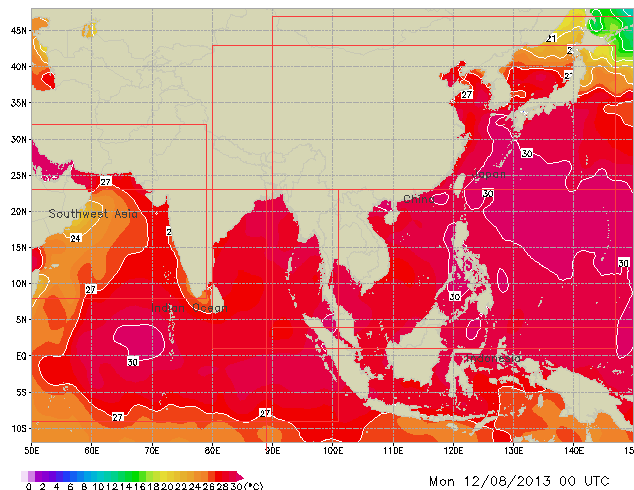
Asia in Hot Water
Ocean Heat Dome Puts Asia in Hot Water
(Image source: Weather Online)
Forecasts for Shanghai, Korea, and Japan call for slightly less sweltering temperatures in the upper 90s with more isolated readings in the 100s as clouds are expected to move in and increase chances of rainfall by later this week. A slight improvement but a welcome change, nonetheless. Meanwhile, hot ocean conditions create a risk for continued very hot temperatures for much of this coastal region.
(Hat Tip to Colorado Bob for the head’s up)
http://robertscribbler.wordpress.com/2013/08/13/china-falls-under-suspicion-of-covering-up-deaths-as-ocean-heat-dome-expands-to-cover-korean-and-japan/
Read More
Posted in 2013 temperatures, China, heat dome, Heat waves | No comments

Wednesday, August 14, 2013

China and Japan suffer unprecedented heat waves

Posted on 10:32 AM by Unknown
Hat tip to rjsigmund

China heat wave: Beware of 'spontaneously' combusting trees and billboards - Yahoo! News: For the past few weeks Beijing has been either a furnace or a sauna, depending on the rain, as China endures its hottest summer in more than half a century. The press is full of the most alarming stories as the country sweats through its second major heat wave this year. In the southern city of Wuhan, witnesses last weekend reported seeing a willow tree spontaneously burst into flames, “which rarely happens under normal circumstances,” according to a local forestry expert. In the eastern province of Zhejiang the same thing happened to a billboard, which presumably is equally unusual. I myself have sometimes felt I was about to go up in flames recently, and I am not alone. The Chinese National Meteorological Center announced on Monday that temperatures had exceeded 95 degrees Fahrenheit in eight provinces on more than 25 of the previous 41 days. It hasn’t been that hot here since 1961. For the first time ever the government has declared the heat to be a level two weather emergency – a warning normally reserved for typhoons and floods – amid reports that more than 40 people have died from the high temperatures.  

Weather Extremes : Japan Breaks National Heat Record. Chinese Heat Wave Continues | Weather Underground: An all-time national heat record was set in Japan today (August 12th) when the temperature peaked at 41.0°C (105.8°F) at the Ekawasaki site in Shimanto (part of Kochi Prefecture). The previous record of 40.9°C (105.6°F) was recorded at Tajima and Kumagaya on August 16, 2007. Tokyo endured its warmest daily minimum on August 11th with a low of 30.4°C (86.7°F). This was the 2nd warmest minimum on record for Japan following a minimum of 30.8°C (87.4°F) at Itoigawa on August 22, 1990. On Sunday, August 11th, the temperature peaked at 42.7°C (108.9°F) at Shengxian, its hottest temperature measured so far during the heat wave. At Hangzhou the temperature reached 41.1°C (106.0°F) on August 11th and 40.3°C (104.5°F) on August 12th marking the 12th day since July 24th that the city surpassed or tied its previous all-time record high of 40.3° set on August 1, 2003. Eastern China, where about 30% of the population of the country and 5% of the global population reside (approximately 400 million people) has undergone a heat wave unprecedented in its history. No one really knows how many have died as a result of the heat wave (Chinese news sources claim ‘about two dozen’), but statistically it is almost certain that many thousands must have perished as the result of the heat over the past month.  
Read More
Posted in 2013 temperatures, China, Heat waves | No comments

Monday, August 5, 2013

Alaska's Troublesome Glacier cracks up right beneath tour guide's feet

Posted on 7:35 AM by Unknown

by Laurel Andrews, Alaska Dispatch, August 3, 2013

Setting up camp on Troublesome glacier. Courtesy Eric Rogers
 
Dog-mushing tour group Knik Glacier Tours was forced to shut down operations weeks earlier than planned when Troublesome Glacier, in Southcentral Alaska near Palmer, began to split open beneath the crew’s feet on Saturday, following weeks of hot weather that caused rapid melting on the glacier despite a thick covering of snow. 

“I’ve never seen a glacier deteriorate so fast,” Owner Rick Casillo said on Thursday. He has been leading tours on Troublesome Glacier for the past 10 years. 

Knik Glacier Tours leads 2-mile dog sledding tours on the glacier, using veteran Iditarod dogs that seamlessly navigate the route, allowing tourists to steer a second sled behind the lead musher.

At the beginning of the season, the crew sets up camp at lower elevations; as summer progresses and snow melts, the crew moves to higher elevations to stay on deep snow pack and away from bare ice. They had been camping at a high-elevation spot for around two weeks, where snow cover was measuring nine feet deep, when the glacial crevasses began to form. “That was the crazy thing about it,” Casillo said. "(Crevasses) usually don’t open up with that much snow.”

Crews discovered the first glacial crevasse, a 6-inch-wide hole in the glacier, in front of crew member Nick Guy’s tent on Saturday morning. The crevasse was only wide enough to stick your foot into, but it extended “probably 1,000 feet” into the depths of the glacier, Casillo said.

The crew marked the crevasse’s location, repositioned Guy’s tent, and continued on with their day. But soon, they discovered a second crevasse of similar size near the dog’s kennels. Then, a third.

As the extent of the rapidly-developing crevasses became clear, Casillo took to the air to survey the glacier’s conditions. Cracks were showing on the side of the glacier, and there didn’t appear to be anywhere safe to set up camp. So Casillo made the call to end the season then and there. “That was the first time I’ve actually had to shut down because of crevasses,” he said.

Snow is constantly melting on the glacier during summer months, but this season’s heat took the melt to a whole new level. Cloudless days and the burning sun brought temperatures that normally hover around 50 degrees on the glacier up into “t-shirt weather,” Musher Eric Rogers said.

Crews will also normally dig a ditch to position melting water away from the camp, but this year, “it turned into a stream, flowing down the glacier like a bandit,” Rogers said.   

Casillo had more than 100 people booked to tour the glacier in the next few weeks. “That was a tough thing to stomach,” he said, but he noted that the season had been profitable regardless. Among the cancellations were military veterans with the Wounded Warrior program, to whom Casillo had donated free tours. Casillo, an Iditarod runner who has renamed his kennel Battle Dawgs in support of Alaska’s Healing Hearts program, was most upset about having to cancel on the veterans.

This was Rogers’ first summer working on Troublesome Glacier. While he has seen operations shut down by snow and fog while working on glacier tours in Juneau, “I’ve never been chased out by crevasses,” he said.

Outhouse accident a bad omen?

Saturday was a surprise, because everything was “looking really great, everybody’s happy, and all of a sudden we start stepping in these holes in the ice,” Rogers said.

Rogers said that Saturday’s troubles really began, however, in the outhouse, after an accident proved to be a bad omen for the rest of the day.

Rogers described the tour group’s make-shift outhouse as a wooden structure sitting on two PVC pipes, which keep the structure aloft above the snow. Inside is a honey bucket that acts as the toilet. Every morning, Rogers gingerly steps into the outhouse, testing to make sure it’s stable on the snow.

All seemed well on Saturday, but the hot days had melted the snow from the outhouse’s exterior, leaving it on an unsteady pedestal of snow.

Rogers writes on his blog:  

“I settled on the throne and was entering deep contemplation when the outhouse shifted on its base and tumbled over backwards. Oh Fecal Material! Literally! I climbed off my back, opened the door and stood there in the toppled structure bare from the waist down. Luckily the honey bucket didn’t spill -- thank you God.”

That’s when his coworker, Nick Guy, emerged from his tent and found Rogers standing amid the tumbled toilet. Guy helped Rogers resurrect the outhouse, and even resisted making fun of him.

After the outhouse incident, Rogers was struck with the feeling that “it was going to be a bad day,” he said.
The bad omen was soon confirmed. Hours later, as glacial crevasses cracked open around them seemingly out of nowhere, the tour season came to an abrupt halt.

Rogers writes:

“As Saturday progressed we went from no surface expression in camp to doing one-leggers into 4 different crevasses that spanned camp from one end to the other. Nothing wider than half a foot, but the fact we had been walking on that surface for a week and not known there was anything there got our attention. Like the outhouse, very disconcerting, but nobody hurt.”

“What a crazy summer,” Rogers concluded.
 
http://www.alaskadispatch.com/article/20130803/troublesome-glacier-cracks-right-beneath-tour-guides-feet
Read More
Posted in 2013 temperatures, Alaska | No comments

Thursday, August 1, 2013

China swelters in record heat wave

Posted on 8:39 PM by Unknown

By Staff  The Associated Press, August 1, 2013

  •  52
  •  
  •  4
  •  
  •  Plus 1
  •  
  • Share
 PLAY VIDEO
Above: Zoo animals in eastern China try to stay cool as the country deals with its most extreme heatwave in 140 years
SHANGHAI, China – It’s been so hot in China that folks are grilling shrimp on manhole covers, eggs are hatching without incubators and a highway billboard has mysteriously caught fire by itself.
“It is just hot! Like in a food steamer!” 17-year-old student Xu Sichen said outside the doors of a shopping mall in the southern financial hub of Shanghai while her friend He Jiali, also 17, complained that her mobile phone had in recent days turned into a “grenade.”The heat wave – the worst in at least 140 years in some parts – has left dozens of people dead and pushed thermometers above 40 degrees C (104 F) in at least 40 cities and counties, mostly in the south and east. Authorities for the first time have declared the heat a “level 2″ weather emergency- a label normally invoked for typhoons and flooding.
“I’m so worried that the phone will explode while I’m using it,” He said.
Extreme heat began hitting Shanghai and several eastern and southern provinces in early July and is expected to grip much of China through mid-August.
Shanghai set its record high temperature of 40.6 C (105 F) on July 26, and Thursday’s heat marked the city’s 28th day above 35 C. At least 10 people died of heat stroke in the city over the past month, including a 64-year-old Taiwanese sailor, the official Xinhua News Agency said.
Wu Guiyun, 50, who has a part-time job making food deliveries in Shanghai, said she has been trying to linger inside air-conditioned offices for as long as possible whenever she brings in a takeout order. Outside, she said: “It’s so hot that I can hardly breathe.”
The highest temperature overall was recorded in the eastern city of Fenghua, which recorded its historic high of 42.7 degrees (108.9 F) on July 24.
On Tuesday, the director of the China Meteorological Administration activated a “level 2″ emergency response to the persistent heat wave. This level requires around-the-clock staffing, the establishment of an emergency command centre and frequent briefings.
Some Chinese in heat-stricken cities have been cooking shrimps, eggs and bacon in skillets placed directly on manhole covers or on road pavement that has in some cases heated up to 60 degrees C (140 F).
In one photo displayed prominently in the China Daily newspaper, a boy tended to shrimps and an egg in a pan over a manhole cover in eastern Chinese city of Jinan.
In the port city of Ningbo in Zhejiang province, glass has cracked in the heat, vehicles have self-combusted, and a highway billboard caught fire by itself, sending up black smoke in the air, according to China Central Television. The broadcaster said the heat might have shorted an electrical circuit on the billboard.
In the southern province of Hunan, a housewife grabbed several eggs stored at room temperature only to find half-hatched chicks, state media reported.
A joke making the rounds: The only difference between me and barbequed meat is a little bit of cumin.
—
Associated Press writer Didi Tang in Beijing and news assistant Fu Ting in Shanghai contributed to this report.
http://globalnews.ca/news/754643/china-swelters-in-record-heat-wave/
Read More
Posted in 2013 temperatures, China, Heat waves | No comments

Maniitsoq, Greenland, at nearly 80 F, its highest temperature ever recorded

Posted on 1:28 PM by Unknown
by Jason Samenow, Capitol Weather Gang, Washington Post, August 1, 2013

The Danish Meteorological Institute is reporting that on Tuesday, July 30, the mercury rose to 25.9 C (78.6 F) at a station in Greenland, the highest temperature measured in the Arctic country since records began in 1958.

The balmy reading was logged at the observing station Maniitsoq / Sugar Loaf, which is on Greenland’s southwest coast, the DMI reports. It exceeded the 25.5 C (77.9 F) reading taken at  Kangerlussuaq on July 27, 1990, in the same general area. Mantiitsoq is Greenland’s sixth-largest town, with a 2010 population of 2,784.

4880007af6
Weather pattern responsible for record warmth in southwest Greenland (Danish Meteorological Institute)

The DMI says the record warmth was brought about by southeasterly winds, funneled by the flow between a large area of high pressure over continental Greenland, and low pressure over Baffin Island to the west.

It adds the warmth may have been enhanced by a phenomenon known as the Foehn Effect, in which air flows over nearby elevated terrain and compresses and heats on its way down. In this case, DMI believes the air may have passed over the elevated Sugar Loaf ice cap and then dried and warmed up as it descended (or downsloped) on its leeward side into Maniitsoq.

Via the Danish Meteorological Institute: "Satellite photo of the area around Maniitsoq and Sugar Loaf Mountain on Tuesday 30 July 2013. Photo from NASA's Terra satellite."
Via the Danish Meteorological Institute: “Satellite photo of the area around Maniitsoq and Sugar Loaf Mountain on Tuesday 30 July 2013. Photo from NASA’s Terra satellite.”

(IPCC)
Conceptual model of how a warming baseline climate increases the chance of record-breaking weather (IPCC)

The DMI says the warmth was not “unnatural,” but explains it fits into a long-term pattern of climate warming.

“[T]here is an indisputable gradual increase in temperature in Greenland,” DMI writes. “Along the way, any ‘warm event’ thus have a higher probability of being slightly warmer than the previous one.”

Related, from 2012: Greenland ice sheet surface melt: massive meltdown or meaningless trickle?

This warm temperature extreme in Greenland comes on the heels of an astonishing heat wave in northern Siberia.

Wunderground weather historian Christopher Burt described a “perhaps unprecedented” streak of 10 days in the central Arctic region of Russia in which temperatures exceeded 86 degrees F (30 C) in mid-to-late July.

Prior to this, it was the desert southwest reaching heat milestones.  Recall Death Valley set the record for hottest U.S. temperature ever recorded in June, climbing to a blistering 129 degrees.

At the moment, China is in the midst of a record-breaking heat wave.  And in Alaska, Fairbanks and Anchorage have ongoing historically long streaks of warm weather.

These heat events were all likely set up predominantly by the configuration of naturally varying weather patterns. [Yeah, right.]  But  elevated greenhouse gas concentrations may well be tacking on a small [yeah, right] warming contribution, nudging these extreme events into record territory.

http://www.washingtonpost.com/blogs/capital-weather-gang/wp/2013/08/01/greenland-soars-to-highest-temperature-ever-recorded/
Read More
Posted in 2013 temperatures, Greenland ice melt, GrIS | No comments

Wednesday, May 15, 2013

Jeff Masters: Extreme weather whiplash in the Upper Midwest -- Climate change much?

Posted on 11:24 AM by Unknown
by Jeff Masters and Christopher C. Burt, Wunderground Blog, May 15, 2013

Does not compute! That must be what residents of Iowa and the Midwest have have been saying to themselves on Tuesday as a ferocious heat wave unprecedented in intensity for so early in the year sent temperatures soaring as high as 108 °F. Just two weeks ago, the deepest snowfall ever measured during any May of record buried a wide swath from Arkansas to Minnesota, with Iowa breaking its all-time snowfall record for May (13” accumulation at Osage on May 1-3.) And how's this for a definition of "Weather Whiplash": Sioux City, Iowa, had their first-ever snowfall on record in the month of May on May 1st (1.4"), but hit an astonishing 106 °F yesterday. Not only was this their hottest temperature ever measured in the month of May, but only two June days in recorded history have been hotter (June, 10, 1933: 107 °F; and June 21, 1988: 108 °F). On May 12th they registered 29 °F, and thus had a 77-degree rise over 56 hours (from 6 a.m. May 12 to 1:30 p.m May 14.)


Figure 1. Intense heat and strong winds fanned a wildfire in northwestern Wisconsin's Douglas County near Gordon on Tuesday, May 14, 2013. The fire spread to 8,700 acres and forced dozens of residents to leave their homes. Image credit: Kevin Harter/Wisconsin Department of Natural Resources, and courtesy of wisconsinrapidstribune.com.

The hottest temperature of all on Tuesday was 108 °F at Tekamah, Nebraska. This is just 2 degrees short of warmest temperature ever recorded in the state of Nebraska during May: 110 °F at Broken Bow in 1895 (exact day unknown). Numerous all-time early season heat records were set on Tuesday, making the event the most notable May wave in the Midwest since multi-day event in 1934. That heat wave was not preceded by unusually cold weather, which is what makes the May 2013 Midwest heat event truly extraordinary. A few notable cases of "Weather Whiplash" from the May 14, 2013, heat wave:

- Chicago, Illinois, hit 91 °F, after hitting a low of 36 °F the previous morning. The 1-day temperature swing of 52 degrees was the city's greatest on record for the month of May.

- Rochester, Minnesota, where 14.5” of snow fell just 10-12 days ago (4th greatest snowstorm for any month on record), saw an all-time early season heat record of 97 °F on May 14th. The previous day, May 13th, it was 32 °F in Rochester -- a 65-degree rise in temperature over the course of 36 hours. 

- Omaha, Nebraska, hit 101 °F, the earliest 100 °F on record (old record was 102 °F on May 29, 1934). It was 32 °F in Omaha on May 12th! That tied for the coldest so late in the season with 32 °F on May 13, 1997, and also on May 15, 1983.

- Albert Lea and St. James, Minnesota, hit 102 °F (hottest in the state on Tuesday). Both cities had May snow less than two weeks previously. Tuesday morning, it was 27 °F at Crane Lake and Silver Bay, for a same-day state temperature spread of 75 degrees in Minnesota. This is a relatively common figure for California or Texas, but almost unprecedented for a Midwestern state.

- Minneapolis hit 98 °F, the hottest so early in season (next is 99 °F on May 22, 1925). May record is 106 °F on May 31, 1934 (the only time 100 °F has been measured during May).

- Norfolk, Nebraska, hit 103 °F, the hottest temperature ever measured so early in the year (previous record: 103 °F on May 25, 1967). A daily record low of 29 °F was recorded on May 12th, just two days previous.

Fires in Wisconsin and Minnesota
The intense heat was accompanied by strong winds, which fanned multiple fires in Minnesota and Wisconsin. One fire, near Gordon, Wisconsin, burned 8,700 acres, making it the largest fire in Wisconsin since the Cottonville fire on May 5, 2005, and the largest fire in Northern Wisconsin since the Oak Lake fire of April 22, 1980 (11,418 acres.) The Gordon fire destroyed 47 structures, including 17 homes, and forced the evacuation of several dozen people. The fire was 90% contained Wednesday morning. At least 25 smaller wildfires were reported in Minnesota, and Governor Mark Dayton signed an emergency order on Tuesday to help the Minnesota Interagency Fire Center fight wildfires around the state.

Why the crazy extremes? Blame the jet stream
The position of the jet stream is a critical controller of weather regimes across the U.S., Europe, and Asia. Precipitation-bearing low pressure system ride along the axis of the jet, and the jet marks the boundary between cold, Canadian air to the north, and warm, subtropical air to the south. On average, the jet flows from west to east, but the jet often departs from average. The jet is continually rippling with U-shaped troughs of low pressure that allow cold air to spill southwards. The troughs are counterbalanced by upside-down-U-shaped ridges of high pressure that bring warm air northwards. When these ridges and troughs grow to unusually large amplitude, record extremes of both cold and heat occur adjacent to each other. Often times, the jet will have multiple extreme loops that result in unusual extremes over large portions of the Northern Hemisphere. That was the case Tuesday in Europe, where an unusually strong ridge of high pressure was present over Western Russia, with a companion strong trough of low pressure over the UK.  Moscow hit 29.7 °C (85.5 °F) on Tuesday, and several locations within the city rose to 31 °C (88 °F). According to weather records researcher Maximiliano Herrera, this has never happened in the first half of May before. At the same time, up to 3" of snow fell in the UK on Tuesday, a rare occurrence for mid-May. Could climate change be a factor in the extreme gyrations of the jet stream this year? It could, and I discussed some of the possible connections in my April 2013 post: Unusually cold spring in Europe and the Southeast U.S. due to the Arctic Oscillation.


Figure 2. Monday afternoon's jet stream shows the pronounced ridge (upside-down U-shaped curve to the jet stream) over the midwestern U.S., which led to all-time, record-high temperatures for so early in the year. At the same time, a sharp trough of low pressure (U-shaped dip in the jet stream) was present over the East Coast, which allowed cold air from Canada to spill southwards and set record lows -- for example, 44 °F at Tallahassee, Florida on May 14, 2013.

http://www.wunderground.com/blog/JeffMasters/comment.html?entrynum=2407
Read More
Posted in 2013 temperatures, Extreme weather events, Forest fires, Heat waves, Jeff Masters, Jet stream | No comments
Older Posts Home
Subscribe to: Posts (Atom)

Popular Posts

  • James Hansen: Tar Sands and Dirty Tricks
    by James Hansen, September 13, 2013 The New Yorker just published (16 September issue) an excellent article "The President and the Pip...
  • Andrew Glikson: Another link between CO2 and mass extinctions of species
    by Andrew Glikson , The Conversation , March 22, 2013 It’s long been known that massive increases in emission of CO 2 from volcanoes, assoc...
  • Bombshell: Recent Warming Is ‘Amazing And Atypical’ And Poised To Destroy Stable Climate That Enabled Civilization
    by Joe Romm , Climate Progress , March 8, 2013 New Science Study Confirms ‘Hockey Stick’: The Rate Of Warming Since 1900 Is 50 Times Greater...
  • Real Pragmatism for Real Climate Change: Interview with Dr. John Abraham
    by John Stafford, OilPrice.com, March 26, 2013 At a time when extreme weather incidents are causing billions in damages, businesses, governm...
  • Steve Horn: State Dept Keystone XL Enironmental Reviewer Claimed Delaware Tar Sands Refinery Made Air Cleaner
    by Steve Horn, DeSmogBlog, July 18, 2013 A  DeSmogBlog  investigation reveals  Environmental Resources Management, Inc. (ERM Group) , the co...
  • James Hansen interview (video) of why he retired from NASA to be more active in climate actions
    by Climate Science Watch, April 12, 2013 Sustainability Media Lab shot this video interview on April 10, 2013, with James Hansen on why he l...
  • Justin Gillis, NYT: Maverick climate scientist James Hansen retiring from NASA, can now take a more active role in lawsuits challenging states and the federal government over their failure to limit CO2 emissions
    Climate Maverick to Quit NASA by  JUSTIN GILLIS , The New York Times , April 1, 2012 James E. Hansen , the climate scientist who issued the ...
  • Exxon acting like national guard under martial law in Mayflower, Arkansas, Pegasus tar sands dilbit spill cleanup
    Arkansas town in lockdown after oil spill nightmare by  Suzi Parker , Grist, April 5, 2013 REUTERS / Jacob Slaton There’s one Exxon gas stat...
  • Steve Horn: State Department's out-sourced Keystone XL environmental impact evaluation performed without knowing pipeline's route!!!
    by Steve Horn, DeSmogBlog, July 8, 2013 The State Department's decision to hand over control to the oil industry to evaluate its own ...
  • "A Reconstruction of Regional and Global Temperature for the Past 11,300 Years," by S. A. Marcott et al., Science, 339 (2013); doi: 10.1126/science.1228026
    Science  (8 March 2013),  Vol. 339, N o. 6124,  pp. 1198-1201  DOI:  10.1126/science.1228026 REPORT A Reconstruction of Regional and Global ...

Categories

  • 2012 temperatures (3)
  • 2013 temperatures (6)
  • acidizing (1)
  • Adam Siegel (1)
  • Adaptation (1)
  • Aerosols (7)
  • Africa (2)
  • Al Gore (1)
  • Alaska (6)
  • albedo (2)
  • albedo flip (5)
  • ALEC (8)
  • Alun Hubbard (2)
  • Amazon rainforest (1)
  • Andrew C. Revkin (2)
  • Andrew Freedman (1)
  • Andrew Glikson (1)
  • Andrew J. Weaver (1)
  • Antarctic bottom water (2)
  • Antarctic Circumpolar Winds (1)
  • Antarctic Ice Sheet -- Western (WAIS) (4)
  • Antarctic Oscillation - AAO (1)
  • Antarctic warming (1)
  • Anthony R Ingraffea (1)
  • Anthony Watts (1)
  • Arctic amplification (7)
  • Arctic melt season (1)
  • Arctic Methane Emergency Group (7)
  • Arctic Ocean (5)
  • Arctic Oscillation (5)
  • Arctic sea ice mean speed (4)
  • Arctic sea ice volume (24)
  • Argo (1)
  • Atlantic Meridional Overturning Circulation - AMOC (2)
  • Atmospheric CO2 (8)
  • Australia (6)
  • Barry Bickmore (1)
  • bees (9)
  • Benjamin Santer (4)
  • Bidder 70 (1)
  • Big Oil Big Coal (89)
  • Bill McKibben (11)
  • Black carbon (2)
  • BOEMRE (2)
  • Brad Johnson (1)
  • Brazil (2)
  • Brian Eister (2)
  • Canada (24)
  • Carbon sinks (2)
  • Catastrophic climate change (1)
  • Charles Monnett (3)
  • China (15)
  • Chris Mooney (1)
  • Civil resistance (33)
  • Climate Change Criminals (24)
  • Climate Denial Machine (47)
  • Climate modelling (5)
  • Climate Patriots (2)
  • Climate sensitivity (1)
  • CO2 draw-down (1)
  • Consequences to infrastructure (1)
  • contrails (1)
  • coral reefs (1)
  • Corexit (1)
  • corrupt officials (60)
  • Coupled ice-ocean model (3)
  • Coupled ocean–atmosphere model (2)
  • crop yields (9)
  • CRU e-mails (2)
  • CryoSat-2 (1)
  • cyclones (2)
  • Dana Nuccitelli (9)
  • Dansgaard–Oeschger event (1)
  • David Roberts (2)
  • David Spratt (2)
  • Deforestation (2)
  • deglaciation (1)
  • Denial psychology (9)
  • divestment (11)
  • Donors Trust (2)
  • Drought (9)
  • dust (1)
  • earthquakes (3)
  • East Siberian Arctic Shelf (1)
  • Eastern Siberian Arctic Shelf -- ESAS (2)
  • Eemian (3)
  • Eli Rabett (5)
  • Elizabeth Kolbert (1)
  • Ellesmere (1)
  • ENSO (11)
  • Eric Rignot (1)
  • Extreme weather events (15)
  • Ferrel cells (1)
  • First Nations (9)
  • Flooding (7)
  • floods (1)
  • Forest fires (3)
  • fracking (47)
  • Fred Singer (1)
  • freshwater lens (1)
  • fugitive emissions (2)
  • Gareth Renowden (2)
  • Gavin Schmidt (3)
  • Geoengineering (1)
  • George Monbiot (2)
  • Gerald Meehl (2)
  • glacial runoff (1)
  • Global dimming (1)
  • glyphosate (1)
  • Graham Readfearn (9)
  • Greenland ice melt (21)
  • Greenpeace (3)
  • Greg Laden (3)
  • GrIS (9)
  • Hadley cells (2)
  • Hadley circulation (2)
  • Hans Joachim Schellnhuber (1)
  • Harrison Loony Tool Schmitt (1)
  • Heartland Institute (14)
  • heat dome (3)
  • Heat waves (13)
  • hockey stick (10)
  • Holocene thermal maximum (2)
  • hurricanes (1)
  • IceSat (2)
  • Igor Semiletov (4)
  • Inhofe (2)
  • Insurers (2)
  • Intertropical Convergence Zone - ICZ (2)
  • Jakobshavn Isbræ (1)
  • James Hansen (15)
  • Jason Box (10)
  • Jeff Masters (6)
  • Jennifer Francis (7)
  • Jeremy Grantham (1)
  • Jet stream (4)
  • John Abraham (15)
  • John Christy (1)
  • John Cook (2)
  • John Kerry (2)
  • Joseph Romm (12)
  • Josh Willis (2)
  • Judith Curry (1)
  • Julie Brigham-Grette (1)
  • Justin Gillis (3)
  • Katharine Hayhoe (2)
  • Kerry Emanuel (2)
  • Kevin Grandia (1)
  • Kevin Trenberth (14)
  • Keystone Principle (14)
  • Keystone XL (57)
  • Koch Industries (13)
  • Konrad Steffen (2)
  • Lake El'gygytgyn (1)
  • Leo Hickman (2)
  • Marc Morano (3)
  • Mark Boslough (1)
  • Mark Hertsgaard (1)
  • Mark Serreze (1)
  • Mass extinctions (1)
  • Mauri Pelto (1)
  • Medieval Climate Anomaly (2)
  • Meridonal heat transport - MHT (1)
  • Methane (2)
  • Methane Gun hypothesis (9)
  • Methane hydrates (11)
  • Michael Mann (20)
  • Michael Oppenheimer (2)
  • Michael Tobis (2)
  • Milne Ice Shelf (1)
  • Mitigation (1)
  • Monckton (6)
  • Monsanto (3)
  • Myles Allen (1)
  • Naomi Klein (1)
  • Natalia Shakhova (4)
  • national security (3)
  • Neela Banerjee (1)
  • neonicotinoid pesticide (9)
  • Nitrous oxide (1)
  • North Atlantic meridional overturning circulation (1)
  • North Atlantic Oscillation (2)
  • Obama (1)
  • OccupyWallStreet (5)
  • ocean acidification (2)
  • Ocean chemistry (1)
  • ocean heat content (15)
  • Ocean salinity (2)
  • Ocean temperatures (4)
  • ozone levels (1)
  • paleo-climate (4)
  • Paleo-CO2 (2)
  • Patrick Michaels (1)
  • Paul Douglas (1)
  • PDO - Pacific Decadal Oscillation (4)
  • Peak food (10)
  • Peak oil (1)
  • Peak Water (3)
  • Permafrost (1)
  • Permafrost - subsea (2)
  • Permian mass extinction (1)
  • Peter Gleick (3)
  • Peter Sinclair (13)
  • Peter Wadhams (4)
  • Petermann Glacier (1)
  • Phil Jones (1)
  • Pinatubo rebound effect (2)
  • pine beetles (1)
  • Pine Island Glacier (1)
  • PIOMAS (3)
  • polar bears (5)
  • Polar jet stream (8)
  • Polar vortex (2)
  • Positive feedbacks (1)
  • Precipitation extremes (4)
  • radiative forcing (2)
  • Ray Weymann (1)
  • Raypierre (1)
  • resilience (1)
  • resource scarcity (3)
  • Richard Alley (3)
  • Richard Somerville (1)
  • Rick Piltz (2)
  • Robert Corell (1)
  • Roger Pielke Jr. (1)
  • Rossby waves (2)
  • Russia (1)
  • saltwater intrusion (1)
  • Scott Mandia (1)
  • Sea level rise (13)
  • sea surface temperature anomalies (1)
  • Sediment cores (2)
  • Shell Oil (4)
  • snow cover (3)
  • Snowden (1)
  • Solar activity (1)
  • solar radiation (1)
  • Soot (3)
  • Stefan Rahmstorf (5)
  • Steve Horn (13)
  • Storm intensity (1)
  • Storm tracks diverted polewards (1)
  • Stratospheric Sudden Warmings (3)
  • sulfoxaflor (1)
  • Tamino (1)
  • tar sands (57)
  • Ted Scambos (1)
  • Terracide (1)
  • These people are completely insane (7)
  • Thomas L. Friedman (2)
  • threat multiplier (1)
  • Threat to our democracy (49)
  • Tim DeChristopher (1)
  • Tipping elements (1)
  • Tom Steyer (1)
  • Tornado statistics (2)
  • TransCanada (3)
  • trees (1)
  • tropospheric water vapor (1)
  • Typhoon Yasi (1)
  • Van Jones (2)
  • volcanism (1)
  • WAIS (1)
  • Waleed Abdalati (1)
  • Walker circulation (2)
  • Walt Meier (1)
  • Water shortage (2)
  • William Krabill (1)
  • Willie Soon (1)
  • Wind pattern changes (2)
  • Wind power (2)

Blog Archive

  • ▼  2013 (500)
    • ▼  September (27)
      • James Hansen: Tar Sands and Dirty Tricks
      • Summer 2013 weather extremes tied to extraordinari...
      • Court rulings show judges accept climate science
      • DC judge denies another effort to derail Michael M...
      • Scientist Michael Mann named in top 10 influential...
      • Justin Gillis, NYT: A Climate Alarm, Too Muted for...
      • Top Obama aide Heather Zichal worked the Pavillion...
      • Call Sacramento. Vote NO on SB4
      • Graham Readfearn: The undiscerning climate bookshelf
      • Graham Readfearn: Australia's Department of Defenc...
      • Top Occupy Wall Street Cartoons
      • URGENT: phone your CA rep to prevent industry amen...
      • Tom Steyer, NexGen: Keystone XL bad economics for ...
      • Daily Mail Lies! No 60% recovery in Arctic sea ice...
      • Steve Horn: The Flip Side of Obama’s Keystone XL D...
      • Joseph E. Stiglizt, NYT: Why Janet Yellen, Not Lar...
      • "Global crop exposure to critical high temperature...
      • Naomi Klein: Green groups may be more damaging th...
      • Margaret Heffernan: Dare to Disagree
      • "Spring snow cover extent reductions in the 2008-2...
      • U.S. Becomes Largest Wood Pellet Exporter,Enviva, ...
      • Rebuttal to Michael Tobis' unsubstantiated attacks...
      • Why trust climate models? It’s a matter of simple ...
      • Steve Horn: "Frackademia" By Law: Section 999 of t...
      • MUST SEE, Peter Sinclair: No Slowdown in Global Wa...
      • Dana Nuccitelli: The Pacific Ocean fills in anothe...
      • Posts from August 2013
    • ►  August (78)
    • ►  July (74)
    • ►  June (56)
    • ►  May (62)
    • ►  April (105)
    • ►  March (98)
Powered by Blogger.

About Me

Unknown
View my complete profile