TheNextGeneration

  • Subscribe to our RSS feed.
  • Twitter
  • StumbleUpon
  • Reddit
  • Facebook
  • Digg
Showing posts with label Permafrost - subsea. Show all posts

Sunday, May 12, 2013

Climate Sensitivity Stunner: Last Time CO2 Levels Hit 400 Parts Per Million The Arctic Was 14 °F Warmer!

Posted on 2:25 PM by Unknown
by Joe Romm, Climate Progress, May 12, 2013
We have pushed atmospheric CO2 levels to 400 parts per million (ppm) for the first time in human existence.
At the same time, a truly remarkably set of paleoclimate data shows the climate is much more sensitive to CO2 than we thought. And that means returning as quickly as possible back to 350 ppm is a vastly more rational course of action for a non-suicidal civilization, than, say continuing our unrestrained march toward 600 ppm, then 800, and then 1,000.
NOAA reported Friday that the daily mean concentration of CO2 in the air around Mauna Loa, Hawaii, surpassed 400 parts per million this week:
At the same time, a major new Science study of paleoclimate temperatures — based on “the longest sediment core ever collected on land in the Arctic” – revealed what happened the last time we had similar CO2 levels:
“One of our major findings is that the Arctic was very warm in the Pliocene [~5.3 to 2.6 million years ago] when others have suggested atmospheric CO2 was very much like levels we see today. This could tell us where we are going in the near future. In other words, the Earth system response to small changes in carbon dioxide is bigger than suggested by earlier models,” the authors state.
Yes, contrary to one or two (misreported) models suggesting a climate sensitivity on the low side, this study joins the myriad analyses of data that find it is likely to prove to be on the high side. For instance, recent observations of relative humidity in the tropics and subtropics found that “Future warming likely to be on high side of climate projections,” according to a November paper in Science.
How sensitive is the climate to increases in CO2, according to this “absolutely new knowledge” of paleoclimate temperatures?
Another significant finding to emerge from this first continuous, high-resolution record of the Middle Pliocene is documentation of sustained warmth with summer temperatures of about 59–61 
°F [15–16 °C], about 8 °C [14 °F] warmer than today.
This period of Arctic warmth “coincides, in part, with a long interval of 1.2 million years when the West Antarctic Ice sheet did not exist.” Indeed, sea levels during the mid-Pliocine were about 25 m [82 feet] higher than today!
It is worth noting that a 2009 analysis in Science found that when CO2 levels were this high 15–20 million years ago, it was 5–10 °F warmer globally and seas were also 75–120 feet higher.
The risks of failing to sharply curtail carbon pollution are enormous if the climate sensitivity is on the low side (see “Memo To Media: ‘Climate Sensitivity’ Is NOT The Same As Projected Future Warming, World Faces 10 °F Rise”). But the risks of inaction are beyond incalculable if climate sensitivity is in the middle end of the range, let alone the high end suggested by the paleoclimate data:
Science (1/11) study — On our current emissions path, CO2 levels in 2100 will hit levels last seen when the Earth was 29 °F (16 °C) hotter: Paleoclimate data suggests CO2 “may have at least twice the effect on global temperatures than currently projected by computer models.”
As I explained in Nature online back in 2008 (here), once you factor in carbon-cycle feedbacks, even the uber-cautious Fourth Assessment report (AR4) of the IPCC makes clear we are headed toward 1,000 ppm (the A1FI scenario). That conclusion has been supported by just about every major independent analysis, including a recent report by PricewaterhouseCoopers (see Study: We’re Headed To 11 °F Warming And Even 7 °F Requires “Nearly Quadrupling The Current Rate Of Decarbonisation”).
This new paper is just the latest to suggest the Arctic will warm much faster than the models have suggested. For instance, back in 2006, scientists analyzed deep marine sediments to understand the Paleocene Eocene thermal maximum, a brief period some 55 million years ago of “widespread, extreme climatic warming that was associated with massive atmospheric greenhouse gas input.” That Nature study (subs. req’d) found Arctic temperatures almost beyond imagination – above 23 °C (74 °F) – temperatures more than 18 °F warmer than climate models had predicted when applied to this period. The three dozen authors conclude that existing climate models are missing crucial feedbacks that can significantly amplify polar warming.
Clearly our climate models don’t do a good job of explaining what’s happening in the Arctic right now:
Arctic sea ice is melting much, much faster than even the best climate models had projected (actual observations in red). The reason is most likely unmodeled amplifying feedbacks. The image (from Climate Crocks via Arctic Sea Ice Blog) comes from a 2007 GRL research paper by Stroeve et al.
And this underestimation of polar amplification in turn leads the authors of the new study — and many other scientists — to conclude that the climate’s overall sensitivity is on the high side. As the UK Guardian reports:
Prof Robert Spicer, at the Open University and not part of the new study, agreed: “This is another piece of evidence showing that climate models have a systematic problem with polar amplification,” i.e., the fact that global warming has its greatest effects at the poles. “This has enormous implications and suggests model are likely to underestimate the degree of future change.”
Given that the Arctic is already losing ice several decades faster than any major climate model had projected, we should expect that the permafrost — which contains twice as much carbon as the atmosphere currently does — will also go faster than the models suggest.
Indeed, a 2008 study by leading tundra experts found “Accelerated Arctic land warming and permafrost degradation during rapid sea ice loss.” The study’s ominous conclusion:
We find that simulated western Arctic land warming trends during rapid sea ice loss are 3.5 times greater than secular 21st century climate-change trends. The accelerated warming signal penetrates up to ,km inland….
This in turn suggests that the extra warming from the released permafrost carbon will be on the high side (see “Carbon Feedback From Thawing Permafrost Will Likely Add 0.4–1.5 °F To Total Global Warming By 2100”).
Anyone betting on a low sensitivity of the climate to carbon is literally betting against history.
Finally, this new analysis of Arctic sediments is a very impressive piece of work whose conclusions are hard to dismiss:
“It shows a huge warming – unprecedented in human history,” said Prof Scott Elias, at Royal Holloway University of London, and not involved in the work. “It is a frightening experiment we are conducting with our climate.”
The sediments have been slowly settling in Lake El’gygytgyn since it was formed 3.6 million years ago, when a kilometre-wide meteorite blasted a crater 100 km north of the Arctic circle. Unlike most places so far north, the region was never eroded by glaciers, so a continuous record of the climate has lain undisturbed ever since. “It’s a phenomenal record,” said Prof Peter Sammonds, at University College London. “It is also an incredible achievement [the study's work], given the remoteness of the lake.” Sixteen shipping containers of equipment had to be hauled 90 km over snow by bulldozers from the nearest ice road, used by gold miners.
Previous research on land had revealed glimpses of the Arctic climate and ocean sediments had recorded the marine climate, but the disparate data are not consistent with one another. “Lake El’gygytgyn may be the only place in the world that has this incredible unbroken record of sediments going back millions of years,” said Elias. “When you have a very long record it is very different to argue with.”
If you want to learn more about this research, you can read the news release, the study itself (subs. req’d) or watch this video from the lead author, where you will also learn how to pronounce “El’gygytgyn”:
http://thinkprogress.org/climate/2013/05/12/1993531/climate-sensitivity-stunner-last-time-co2-levels-hit-400-parts-per-million-the-arctic-was-14f-warmer/
Read More
Posted in Arctic amplification, Atmospheric CO2, Climate sensitivity, Joseph Romm, Methane hydrates, Permafrost - subsea, Sediment cores | No comments

Sunday, March 3, 2013

Angry Bear: Updates on atmospheric methane and volume measurements of Arctic sea ice

Posted on 12:51 PM by Unknown

by Dan Crawford (Rdan), Angry Bear blog, February 18, 2013


Here is a link-filled update on the rise of atmospheric methane and a decrease in volume of Arctic sea ice from reader rjs.

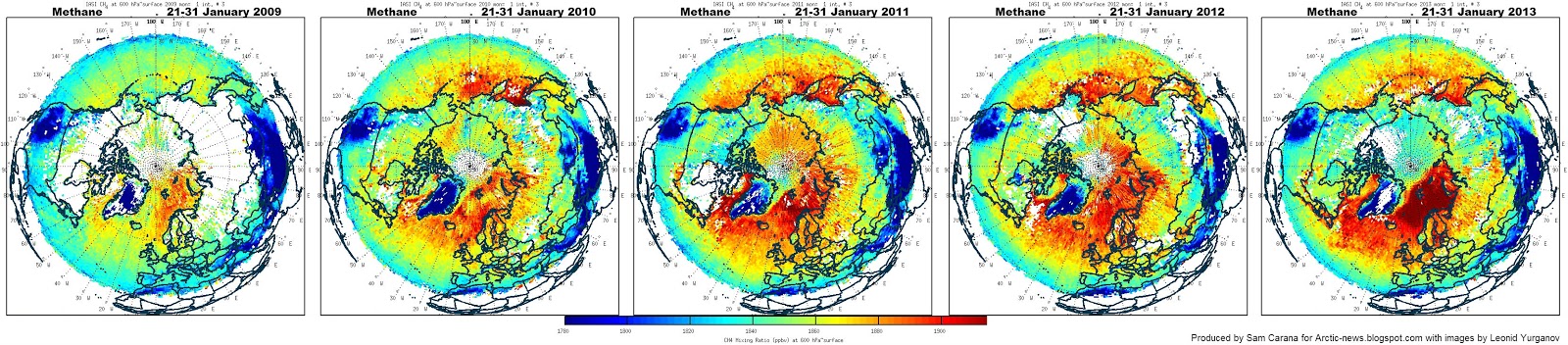
Today we’d like to make note of an interesting development in the arctic     during January. Below we have 3 images of methane concentrations above the Arctic Ocean from 3 ten day periods in january (January 1-10, January 11-20, and January 21-31, 2013) from Russian physicist Dr. Leonid Yurganov. The methane concentration scale, with darker reds being the highest, can be viewed by clicking on the image to enlarge it.


Quite obviously, there's been a sudden increase in atmospheric methane in an area of the arctic ocean north of eastern Europe and western Asia. As shown in the post about this at Arctic News, that area where the methane concentrations are highest coincides with the area of the arctic ocean that is still relatively ice-free. 


This dramatic increase in atmospheric methane seems to be similar to an arctic event that we covered a little over a year ago that occurred in November 2011. At that time Russian scientists [Shakhova & Semiletov] had observed vast plumes of methane bubbling to the surface of the arctic ocean off the coast of eastern Siberia [and again, even more pervasive, in late 2012], which they described as "powerful and impressive seeping structures more than 1,000 metres in diameter."

Back then we figured that since that eastern Siberian area was one of the shallowest areas of the arctic, it had warmed enough during a period of unusual atmospheric circulation that fall to thaw the extensive amounts of frozen methane hydrates known to be locked up by high pressure and cold temperatures on the ocean floor, and they were melting and rising to the surface. In this case it appears that a branch of the warm gulf stream current is causing enough warming to destabilize the frozen methane on the ocean floor in the areas between Norway and Svalbard and points east. This is similar to a scenario that was warned about in a study in the journal Nature in October.

What happens next is anyone's guess, but Dr Yurganov's records indicate that higher levels of arctic methane emissions have been increasing over time. (US scientists must now rely on Canadian and European monitoring of greenhouse gas emissions because NOAA’s monitoring of Arctic methane and CO2 was halted last week by budget cuts.) We've pointed out before that atmospheric methane hit a new high of about 1,813 parts per billion (ppb) in 2011, which was at 259% of the pre-industrial level, and that 40% of the increase was coming from natural sources such as this. 


Methane is 25 times as potent a heat-trapping gas as CO2 over a 100-year time horizon, but 72 times as potent over 20 years, and methane's global heat trapping effect is now roughly one-third that of CO2. Further thoughts on the potential impact of large abrupt release of methane in the Arctic are here. Suffice it to say that if all the ancient carbon were to be released from the arctic it would be enough to raise global temperatures 3 C on top of the 4 C temperature rise from human activities predicted by the recent World Bank study…

Our awareness of this comes the same week that the European Space Agency’s CryoSat-2 probe has confirmed the conclusion of the Pan-Arctic Ice Ocean Modeling and Assimilation System (PIOMAS) at the University of Washington’s Polar Science Center that not only is the extent of the Arctic ice receding, but its thickness has diminished considerably as well. The combined result has been a collapse in total arctic ice volume to one-fifth of what was the minimum ice volume as recently as 1980. With the associated warming in the Arctic, we can only expect the frequency and range of such Arctic methane releases to increase, from both the seabed and the permafrost.


4 comments
  1. AbyNormal Feb 19, 2013, 6:04:00 AM
    Methane is 25 times as potent a heat-trapping gas as CO2 over a 100 year time horizon, but 72 times as potent over 20 years...about 110 times as potent over 10 years too = STEALTH SPEED

    http://www.angrybearblog.com/2013/02/updates-on-atmospheric-methane-and.html
Read More
Posted in Arctic Methane Emergency Group, Methane, Permafrost, Permafrost - subsea, PIOMAS | No comments
Older Posts Home
Subscribe to: Posts (Atom)

Popular Posts

  • James Hansen: Tar Sands and Dirty Tricks
    by James Hansen, September 13, 2013 The New Yorker just published (16 September issue) an excellent article "The President and the Pip...
  • Andrew Glikson: Another link between CO2 and mass extinctions of species
    by Andrew Glikson , The Conversation , March 22, 2013 It’s long been known that massive increases in emission of CO 2 from volcanoes, assoc...
  • Bombshell: Recent Warming Is ‘Amazing And Atypical’ And Poised To Destroy Stable Climate That Enabled Civilization
    by Joe Romm , Climate Progress , March 8, 2013 New Science Study Confirms ‘Hockey Stick’: The Rate Of Warming Since 1900 Is 50 Times Greater...
  • Real Pragmatism for Real Climate Change: Interview with Dr. John Abraham
    by John Stafford, OilPrice.com, March 26, 2013 At a time when extreme weather incidents are causing billions in damages, businesses, governm...
  • Exxon acting like national guard under martial law in Mayflower, Arkansas, Pegasus tar sands dilbit spill cleanup
    Arkansas town in lockdown after oil spill nightmare by  Suzi Parker , Grist, April 5, 2013 REUTERS / Jacob Slaton There’s one Exxon gas stat...
  • James Hansen interview (video) of why he retired from NASA to be more active in climate actions
    by Climate Science Watch, April 12, 2013 Sustainability Media Lab shot this video interview on April 10, 2013, with James Hansen on why he l...
  • Steve Horn: State Dept Keystone XL Enironmental Reviewer Claimed Delaware Tar Sands Refinery Made Air Cleaner
    by Steve Horn, DeSmogBlog, July 18, 2013 A  DeSmogBlog  investigation reveals  Environmental Resources Management, Inc. (ERM Group) , the co...
  • Steve Horn: State Department's out-sourced Keystone XL environmental impact evaluation performed without knowing pipeline's route!!!
    by Steve Horn, DeSmogBlog, July 8, 2013 The State Department's decision to hand over control to the oil industry to evaluate its own ...
  • "A Reconstruction of Regional and Global Temperature for the Past 11,300 Years," by S. A. Marcott et al., Science, 339 (2013); doi: 10.1126/science.1228026
    Science  (8 March 2013),  Vol. 339, N o. 6124,  pp. 1198-1201  DOI:  10.1126/science.1228026 REPORT A Reconstruction of Regional and Global ...
  • Steve Horn: The Flip Side of Obama’s Keystone XL Delay
    Even as President Obama cast a veneer of caution over the Keystone pipeline’s northern half, he quietly expedited dozens of similar projec...

Categories

  • 2012 temperatures (3)
  • 2013 temperatures (6)
  • acidizing (1)
  • Adam Siegel (1)
  • Adaptation (1)
  • Aerosols (7)
  • Africa (2)
  • Al Gore (1)
  • Alaska (6)
  • albedo (2)
  • albedo flip (5)
  • ALEC (8)
  • Alun Hubbard (2)
  • Amazon rainforest (1)
  • Andrew C. Revkin (2)
  • Andrew Freedman (1)
  • Andrew Glikson (1)
  • Andrew J. Weaver (1)
  • Antarctic bottom water (2)
  • Antarctic Circumpolar Winds (1)
  • Antarctic Ice Sheet -- Western (WAIS) (4)
  • Antarctic Oscillation - AAO (1)
  • Antarctic warming (1)
  • Anthony R Ingraffea (1)
  • Anthony Watts (1)
  • Arctic amplification (7)
  • Arctic melt season (1)
  • Arctic Methane Emergency Group (7)
  • Arctic Ocean (5)
  • Arctic Oscillation (5)
  • Arctic sea ice mean speed (4)
  • Arctic sea ice volume (24)
  • Argo (1)
  • Atlantic Meridional Overturning Circulation - AMOC (2)
  • Atmospheric CO2 (8)
  • Australia (6)
  • Barry Bickmore (1)
  • bees (9)
  • Benjamin Santer (4)
  • Bidder 70 (1)
  • Big Oil Big Coal (89)
  • Bill McKibben (11)
  • Black carbon (2)
  • BOEMRE (2)
  • Brad Johnson (1)
  • Brazil (2)
  • Brian Eister (2)
  • Canada (24)
  • Carbon sinks (2)
  • Catastrophic climate change (1)
  • Charles Monnett (3)
  • China (15)
  • Chris Mooney (1)
  • Civil resistance (33)
  • Climate Change Criminals (24)
  • Climate Denial Machine (47)
  • Climate modelling (5)
  • Climate Patriots (2)
  • Climate sensitivity (1)
  • CO2 draw-down (1)
  • Consequences to infrastructure (1)
  • contrails (1)
  • coral reefs (1)
  • Corexit (1)
  • corrupt officials (60)
  • Coupled ice-ocean model (3)
  • Coupled ocean–atmosphere model (2)
  • crop yields (9)
  • CRU e-mails (2)
  • CryoSat-2 (1)
  • cyclones (2)
  • Dana Nuccitelli (9)
  • Dansgaard–Oeschger event (1)
  • David Roberts (2)
  • David Spratt (2)
  • Deforestation (2)
  • deglaciation (1)
  • Denial psychology (9)
  • divestment (11)
  • Donors Trust (2)
  • Drought (9)
  • dust (1)
  • earthquakes (3)
  • East Siberian Arctic Shelf (1)
  • Eastern Siberian Arctic Shelf -- ESAS (2)
  • Eemian (3)
  • Eli Rabett (5)
  • Elizabeth Kolbert (1)
  • Ellesmere (1)
  • ENSO (11)
  • Eric Rignot (1)
  • Extreme weather events (15)
  • Ferrel cells (1)
  • First Nations (9)
  • Flooding (7)
  • floods (1)
  • Forest fires (3)
  • fracking (47)
  • Fred Singer (1)
  • freshwater lens (1)
  • fugitive emissions (2)
  • Gareth Renowden (2)
  • Gavin Schmidt (3)
  • Geoengineering (1)
  • George Monbiot (2)
  • Gerald Meehl (2)
  • glacial runoff (1)
  • Global dimming (1)
  • glyphosate (1)
  • Graham Readfearn (9)
  • Greenland ice melt (21)
  • Greenpeace (3)
  • Greg Laden (3)
  • GrIS (9)
  • Hadley cells (2)
  • Hadley circulation (2)
  • Hans Joachim Schellnhuber (1)
  • Harrison Loony Tool Schmitt (1)
  • Heartland Institute (14)
  • heat dome (3)
  • Heat waves (13)
  • hockey stick (10)
  • Holocene thermal maximum (2)
  • hurricanes (1)
  • IceSat (2)
  • Igor Semiletov (4)
  • Inhofe (2)
  • Insurers (2)
  • Intertropical Convergence Zone - ICZ (2)
  • Jakobshavn Isbræ (1)
  • James Hansen (15)
  • Jason Box (10)
  • Jeff Masters (6)
  • Jennifer Francis (7)
  • Jeremy Grantham (1)
  • Jet stream (4)
  • John Abraham (15)
  • John Christy (1)
  • John Cook (2)
  • John Kerry (2)
  • Joseph Romm (12)
  • Josh Willis (2)
  • Judith Curry (1)
  • Julie Brigham-Grette (1)
  • Justin Gillis (3)
  • Katharine Hayhoe (2)
  • Kerry Emanuel (2)
  • Kevin Grandia (1)
  • Kevin Trenberth (14)
  • Keystone Principle (14)
  • Keystone XL (57)
  • Koch Industries (13)
  • Konrad Steffen (2)
  • Lake El'gygytgyn (1)
  • Leo Hickman (2)
  • Marc Morano (3)
  • Mark Boslough (1)
  • Mark Hertsgaard (1)
  • Mark Serreze (1)
  • Mass extinctions (1)
  • Mauri Pelto (1)
  • Medieval Climate Anomaly (2)
  • Meridonal heat transport - MHT (1)
  • Methane (2)
  • Methane Gun hypothesis (9)
  • Methane hydrates (11)
  • Michael Mann (20)
  • Michael Oppenheimer (2)
  • Michael Tobis (2)
  • Milne Ice Shelf (1)
  • Mitigation (1)
  • Monckton (6)
  • Monsanto (3)
  • Myles Allen (1)
  • Naomi Klein (1)
  • Natalia Shakhova (4)
  • national security (3)
  • Neela Banerjee (1)
  • neonicotinoid pesticide (9)
  • Nitrous oxide (1)
  • North Atlantic meridional overturning circulation (1)
  • North Atlantic Oscillation (2)
  • Obama (1)
  • OccupyWallStreet (5)
  • ocean acidification (2)
  • Ocean chemistry (1)
  • ocean heat content (15)
  • Ocean salinity (2)
  • Ocean temperatures (4)
  • ozone levels (1)
  • paleo-climate (4)
  • Paleo-CO2 (2)
  • Patrick Michaels (1)
  • Paul Douglas (1)
  • PDO - Pacific Decadal Oscillation (4)
  • Peak food (10)
  • Peak oil (1)
  • Peak Water (3)
  • Permafrost (1)
  • Permafrost - subsea (2)
  • Permian mass extinction (1)
  • Peter Gleick (3)
  • Peter Sinclair (13)
  • Peter Wadhams (4)
  • Petermann Glacier (1)
  • Phil Jones (1)
  • Pinatubo rebound effect (2)
  • pine beetles (1)
  • Pine Island Glacier (1)
  • PIOMAS (3)
  • polar bears (5)
  • Polar jet stream (8)
  • Polar vortex (2)
  • Positive feedbacks (1)
  • Precipitation extremes (4)
  • radiative forcing (2)
  • Ray Weymann (1)
  • Raypierre (1)
  • resilience (1)
  • resource scarcity (3)
  • Richard Alley (3)
  • Richard Somerville (1)
  • Rick Piltz (2)
  • Robert Corell (1)
  • Roger Pielke Jr. (1)
  • Rossby waves (2)
  • Russia (1)
  • saltwater intrusion (1)
  • Scott Mandia (1)
  • Sea level rise (13)
  • sea surface temperature anomalies (1)
  • Sediment cores (2)
  • Shell Oil (4)
  • snow cover (3)
  • Snowden (1)
  • Solar activity (1)
  • solar radiation (1)
  • Soot (3)
  • Stefan Rahmstorf (5)
  • Steve Horn (13)
  • Storm intensity (1)
  • Storm tracks diverted polewards (1)
  • Stratospheric Sudden Warmings (3)
  • sulfoxaflor (1)
  • Tamino (1)
  • tar sands (57)
  • Ted Scambos (1)
  • Terracide (1)
  • These people are completely insane (7)
  • Thomas L. Friedman (2)
  • threat multiplier (1)
  • Threat to our democracy (49)
  • Tim DeChristopher (1)
  • Tipping elements (1)
  • Tom Steyer (1)
  • Tornado statistics (2)
  • TransCanada (3)
  • trees (1)
  • tropospheric water vapor (1)
  • Typhoon Yasi (1)
  • Van Jones (2)
  • volcanism (1)
  • WAIS (1)
  • Waleed Abdalati (1)
  • Walker circulation (2)
  • Walt Meier (1)
  • Water shortage (2)
  • William Krabill (1)
  • Willie Soon (1)
  • Wind pattern changes (2)
  • Wind power (2)

Blog Archive

  • ▼  2013 (500)
    • ▼  September (27)
      • James Hansen: Tar Sands and Dirty Tricks
      • Summer 2013 weather extremes tied to extraordinari...
      • Court rulings show judges accept climate science
      • DC judge denies another effort to derail Michael M...
      • Scientist Michael Mann named in top 10 influential...
      • Justin Gillis, NYT: A Climate Alarm, Too Muted for...
      • Top Obama aide Heather Zichal worked the Pavillion...
      • Call Sacramento. Vote NO on SB4
      • Graham Readfearn: The undiscerning climate bookshelf
      • Graham Readfearn: Australia's Department of Defenc...
      • Top Occupy Wall Street Cartoons
      • URGENT: phone your CA rep to prevent industry amen...
      • Tom Steyer, NexGen: Keystone XL bad economics for ...
      • Daily Mail Lies! No 60% recovery in Arctic sea ice...
      • Steve Horn: The Flip Side of Obama’s Keystone XL D...
      • Joseph E. Stiglizt, NYT: Why Janet Yellen, Not Lar...
      • "Global crop exposure to critical high temperature...
      • Naomi Klein: Green groups may be more damaging th...
      • Margaret Heffernan: Dare to Disagree
      • "Spring snow cover extent reductions in the 2008-2...
      • U.S. Becomes Largest Wood Pellet Exporter,Enviva, ...
      • Rebuttal to Michael Tobis' unsubstantiated attacks...
      • Why trust climate models? It’s a matter of simple ...
      • Steve Horn: "Frackademia" By Law: Section 999 of t...
      • MUST SEE, Peter Sinclair: No Slowdown in Global Wa...
      • Dana Nuccitelli: The Pacific Ocean fills in anothe...
      • Posts from August 2013
    • ►  August (78)
    • ►  July (74)
    • ►  June (56)
    • ►  May (62)
    • ►  April (105)
    • ►  March (98)
Powered by Blogger.

About Me

Unknown
View my complete profile