TheNextGeneration

  • Subscribe to our RSS feed.
  • Twitter
  • StumbleUpon
  • Reddit
  • Facebook
  • Digg
Showing posts with label North Atlantic Oscillation. Show all posts

Monday, June 17, 2013

Jet stream changes cause climatically exceptional Greenland Ice Sheet melt

Posted on 3:38 PM by Unknown

The research team at the GrISThe edge of the GrIS.
from University of Sheffield News, June 17, 2013

Research from the University of Sheffield has shown that unusual changes in atmospheric jet stream circulation caused the exceptional surface melt of the Greenland Ice Sheet (GrIS) in summer 2012.


An international team led by Professor Edward Hanna from the University of Sheffield’s Department of Geography used a computer model simulation (called SnowModel) and satellite data to confirm a record surface melting of the GrIS for at least the last 50 years -- when on 11 July 2012 more than 90% of the ice-sheet surface melted. This far exceeded the previous surface melt extent record of 52% in 2010.
The team also analysed weather station data from on top of and around the GrIS, largely collected by the Danish Meteorological Institute but also by US programmes, which showed that several new high Greenland temperature records were set in summer 2012.
The research, published today in the International Journal of Climatology, clearly demonstrates that the record surface melting of the GrIS was mainly caused by highly unusual atmospheric circulation and jet stream changes, which were also responsible for last summer's unusually wet weather in England.
The analysis shows that ocean temperatures and Arctic sea-ice cover were relatively unimportant factors in causing the extra Greenland melt.
Professor Hanna said: “The GrIS is a highly sensitive indicator of regional and global climate change, and has been undergoing rapid warming and mass loss during the last 5-20 years. Much attention has been given to the NASA announcement of record surface melting of the GrIS in mid-July 2012. This event was unprecedented in the satellite record of observations dating back to the 1970s and probably unlikely to have occurred previously for well over a century.
“Our research found that a ‘heat dome’ of warm southerly winds over the ice sheet led to widespread surface melting. These jet stream changes over Greenland do not seem to be well captured in the latest Intergovernmental Panel on Climate Change (IPCC) computer model predictions of climate change, and this may indicate a deficiency in these models. According to our current understanding, the unusual atmospheric circulation and consequent warm conditions of summer 2012 do not appear to be climatically representative of future ‘average’ summers predicted later this century.
“Taken together, our present results strongly suggest that the main forcing of the extreme GrIS surface melt in July 2012 was atmospheric, linked with changes in the summer North Atlantic Oscillation (NAO), Greenland Blocking Index (GBI: a high-pressure system centred over Greenland) and polar jet stream which favoured southerly warm air advection along the western coast.
“The next 5-10 years will reveal whether or not 2012 was a rare event resulting from the natural variability of the NAO or part of an emerging pattern of new extreme high melt years. Because such atmospheric, and resulting GrIS surface climate, changes are not well projected by the current generation of global climate models, it is currently very hard to predict future changes in Greenland climate. Yet it is crucial to understand such changes much better if we are to have any hope of reliably predicting future changes in GrIS mass balance, which is likely to be a dominant contributor to global sea-level change over the next 100-1,000 years.”
http://www.shef.ac.uk/news/nr/jet-stream-greenland-ice-sheet-melt-1.280360
Read More
Posted in Greenland ice melt, GrIS, heat dome, Jet stream, North Atlantic Oscillation, Polar jet stream | No comments

Friday, March 29, 2013

Stefan Rahmstorf: Arctic sea ice and cold weather in Northern Europe and Northeastern U.S.

Posted on 10:22 AM by Unknown
Melting Ice and Cold Weather
Translated by the inestimable Eli Rabett from an article by Stefan Rahmstorf  [] are translation notes, March 29, 2013

The media are debating if the decrease in  Arctic ice  is related to this winter's cold weather in Germany. This post discusses the most recent current research about this including the most important figures from relevant studies.

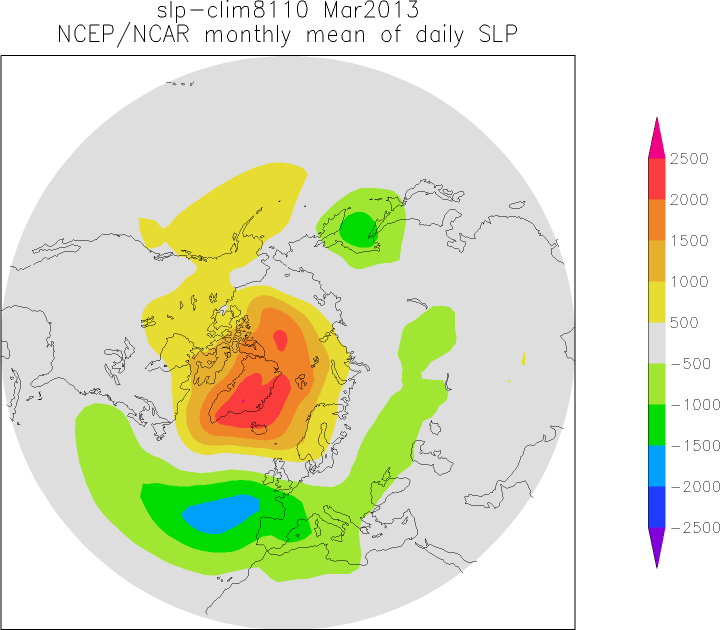
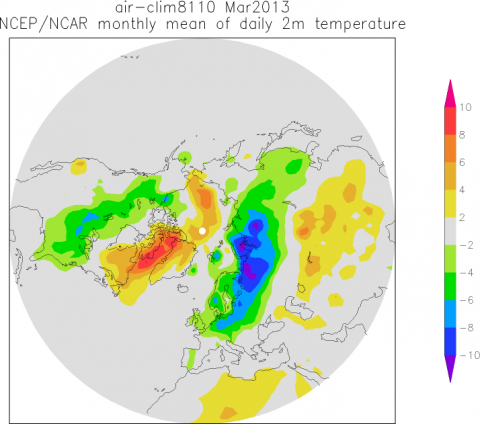
First, what does the unusual temperature distribution observed this March actually look like? Here is a map showing the data (up to and including March 25, 2013; NCEP / NCAR data plotted with KNMI Climate Explorer):
 
Freezing cold in Siberia, reaching across northwestern Europe, unusually mild temperatures over the Labrador Sea and parts of Greenland and a cold band diagonally across North America, from Alaska to Florida. Averaged over the Northern Hemisphere, the anomaly disappears - the average is close to the long-term average. Of course, the distribution of hot and cold is related to atmospheric circulation, and thus the air pressure distribution. The air pressure anomaly looks like this:

There was unusually high air pressure between Scandinavia and Greenland. Since circulation around a high flows is clockwise [anticyclone], this explains the influx of arctic cold air in Europe and the warm Labrador Sea. 

Arctic sea ice

Let us now discuss the Arctic sea ice.  The summer minimum in September set a
new record low, but also at the recent winter maximum there was unusually little ice (ranking 6th lowest - the ten years with the lowest ice extent were all in the last decade). The ice cover in the Barents sea was particularly low this winter.  All in all until March the deficit was  about the size of Germany compared  to the long-term average. Is there a connection with the winter weather?

Is there a relationship with the winter weather?  Did the disappearing ice influence the atmospheric circulation, because the open ocean, strongly heated the Arctic atmosphere from below?  (The water is much warmer than the overlying cold polar air.) Did the resulting evaporation of sea water moisten the air and thus lead to more snow? These questions have been investigated by several studies in recent years, .

Petoukhov and Semenov, (JGR 2010)

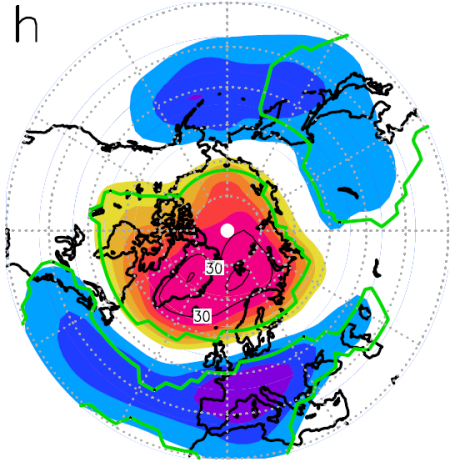
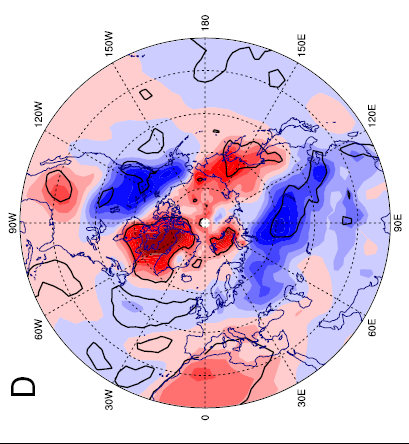
These two scientists from the Potsdam Institute and the Leibniz Institute of Marine Sciences in Kiel used the ECHAM5 atmospheric model.  As a boundary condition in a series of simulations they reduced ice cover in the Barents and the adjacent Kara Seas. With a mean reduction in ice volume similar to what we now see, they calculated the anomaly in the pressure distribution shown below:

Thus, abnormally high air pressure between Scandinavia and Greenland. Leading to the following temperature anomaly:


Cold from Siberia to Western Europe and a heat bubble centered on Labrador - quite similar to the temperatures this March.

Jaiser et al. (Tellus 2012)

Our colleagues from the Alfred Wegener Institute, together with U.S. researchers, examined the question of whether one finds this relationship in observational data. For this purpose, they investigated the correlation between the distribution of air pressure distribution and ice cover in an analysis of their covariance. They concluded: 
Our analysis suggests that Arctic sea ice concentration changes exert a remote impact on the large-scale atmospheric circulation during winter 
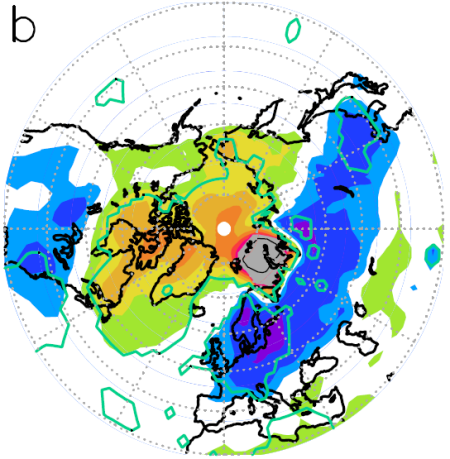
The following graph from this work shows how the distribution of air pressure in winter changes between phases of low and high fall-ice cover in the Arctic:

You can see that low ice cover correlates with high pressure in the Arctic winter, again between Scandinavia and Greenland - just as in the model calculations of Petoukhov and Semenov (Jaiser et al. do not show temperature maps).

Liu et al. (PNAS 2012)

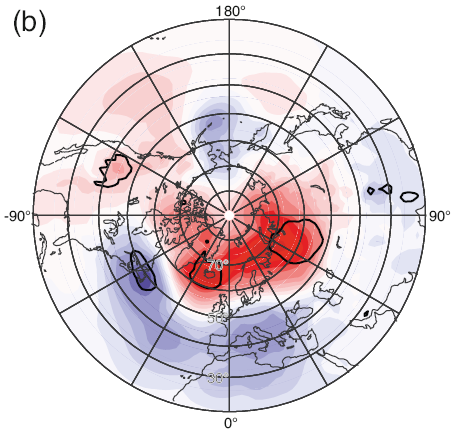
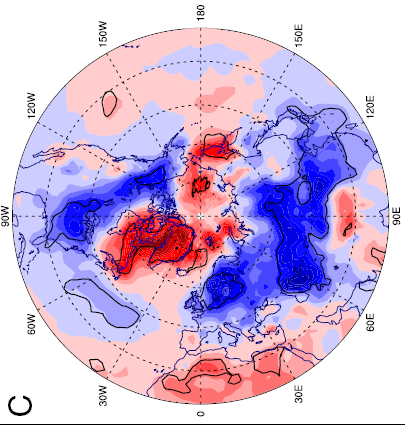
Next on the dance card is a study which appeared shortly thereafter by researchers from the U.S. and China, which approached the problem from both sides: model simulations and data analysis. The following map shows the linear regression between less ice cover in autumn and winter the temperature in the following:

Again, these temperature anomalies are similar to the two shown above, the temperature map for this March and that from the model of Petoukhov and Semenov.

An observed correlation (as in this diagram and in Jaiser et al.) is still not a causal connection, therefore Liu et al. also made a series of model calculations, but with a different model (the American model from NCAR). Further, they calculated a larger ensemble (20 runs with varying initial conditions), which makes the results statistically more robust. As a boundary condition in the model they took the observed reduction of the ice cover in the Arctic and calculated ensembles with or without the ice decrement. The result of these simulations for the temperature is as follows:

Again cold in Siberia and Europe, warmer over the Labrador Sea, and a cold band across North America. From the model, we know that it's not just a correlation, but a causal relationship: In the model setting the initial ice cover results in cold temperatures over Europe, just as in Petoukhov and Semenov. The associated air pressure maps are similar. 

Liu et al. also have dealt with whether alternatively the Arctic Oscillation (AO) or the North Atlantic Oscillation (NAO) could explain the temperature anomalies.  They showed that these natural oscillations lead to different spatial patterns and inter-annual fluctuations - they close out those arguments as causes. 

They also have examined the relationship with snow and come to the conclusion that additional open water in the Arctic humidifies the air, leading to increased snowfall.  The snowpack is important because even the strong March sun can hardly heat up snow-covered land; the white surface simply reflects the sun's rays. According to Liu et al.:
 We conclude that the recent decline of Arctic sea ice has played a critical role in the recent cold and snowy winters. 
However, the taz quoted [German paper] yesterday the spokesman of the German Weather Service [DWD in German] as saying that if there was a direct relationship with the sea ice cover,  the entire winter would have to be very cold in Germany.  I think this trivial argument with which he would like to wipe from the table the climate research results shown above is pretty embarrassing for the DWD.  Of course open water in the Arctic  does not override the stochastic weather patterns.  There will always be warm and cold periods. In all these studies it comes down to changing probabilities in the prevailing weather patterns: Petoukhov and Semenov estimate that the probability of cold winter extremes could triple, that is even in the Abstract. One wonders whether the DWD representative has read the relevant studies at all - and if not, why he feels the urge to comment on them in the media. Unfortunately, there is a certain tradition that meteorologists dealing with weather are not familiar with climate science. 

In my view, the above studies provide strong evidence for a link between Arctic ice loss due to global warming, more frequent winter high-pressure air masses, especially over the Atlantic-European part of the Arctic, and an associated influx of cold air to Europe. As we have often seen in recent winters - for example in a spectacular way in the first half of February 2012. 

Still this is not a slam dunk - the studies are relatively new and need to be discussed intensively in the professional community and confirmed by further research, or perhaps again questioned. This is the normal process of scientific debate, through which at the end findings are robust and widely accepted, such as the fact that our emissions of greenhouse gases warm the climate. 

P.S. (29.3.) I see now that
the climate lie detector has put its finger on the wonderful products of the Welt Online, which a few days ago once again presented the proverbial "Russian scientists who predict an ice age" warning of a "frozen pig cycle."  There is no better way of actually disproving the theories of  solar fluctuations, when even diehard "climate skeptics" can not find any more respectable arguments. This time, even sponsored by Gazprom (for real!).  Anyone interested in the subject of climate and sun could read What role does the sun play? [Maybe Eli will translate some day for some carrots.]
References

Jaiser R, Dethloff K, Handorf D, Rinke A, Cohen J (2012) Impact of sea ice cover changes on the Northern Hemisphere winter atmospheric circulation.Tellus Series A-Dynamic Meteorology and Oceanography 64th doi: 10.3402/tellusa.v64i0.11595

Liu JP, Curry JA, Wang HJ, Song MR, Horton RM (2012) Impact of declining Arctic sea ice on winter snowfall. Proceedings of the National Academy of Sciences of the United States of America 109 (11):4074-4079; doi: 10.1073/pnas.1114910109

Petoukhov V, Semenov VA (2010) A link between reduced Barents-Kara sea ice and cold winter extremes over northern continents. Journal of Geophysical Research-Atmospheres 115th doi: 10.1029/2009jd013568
Read More
Posted in Arctic Oscillation, Arctic sea ice volume, Eli Rabett, North Atlantic Oscillation, Stefan Rahmstorf | No comments
Older Posts Home
Subscribe to: Posts (Atom)

Popular Posts

  • James Hansen: Tar Sands and Dirty Tricks
    by James Hansen, September 13, 2013 The New Yorker just published (16 September issue) an excellent article "The President and the Pip...
  • Andrew Glikson: Another link between CO2 and mass extinctions of species
    by Andrew Glikson , The Conversation , March 22, 2013 It’s long been known that massive increases in emission of CO 2 from volcanoes, assoc...
  • Bombshell: Recent Warming Is ‘Amazing And Atypical’ And Poised To Destroy Stable Climate That Enabled Civilization
    by Joe Romm , Climate Progress , March 8, 2013 New Science Study Confirms ‘Hockey Stick’: The Rate Of Warming Since 1900 Is 50 Times Greater...
  • Real Pragmatism for Real Climate Change: Interview with Dr. John Abraham
    by John Stafford, OilPrice.com, March 26, 2013 At a time when extreme weather incidents are causing billions in damages, businesses, governm...
  • Steve Horn: State Dept Keystone XL Enironmental Reviewer Claimed Delaware Tar Sands Refinery Made Air Cleaner
    by Steve Horn, DeSmogBlog, July 18, 2013 A  DeSmogBlog  investigation reveals  Environmental Resources Management, Inc. (ERM Group) , the co...
  • James Hansen interview (video) of why he retired from NASA to be more active in climate actions
    by Climate Science Watch, April 12, 2013 Sustainability Media Lab shot this video interview on April 10, 2013, with James Hansen on why he l...
  • Justin Gillis, NYT: Maverick climate scientist James Hansen retiring from NASA, can now take a more active role in lawsuits challenging states and the federal government over their failure to limit CO2 emissions
    Climate Maverick to Quit NASA by  JUSTIN GILLIS , The New York Times , April 1, 2012 James E. Hansen , the climate scientist who issued the ...
  • Exxon acting like national guard under martial law in Mayflower, Arkansas, Pegasus tar sands dilbit spill cleanup
    Arkansas town in lockdown after oil spill nightmare by  Suzi Parker , Grist, April 5, 2013 REUTERS / Jacob Slaton There’s one Exxon gas stat...
  • Steve Horn: State Department's out-sourced Keystone XL environmental impact evaluation performed without knowing pipeline's route!!!
    by Steve Horn, DeSmogBlog, July 8, 2013 The State Department's decision to hand over control to the oil industry to evaluate its own ...
  • "A Reconstruction of Regional and Global Temperature for the Past 11,300 Years," by S. A. Marcott et al., Science, 339 (2013); doi: 10.1126/science.1228026
    Science  (8 March 2013),  Vol. 339, N o. 6124,  pp. 1198-1201  DOI:  10.1126/science.1228026 REPORT A Reconstruction of Regional and Global ...

Categories

  • 2012 temperatures (3)
  • 2013 temperatures (6)
  • acidizing (1)
  • Adam Siegel (1)
  • Adaptation (1)
  • Aerosols (7)
  • Africa (2)
  • Al Gore (1)
  • Alaska (6)
  • albedo (2)
  • albedo flip (5)
  • ALEC (8)
  • Alun Hubbard (2)
  • Amazon rainforest (1)
  • Andrew C. Revkin (2)
  • Andrew Freedman (1)
  • Andrew Glikson (1)
  • Andrew J. Weaver (1)
  • Antarctic bottom water (2)
  • Antarctic Circumpolar Winds (1)
  • Antarctic Ice Sheet -- Western (WAIS) (4)
  • Antarctic Oscillation - AAO (1)
  • Antarctic warming (1)
  • Anthony R Ingraffea (1)
  • Anthony Watts (1)
  • Arctic amplification (7)
  • Arctic melt season (1)
  • Arctic Methane Emergency Group (7)
  • Arctic Ocean (5)
  • Arctic Oscillation (5)
  • Arctic sea ice mean speed (4)
  • Arctic sea ice volume (24)
  • Argo (1)
  • Atlantic Meridional Overturning Circulation - AMOC (2)
  • Atmospheric CO2 (8)
  • Australia (6)
  • Barry Bickmore (1)
  • bees (9)
  • Benjamin Santer (4)
  • Bidder 70 (1)
  • Big Oil Big Coal (89)
  • Bill McKibben (11)
  • Black carbon (2)
  • BOEMRE (2)
  • Brad Johnson (1)
  • Brazil (2)
  • Brian Eister (2)
  • Canada (24)
  • Carbon sinks (2)
  • Catastrophic climate change (1)
  • Charles Monnett (3)
  • China (15)
  • Chris Mooney (1)
  • Civil resistance (33)
  • Climate Change Criminals (24)
  • Climate Denial Machine (47)
  • Climate modelling (5)
  • Climate Patriots (2)
  • Climate sensitivity (1)
  • CO2 draw-down (1)
  • Consequences to infrastructure (1)
  • contrails (1)
  • coral reefs (1)
  • Corexit (1)
  • corrupt officials (60)
  • Coupled ice-ocean model (3)
  • Coupled ocean–atmosphere model (2)
  • crop yields (9)
  • CRU e-mails (2)
  • CryoSat-2 (1)
  • cyclones (2)
  • Dana Nuccitelli (9)
  • Dansgaard–Oeschger event (1)
  • David Roberts (2)
  • David Spratt (2)
  • Deforestation (2)
  • deglaciation (1)
  • Denial psychology (9)
  • divestment (11)
  • Donors Trust (2)
  • Drought (9)
  • dust (1)
  • earthquakes (3)
  • East Siberian Arctic Shelf (1)
  • Eastern Siberian Arctic Shelf -- ESAS (2)
  • Eemian (3)
  • Eli Rabett (5)
  • Elizabeth Kolbert (1)
  • Ellesmere (1)
  • ENSO (11)
  • Eric Rignot (1)
  • Extreme weather events (15)
  • Ferrel cells (1)
  • First Nations (9)
  • Flooding (7)
  • floods (1)
  • Forest fires (3)
  • fracking (47)
  • Fred Singer (1)
  • freshwater lens (1)
  • fugitive emissions (2)
  • Gareth Renowden (2)
  • Gavin Schmidt (3)
  • Geoengineering (1)
  • George Monbiot (2)
  • Gerald Meehl (2)
  • glacial runoff (1)
  • Global dimming (1)
  • glyphosate (1)
  • Graham Readfearn (9)
  • Greenland ice melt (21)
  • Greenpeace (3)
  • Greg Laden (3)
  • GrIS (9)
  • Hadley cells (2)
  • Hadley circulation (2)
  • Hans Joachim Schellnhuber (1)
  • Harrison Loony Tool Schmitt (1)
  • Heartland Institute (14)
  • heat dome (3)
  • Heat waves (13)
  • hockey stick (10)
  • Holocene thermal maximum (2)
  • hurricanes (1)
  • IceSat (2)
  • Igor Semiletov (4)
  • Inhofe (2)
  • Insurers (2)
  • Intertropical Convergence Zone - ICZ (2)
  • Jakobshavn Isbræ (1)
  • James Hansen (15)
  • Jason Box (10)
  • Jeff Masters (6)
  • Jennifer Francis (7)
  • Jeremy Grantham (1)
  • Jet stream (4)
  • John Abraham (15)
  • John Christy (1)
  • John Cook (2)
  • John Kerry (2)
  • Joseph Romm (12)
  • Josh Willis (2)
  • Judith Curry (1)
  • Julie Brigham-Grette (1)
  • Justin Gillis (3)
  • Katharine Hayhoe (2)
  • Kerry Emanuel (2)
  • Kevin Grandia (1)
  • Kevin Trenberth (14)
  • Keystone Principle (14)
  • Keystone XL (57)
  • Koch Industries (13)
  • Konrad Steffen (2)
  • Lake El'gygytgyn (1)
  • Leo Hickman (2)
  • Marc Morano (3)
  • Mark Boslough (1)
  • Mark Hertsgaard (1)
  • Mark Serreze (1)
  • Mass extinctions (1)
  • Mauri Pelto (1)
  • Medieval Climate Anomaly (2)
  • Meridonal heat transport - MHT (1)
  • Methane (2)
  • Methane Gun hypothesis (9)
  • Methane hydrates (11)
  • Michael Mann (20)
  • Michael Oppenheimer (2)
  • Michael Tobis (2)
  • Milne Ice Shelf (1)
  • Mitigation (1)
  • Monckton (6)
  • Monsanto (3)
  • Myles Allen (1)
  • Naomi Klein (1)
  • Natalia Shakhova (4)
  • national security (3)
  • Neela Banerjee (1)
  • neonicotinoid pesticide (9)
  • Nitrous oxide (1)
  • North Atlantic meridional overturning circulation (1)
  • North Atlantic Oscillation (2)
  • Obama (1)
  • OccupyWallStreet (5)
  • ocean acidification (2)
  • Ocean chemistry (1)
  • ocean heat content (15)
  • Ocean salinity (2)
  • Ocean temperatures (4)
  • ozone levels (1)
  • paleo-climate (4)
  • Paleo-CO2 (2)
  • Patrick Michaels (1)
  • Paul Douglas (1)
  • PDO - Pacific Decadal Oscillation (4)
  • Peak food (10)
  • Peak oil (1)
  • Peak Water (3)
  • Permafrost (1)
  • Permafrost - subsea (2)
  • Permian mass extinction (1)
  • Peter Gleick (3)
  • Peter Sinclair (13)
  • Peter Wadhams (4)
  • Petermann Glacier (1)
  • Phil Jones (1)
  • Pinatubo rebound effect (2)
  • pine beetles (1)
  • Pine Island Glacier (1)
  • PIOMAS (3)
  • polar bears (5)
  • Polar jet stream (8)
  • Polar vortex (2)
  • Positive feedbacks (1)
  • Precipitation extremes (4)
  • radiative forcing (2)
  • Ray Weymann (1)
  • Raypierre (1)
  • resilience (1)
  • resource scarcity (3)
  • Richard Alley (3)
  • Richard Somerville (1)
  • Rick Piltz (2)
  • Robert Corell (1)
  • Roger Pielke Jr. (1)
  • Rossby waves (2)
  • Russia (1)
  • saltwater intrusion (1)
  • Scott Mandia (1)
  • Sea level rise (13)
  • sea surface temperature anomalies (1)
  • Sediment cores (2)
  • Shell Oil (4)
  • snow cover (3)
  • Snowden (1)
  • Solar activity (1)
  • solar radiation (1)
  • Soot (3)
  • Stefan Rahmstorf (5)
  • Steve Horn (13)
  • Storm intensity (1)
  • Storm tracks diverted polewards (1)
  • Stratospheric Sudden Warmings (3)
  • sulfoxaflor (1)
  • Tamino (1)
  • tar sands (57)
  • Ted Scambos (1)
  • Terracide (1)
  • These people are completely insane (7)
  • Thomas L. Friedman (2)
  • threat multiplier (1)
  • Threat to our democracy (49)
  • Tim DeChristopher (1)
  • Tipping elements (1)
  • Tom Steyer (1)
  • Tornado statistics (2)
  • TransCanada (3)
  • trees (1)
  • tropospheric water vapor (1)
  • Typhoon Yasi (1)
  • Van Jones (2)
  • volcanism (1)
  • WAIS (1)
  • Waleed Abdalati (1)
  • Walker circulation (2)
  • Walt Meier (1)
  • Water shortage (2)
  • William Krabill (1)
  • Willie Soon (1)
  • Wind pattern changes (2)
  • Wind power (2)

Blog Archive

  • ▼  2013 (500)
    • ▼  September (27)
      • James Hansen: Tar Sands and Dirty Tricks
      • Summer 2013 weather extremes tied to extraordinari...
      • Court rulings show judges accept climate science
      • DC judge denies another effort to derail Michael M...
      • Scientist Michael Mann named in top 10 influential...
      • Justin Gillis, NYT: A Climate Alarm, Too Muted for...
      • Top Obama aide Heather Zichal worked the Pavillion...
      • Call Sacramento. Vote NO on SB4
      • Graham Readfearn: The undiscerning climate bookshelf
      • Graham Readfearn: Australia's Department of Defenc...
      • Top Occupy Wall Street Cartoons
      • URGENT: phone your CA rep to prevent industry amen...
      • Tom Steyer, NexGen: Keystone XL bad economics for ...
      • Daily Mail Lies! No 60% recovery in Arctic sea ice...
      • Steve Horn: The Flip Side of Obama’s Keystone XL D...
      • Joseph E. Stiglizt, NYT: Why Janet Yellen, Not Lar...
      • "Global crop exposure to critical high temperature...
      • Naomi Klein: Green groups may be more damaging th...
      • Margaret Heffernan: Dare to Disagree
      • "Spring snow cover extent reductions in the 2008-2...
      • U.S. Becomes Largest Wood Pellet Exporter,Enviva, ...
      • Rebuttal to Michael Tobis' unsubstantiated attacks...
      • Why trust climate models? It’s a matter of simple ...
      • Steve Horn: "Frackademia" By Law: Section 999 of t...
      • MUST SEE, Peter Sinclair: No Slowdown in Global Wa...
      • Dana Nuccitelli: The Pacific Ocean fills in anothe...
      • Posts from August 2013
    • ►  August (78)
    • ►  July (74)
    • ►  June (56)
    • ►  May (62)
    • ►  April (105)
    • ►  March (98)
Powered by Blogger.

About Me

Unknown
View my complete profile