


Showing posts with label Peter Sinclair. Show all posts
Showing posts with label Peter Sinclair. Show all posts
Thursday, September 5, 2013
Wednesday, August 28, 2013

by Peter Sinclair, Climate Denial Crock of the Week, August 28, 2013
The little-questioned assumptions at the heart of the Business-as-usual model for energy development, are that “we are the Saudi Arabia of coal,” and there are “hundreds of years of natural gas” available for us to exploit. I’ve posted recently on the slow fade of the coal industry, and the “cheap natural gas” myth -- but the story continues.
The realization is slowly dawning that we need to develop greater efficiency and renewables, not because it would be nice and “green,” but because that is the only way to maintain our civilization.
Oil companies are hitting the brakes on a U.S. shale land grab that produced an abundance of cheap natural gas — and troubles for the industry.
The spending slowdown by international companies including BHP Billiton Ltd. (BHP) and Royal Dutch Shell Plc (RDSA) comes amid a series of write-downs of oil and gas shale assets, caused by plunging prices and disappointing wells. The companies are turning instead to developing current projects, unable to justify buying more property while fields bought during the 2009-2012 flurry remain below their purchase price, according to analysts.
The deal-making slump, which may last for years, threatens to slow oil and gas production growth as companies that built up debt during the rush for shale acreage can’t depend on asset sales to fund drilling programs. The decline has pushed acquisitions of North American energy assets in the first-half of the year to the lowest since 2004.
“Their appetite has slowed,” said Stephen Trauber, Citigroup Inc.’s vice chairman and global head of energy investment banking, who specializes in large oil and gas acquisitions. “It hasn’t stopped, but it has slowed.”
North American oil and gas deals, including shale assets, plunged 52% to $26 billion in the first 6 months from $54 billion in the year-ago period, according to data compiled by Bloomberg. During the drilling frenzy of 2009 through 2012, energy companies spent more than $461 billion buying North American oil and gas properties, the data show.
Grist reports on the impact fracking wells are having on real estate in heavily drilled areas.
When it comes to the real estate market in Bradford County, Penn., where 62,600 residents live above the Marcellus Shale, nothing is black and white, says Bob Benjamin, a local broker and certified appraiser. There aren’t exactly “fifty shades of grey,” he says, but residential mortgage lending here is an especially murky situation.
When Benjamin fills out an appraisal for a lender, he has to note if there is a fracked well or an impoundment lake on or near the property. “I’m having to explain a lot of things when I give the appraisal to the lender,” he says. “They are asking questions about the well quite often.”
And national lenders are becoming more cautious about underwriting mortgages for properties near fracking, even ones they would have routinely financed in the past, Benjamin says.
That’s a real problem in Bradford County, where 93% of the acreage is now under lease to a gas company.

Local banks are still lending because they have to if they want the business in the county, according to Benjamin, who has been involved in the area’s real estate market since 1980. But, he says, “The big boys, Wells Fargo and the other banks are probably pretty similar, they are going to protect their butt.”
Lawyers, realtors, public officials, and environmental advocates from Pennsylvania to Arkansas to Colorado are noticing that banks and federal agencies are revisiting their lending policies to account for the potential impact of drilling on property values, and in some cases are refusing to finance property with or even just near drilling activity.
Real estate experts say another problematic trend is that many homeowners insurance policies do not cover residential properties with a gas lease or gas well, yet all mortgage companies require homeowners insurance from their borrowers.
“Well, that is a conflict,” says Greg May, vice president of residential mortgage lending at Ithaca, N.Y.-based Tompkins Trust Company.
And don’t count on becoming a Jed Clampett-style millionaire off the gas lease on your back 40.
Don Feusner ran dairy cattle on his 370-acre slice of northern Pennsylvania until he could no longer turn a profit by farming. Then, at age 60, he sold all but a few Angus and aimed for a comfortable retirement on money from drilling his land for natural gas instead.
It seemed promising. Two wells drilled on his lease hit as sweet a spot as the Marcellus shale could offer—tens of millions of cubic feet of natural gas gushed forth. Last December, he received a check for $8,506 for a month’s share of the gas.
Then one day in April, Feusner ripped open his royalty envelope to find that while his wells were still producing the same amount of gas, the gusher of cash had slowed. His eyes cascaded down the page to his monthly balance at the bottom: $1,690.
Chesapeake Energy, the company that drilled his wells, was withholding almost 90% of Feusner’s share of the income to cover unspecified “gathering” expenses and it wasn’t explaining why.
“They said you’re going to be a millionaire in a couple of years, but none of that has happened,” Feusner said. “I guess we’re expected to just take whatever they want to give us.”
–
An analysis of lease agreements, government documents and thousands of pages of court records shows that such underpayments are widespread. Thousands of landowners…are receiving far less than they expected based on the sales value of gas or oil produced on their property. In some cases, they are being paid virtually nothing at all.
In many cases, lawyers and auditors who specialize in production accounting tell ProPublica energy companies are using complex accounting and business arrangements to skim profits off the sale of resources and increase the expenses charged to landowners.
http://climatecrocks.com/2013/08/28/fracking-fraying-at-edges/

Monday, July 29, 2013
by Peter Sinclair, It's Not Cool, July 29, 2013
Latest video for The Yale Forum on Climate Change & the Media, the first since returning from Greenland – includes interviews with ice expert Alun Hubbard, whom I met in Kangerlussuaq, as well as a snip from Richard Alley, at June’s Chapman conference in Granby, CO, and Jason Box, who spoke from our DarkSnowProject HQ in Sisimiut, in early July.
Takeaway – Greenland represents 22 feet of sea level rise, it’s moving faster than anyone thought it could just a few years ago, and there are processes occurring deep in the ice that may make even faster inevitable. According to Hubbard, we may we witnessing the deglaciation of a major ice sheet, with serious global implications.
Sunday, July 21, 2013
by Peter Sinclair, Climate Denial Crock of the Week, July 21, 2013
The most amazing thing about 2012 in the arctic was how un-amazing it was in terms of weather and warming – yet ice last year plunged to a stunning new low, most likely because the ice has become so thin and fragile that even the wear and tear of a normal year are enough to devastate the ice pack.
This year’s melt season has trended only a little below the 1981–2010 average up until about mid-June, then taken a dramatic downward turn. If it does not level off, ice loss will soon match the 2012 pace.
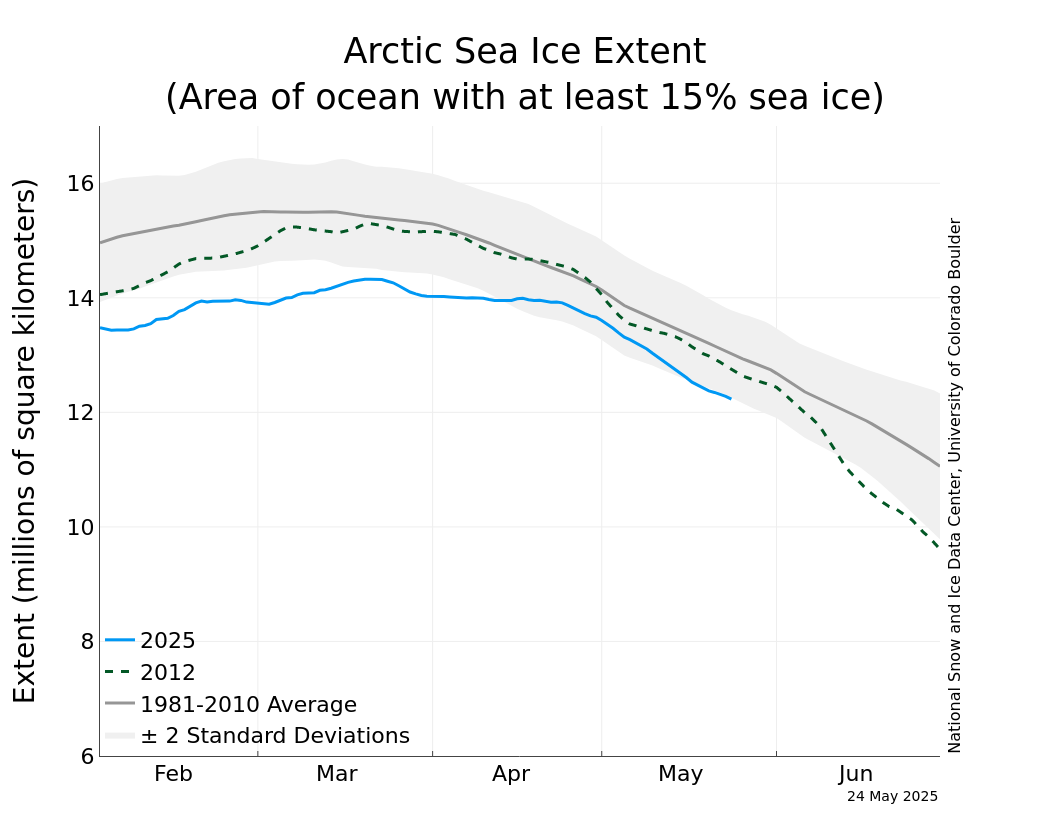
It’s not clear if 2013 levels will match 2012's astonishing record low, but – with temperatures over the Arctic Ocean 1–3 degrees above average – the 2013 melt season has picked up in earnest during July.
“During the first two weeks of July, ice extent declined at a rate of 132,000 square kilometers (51,000 square miles) per day. This was 61% faster than the average rate of decline over the period 1981 to 2010 of 82,000 square kilometers (32,000 square miles) per day,” the National Snow and Ice Data Center writes on its website.
Despite this rapid ice loss, the current mid-July 2013 sea ice extent is greater than 2012 at the same time by about 208,000 square miles NSIDC says.Financial Times (registration required):
Arctic shipping is set for a record year, underlining how melting sea ice is raising the prospect of an important new route for trade between Asia and Europe that shaves thousands of kilometres off the trip.
As of Friday, the administrators of the Northern Sea Route (NSR) – which follows the north coast of Russia – had granted permission to 204 ships to sail this year. In 2012, only 46 ships sailed the entire length from Europe to Asia, up from four vessels just two years earlier.Arctic Sea Ice Blog:
Commenter Danp opened a thread on the ASIF a couple of days ago, showing a cleaned up compilation he made of LANCE-MODIS satellite images (like commenter dabize did last year). The result looks very nice indeed, giving us a clear view of the holes on the Atlantic side of the Arctic, near the North Pole:
Ice experts weigh in – but those swiss-cheese-like holes near the pole appear to be signs that we could see a dramatic disintegration later in the summer.

Arctic Sea Ice Blogger Neven adds the animation shown at the top of this post with this note:
At the same time Dutch blogger Lars Boelen has combined images from the all-new, high-resolution, sea-ice concentration maps that are put out by the University of Hamburg (discussed a couple of weeks ago in this blog post).
To see the most recently updated video, check out Lars’ YouTube channel. He tries to update the video on a daily basis.Below, last year’s Sea Ice Minimum video:
Wednesday, July 10, 2013
by gareth renowden, hot topic, july 11, 2013

Massize forest fires are raging beyond control in Quebec, sending huge plumes of smoke to the east. The Eastmain fire — top left in this image from NASA’s Earth Observatory — is spreading towards the east coast of James Bay, the southernmost extension of Hudson Bay, and is currently estimated to cover an area of 656,000 hectares (1.6 million acres). Smoke from the huge fires has already caused smog problems in Montreal and Maine, and is heading round the globe. On July 8 NASA’s Terra satellite spotted a great swathe of Canadian smoke crossing Norway and Sweden, and heading across the Baltic towards Finland.

The Eastmain fire is the largest wildfire in Canada since 1959, and is almost as big as all the wildfires that have burned in the US so far this year. Forecasts for the area show warm temperatures continuing for at least another 5 days, so the fire is likely to continue to spread.
Meanwhile, up on the Greenland ice sheet, Jason Box, Peter Sinclair and the Dark Snow team, who are investigating the effect of smoke particles deposited on the ice on melting, have successfully completed their first sampling mission. It’s well worth checking Sinclair’s blog for frequent updates — and lovely images — of the team’s progress.
Thursday, June 13, 2013
Darkening causes the snow to absorb more sunlight which in turn increases melting

Climate scientist Jason Box during an expedition in Greenland in July 2008. Photograph: Byrd Polar Research Center
by John Abraham, Climate Consensus: the 97%, The Guardian, June 12, 2013
Last July, a record melting occurred on the Greenland ice sheet. Even in some of the highest and coldest areas, field parties observed rainfall with air temperatures several degrees above the freezing point. A month before, it was as though Greenland expert Jason Box had a crystal ball; he predicted this complete surface melting in a scientific publication. Box's research then got broader public visibility after climate activist and writer Bill McKibben covered it in Rolling Stone magazine.
The basic premise of Box's study was that observations reveal a progressive darkening of Greenland ice. Darkening causes the white snow surface to absorb more sunlight which in turn increases melting. Given that this process is likely to continue, the impact on Greenland melt, and subsequent sea level rise, will be profound.
There are several mechanisms that are known to darken arctic ice, including desert dust, pollen, soot from natural forest fires, and human biomass burning for land clearing and domestic use. Industrial, shipping, and aircraft pollution also play a role. Some of these effects are increasing. As climate change accelerates, more areas are being burned by wildfire each year. Box wondered how much increasing wildfires with resulting soot landing on the northern ice might amplify what scientists call a "positive feedback" (a self-reinforcing cycle) increasing Greenland melting. The cycle starts with initial warming, leading to more fires, more soot, and in turn more warming and more melt. The feedback is important, particularly in polar regions where observed warming is twice the rate of more southerly locations around the globe. Box calculates this effect has doubled Greenland surface melting since year 2000.
The topic has become hot among ice experts as new observations of ice melt continue to outstrip projections from just a few years ago. Arctic sea ice, another key measure of global heating, is now 60 years ahead of worst-case projections from the last report by the Intergovernmental Panel on Climate Change in 2007. Arctic snow cover on land has also been declining more rapidly than projected, even faster than sea ice. While mass loss of the enormous Greenland sheet is difficult to measure, satellite data indicate it has doubled in the last decade. If this acceleration continues, sea level rise could be even higher this century than the 1 or 2 meters that mainstream scientists now project – possibly much higher. Despite a recent study that projected Greenland outflow glaciers to slow, surface melting has increased faster than ice flow. The albedo feedback is a critical piece of physics that enables surface melting to continue dominating the loss.
To test his hypothesis, Box has assembled a team of scientists and communicators to collect and analyze samples from key locations on the ice sheet, and report those results directly to the public. The plan is to arrive in Greenland in late June, just as the peak melting season and fire season coincide. Box will be joined by Bill McKibben, who will be covering the research for Rolling Stone, and videographer Peter Sinclair, whose series of climate change videos on YouTube has gained high praise from climate scientists.
The scientific team includes Sara McKenzie Skiles, a researcher at UCLA and the NASA Jet Propulsion Laboratory, and Marek Stibal, a biogeochemist at the Geological Survey of Denmark and Greenland. Dr Stibal will be looking at yet another potential source of darkening, the activity of microorganisms that produce their own darkening pigments, which may be increasing due to atmospheric warming and fertilization by pollutants.
While government funding contracted, Box decided to push forward with a new approach, financing the research as a "citizen science" initiative, funded by internet crowd sourcing. His project is aptly named DARK SNOW and financial support is being collected online.
It is exciting to watch emerging science collide with novel scientific fundraising initiatives. It is possible that this emergence will grow in the coming years as scientific projects grow in cost and complexity, while more traditional funding sources diminish. The costs of funding projects like DARK SNOW are miniscule compared to the costs we endure from climate-change-related weather disasters. The penny-wise pound-foolish attitude we've taken toward science funding is a complicated issue that I'll deal with in a future post.
http://www.guardian.co.uk/environment/climate-consensus-97-per-cent/2013/jun/12/greenland-darkening-ice-climate-science
Last July, a record melting occurred on the Greenland ice sheet. Even in some of the highest and coldest areas, field parties observed rainfall with air temperatures several degrees above the freezing point. A month before, it was as though Greenland expert Jason Box had a crystal ball; he predicted this complete surface melting in a scientific publication. Box's research then got broader public visibility after climate activist and writer Bill McKibben covered it in Rolling Stone magazine.
The basic premise of Box's study was that observations reveal a progressive darkening of Greenland ice. Darkening causes the white snow surface to absorb more sunlight which in turn increases melting. Given that this process is likely to continue, the impact on Greenland melt, and subsequent sea level rise, will be profound.
There are several mechanisms that are known to darken arctic ice, including desert dust, pollen, soot from natural forest fires, and human biomass burning for land clearing and domestic use. Industrial, shipping, and aircraft pollution also play a role. Some of these effects are increasing. As climate change accelerates, more areas are being burned by wildfire each year. Box wondered how much increasing wildfires with resulting soot landing on the northern ice might amplify what scientists call a "positive feedback" (a self-reinforcing cycle) increasing Greenland melting. The cycle starts with initial warming, leading to more fires, more soot, and in turn more warming and more melt. The feedback is important, particularly in polar regions where observed warming is twice the rate of more southerly locations around the globe. Box calculates this effect has doubled Greenland surface melting since year 2000.
The topic has become hot among ice experts as new observations of ice melt continue to outstrip projections from just a few years ago. Arctic sea ice, another key measure of global heating, is now 60 years ahead of worst-case projections from the last report by the Intergovernmental Panel on Climate Change in 2007. Arctic snow cover on land has also been declining more rapidly than projected, even faster than sea ice. While mass loss of the enormous Greenland sheet is difficult to measure, satellite data indicate it has doubled in the last decade. If this acceleration continues, sea level rise could be even higher this century than the 1 or 2 meters that mainstream scientists now project – possibly much higher. Despite a recent study that projected Greenland outflow glaciers to slow, surface melting has increased faster than ice flow. The albedo feedback is a critical piece of physics that enables surface melting to continue dominating the loss.
To test his hypothesis, Box has assembled a team of scientists and communicators to collect and analyze samples from key locations on the ice sheet, and report those results directly to the public. The plan is to arrive in Greenland in late June, just as the peak melting season and fire season coincide. Box will be joined by Bill McKibben, who will be covering the research for Rolling Stone, and videographer Peter Sinclair, whose series of climate change videos on YouTube has gained high praise from climate scientists.
The scientific team includes Sara McKenzie Skiles, a researcher at UCLA and the NASA Jet Propulsion Laboratory, and Marek Stibal, a biogeochemist at the Geological Survey of Denmark and Greenland. Dr Stibal will be looking at yet another potential source of darkening, the activity of microorganisms that produce their own darkening pigments, which may be increasing due to atmospheric warming and fertilization by pollutants.
While government funding contracted, Box decided to push forward with a new approach, financing the research as a "citizen science" initiative, funded by internet crowd sourcing. His project is aptly named DARK SNOW and financial support is being collected online.
It is exciting to watch emerging science collide with novel scientific fundraising initiatives. It is possible that this emergence will grow in the coming years as scientific projects grow in cost and complexity, while more traditional funding sources diminish. The costs of funding projects like DARK SNOW are miniscule compared to the costs we endure from climate-change-related weather disasters. The penny-wise pound-foolish attitude we've taken toward science funding is a complicated issue that I'll deal with in a future post.
http://www.guardian.co.uk/environment/climate-consensus-97-per-cent/2013/jun/12/greenland-darkening-ice-climate-science
Sunday, June 2, 2013
Peter Sinclair is knocking out so many great posts every day that I can't keep up! Here is his latest interview with climate scientist Kevin Trenberth.
I’ll be doing a longer video piece on the whole issue of climate sensitivity that has been current over the last few months. One of the first people I wanted to talk to was Dr. Kevin Trenberth – and you can see part of the longer Skype interview above. Trenberth contributed to a recent paper showing that the deeper ocean has been collecting more heat over recent years, a factor that has to be considered in any discussion of global surface temps in the past decade or two.
Below, you can read Dr. Trenberth’s very valuable discussion of the issue, recently posted on the “Conversation” blog series out of Australia.
Has global warming stalled? This question is increasingly being asked because the local weather seems cool and wet, or because the global mean temperature is not increasing at its earlier rate or the long-term rate expected from climate model projections.
The answer depends a lot on what one means by “global warming.” For some it is equated to the “global mean temperature.” That keeps going up but also has ups and downs from year to year. More on that shortly.
Why should it go up? Well, because the planet is warming as a result of human activities. With increasing carbon dioxide and other heat-trapping greenhouse gases in the atmosphere, there is an imbalance in energy flows in and out of the top of the atmosphere: the greenhouse gases increasingly trap more radiation and hence create warming. “Warming” really means heating, and this can exhibit itself in many ways.
Rising surface temperatures are just one manifestation. Melting Arctic sea ice is another. So is melting of glaciers and other land ice that contribute to rising sea levels. Increasing the water cycle and invigorating storms is yet another. But most (more than 90%) of the energy imbalance goes into the ocean, and several analyses have now shown this. But even there, how much warms the upper layers of the ocean, as opposed to how much penetrates deeper into the ocean where it may not have much immediate influence, is a key issue.

The ups and downs of global temperature
My colleagues and I have just published a new analysis showing that in the past decade about 30% of the heat has been dumped at levels below 700 m, where most previous analyses stop.
The first point is that this is fairly new; it is not there throughout the record. The cause of the shift is a particular change in winds, especially in the Pacific Ocean where the subtropical trade winds have become noticeably stronger, changing ocean currents and providing a mechanism for heat to be carried down into the ocean. This is associated with weather patterns in the Pacific, which are in turn related to the La Niña phase of the El Niño phenomenon.
Ocean Heat Content from 0 to 300 meters (grey), 700 m (blue), and total depth (violet) from ORAS4, as represented by its 5 ensemble members. The time series show monthly anomalies smoothed with a 12-month running mean, with respect to the 1958–1965 base period. Hatching extends over the range of the ensemble members and hence the spread gives a measure of the uncertainty as represented by ORAS4 (which does not cover all sources of uncertainty). The vertical colored bars indicate a two year interval following the volcanic eruptions with a 6 month lead (owing to the 12-month running mean), and the 1997–98 El Niño event again with 6 months on either side. On lower right, the linear slope for a set of global heating rates (W/m2) is given.
The second point is that we have found distinctive variations in global warming with El Niño. A mini global warming, in the sense of a global temperature increase, occurs in the latter stages of an El Niño event, as heat comes out of the ocean and warms the atmosphere. The ocean’s temperature is also affected by volcanic eruptions, which also affect the perceptions of global warming.
Normal weather also interferes by generating clouds that reflect the sunshine, and there are fluctuations in the global energy imbalance from month to month. But these average out over a year or so.
Another prominent source of natural variability in the Earth’s energy imbalance is changes in the sun itself, seen most clearly as the sunspot cycle. From 2005 to 2010 the sun went into a quiet phase and the warming energy imbalance is estimated to have dropped by about 10 to 15%.
Some of the penetration of heat into the depths of the ocean is reversible, as it comes back in the next El Niño. But a lot is not; instead it contributes to the overall warming of the deep ocean. This means less short-term warming at the surface, but at the expense of greater long-term warming, and faster sea level rise. So this has consequences.

Global warming is here to stay
Coming back to the global temperature record, one thing is clear. The past decade is by far the warmest on record. Human induced global warming really kicked in during the 1970s, and warming has been pretty steady since then.
While the overall warming is about 0.16 °C per decade, there are three ten-year periods where there was a hiatus in warming, as the graph above shows, from 1977 to 1986, from 1987 to 1996, and from 2001 to 2012. But at each end of these periods there were big jumps. We find exactly the same sort of flat periods in climate model projections, lasting easily up to 15 years in length.
Focusing on the wiggles and ignoring the bigger picture of unabated warming is foolhardy, but an approach promoted by climate change deniers. Global sea level keeps marching up at a rate of more than 30 cm per century since 1992 (when global measurements via altimetry on satellites were made possible), and that is perhaps a better indicator that global warming continues unabated. Sea level rise comes from both the melting of land ice, thus adding more water to the ocean, plus the warming and thus expanding ocean itself.
Global warming is manifested in a number of ways, and there is a continuing radiative imbalance at the top of atmosphere. The current hiatus in surface warming is temporary, and global warming has not gone away.http://climatecrocks.com/2013/06/01/the-weekend-wonk-trenberth-on-ocean-heat-and-surface-temps/
Tuesday, May 14, 2013
from Peter Sinclair, Climate Denial Crock of the Week, May 14, 2013
On April 21, 2013, the Dark Snow Project brought a bit of Greenland to Manhattan, to illustrate the importance of this summer’s planned expedition to sample Greenland ice. It kicked off the last leg of our historic citizen-science crowd funding campaign.
If this final fundraising push is successful, I’ll be traveling in June to the Greenland Ice sheet as part of a scientific expedition to investigate the steady darkening and increasing melt of that important ice sheet. Bill McKibben will be coming along to write this up for Rolling Stone, as well.
There are 3 ways to help out, if you haven’t already. One, you can go to Darksnowproject.org, and make a donation at the bottom of the page. Two, you can text darksnow to 50555, or Three, you can go to the IndieGoGo crowdsourcing site.

If this final fundraising push is successful, I’ll be traveling in June to the Greenland Ice sheet as part of a scientific expedition to investigate the steady darkening and increasing melt of that important ice sheet. Bill McKibben will be coming along to write this up for Rolling Stone, as well.
There are 3 ways to help out, if you haven’t already. One, you can go to Darksnowproject.org, and make a donation at the bottom of the page. Two, you can text darksnow to 50555, or Three, you can go to the IndieGoGo crowdsourcing site.
Saturday, April 20, 2013

by Peter Sinclair, Climate Denial Crock of the Week, April 11, 2013
I bumped into some of these sea ice maps squirreled away on a dusty corner of my HD, on my way to researching this week’s video, and it occurred to me this would make a good post. Checking around, I see Neven already had it covered some time ago.
Nevertheless, people should know about these very valuable historical documents –Danish Sea Ice Maps from the early 20th century. [Readers, these maps are amazing. Go to the link and find the publication from 1907 and check out September!]
I’m supposed to be on a holiday and should let this one slide, but it’s too much. I was expecting fake skeptics to remain mostly silent in face of the ice massacre up north, but apparently they acutely sense how big this blow is to the remaining shred of their credibility, and so they upped the ante of misleading and distorting stupidity. Anyone can see and judge the silliness of paid shill Marc Morano, 5-sentence posts regurgitator/vomiter Steve Goddard and of course WUWT. But this Sunday Times article, written by well-known pseudo-journalist Jonathan Leake (search for his name on Deltoid) had a quote by presumed scientist John Christy that really got my hackles up:Professor John Christy director of the Earth System Science Centre at the University of Alabama in Huntsville, said the Arctic had indeed warmed, but there was also anecdotal and other evidence suggesting similar melts from 1938-43 and on other occasions.
“Climate change is a murky science,” he said. “To some it’s an easy answer to say it’s due to extra green house gasses. To the rest of us, separating natural variability from human impacts remains a wicked problem.”Commenters over at Skeptical Science quickly took this nonsense apart. First FrankD:Danske Meteorologiske Institut published a series of annual reports on arctic sea ice covering most years from 1893 to 1956. The link has one folder per year, with each containing individual pages (month identified by the trailing digit) and the whole annual report (about 5 meg each).
Just referring to August extent…
Its true that ice extent was lower in the 1930s than it had been in the preceding 30 years. In particular, 1938 saw a dramatic reduction from the previous years – it was probably 1.4 M km^2 below the then long term average and maybe 0.6 M km^2 below the already low years in the late 30′s (carefully measured using Eyeball, Mk I).
So, it is fair to say there were some big melts in the 30s. But Christy’s false equivalence is an epic fail – “similar melts” is pretty nice weasel-wording for mine. 1.4 M km^2 below recent climatology? Considered like that, 1938 was like 2010, I guess.
But in absolute terms, August 1938 extent was much greater (4 M km^2?) than today. So any attempt to conflate the two is…well…I can[‘t think of an adjective suitable for polite company.
Taking the Kinnard graphic (below) – the 1930s' “similar melt” is the second last dip on the graph, the first decline with modern observational data. This saw a return to “normal” after a peak that had seen the greatest extents in 500 years.
And then Daniel Bailey posted two graphs:Compared to the current decline on Kinnard (even without “enhancement”)? Well, even on Sesame Street they could tell you when one of these things was not like the other…

1. Arctic Sea Ice Extent August 1938 (see top of post).
2. Arctic Sea Ice Extent August 2012 (see below).
http://climatecrocks.com/2013/04/11/pesky-reality-intrudes-in-denierville-again-danish-ice-maps-from-the-30s/
My question to Dr. Christy: Why do you lie?

Friday, April 19, 2013
Here’s what I know so far.
The Dark Snow Project is on track, and will jump to a new level of seriousness this weekend, as we point toward a data gathering trip slated for peak melt season in Greenland this summer.
I have confirmation that writer/activist Bill McKibben will be joining Greenland expert Dr. Jason Box and myself early in the trip. With Dr. Box’s expert guidance, we’ll be taking a closer look at some of the most sensitive and important features of the Greenland sheet. More on this as details become available.
 Meanwhile, this weekend, darksnow awareness-and-fund raising continues in an Earth Day event in Union Square in Manhattan, New York City – as Dr Box and I, along with thousands of others, will be observing a massive darksnow themed ice sculpture illustrating the effects of darkening on the Greenland ice sheet.
http://climatecrocks.com/2013/04/19/bill-mckibben-to-join-dark-snow-project-in-greenland/
I’ve been recovering from earth-month speaking-event whiplash, having criss-crossed the state over recent days to talk about climate change, and what scientists are telling us.
Meanwhile, Paul Douglas, above, gave a brief summary of what we know about the extreme spring in the US, just before the current river of moisture hit across the nation’s midsection last night.

Near record setting flooding is hitting at my location, schools closed and evacuations underway. I got a bump from Jeff Masters last night about the situation, he is grappling with the big picture, will be posting more later today. For now, more concern about extreme weather knock-on effects – possible washing of dangerous invasive species into the Great Lakes water system.
WeatherUnderground:
The rains have brought the Des Plaines River on the east side of Chicago to major flood stage this morning, and a record flood crest is expected on Friday. The Asian Carp, a dangerous invasive species that would cost billions of dollars were it to get loose in the Great Lakes, is present in the Des Plaines River. Today’s flood event is capable of washing significant numbers of Asian Carp from the Des Plaines River into a canal that feeds directly into Lake Michigan, where they might be able to set up a breeding population capable of devastating the Great Lakes’ fishing industry. However, in October 2010, the U.S. Army Corps of Engineers completed the Des Plaines River barricade, a 13-mile-long system of concrete barriers and a specially fabricated wire mesh that allows water to flow through the fence but prevents the passage of fish. Hopefully, this barricade will withstand the flood and prevent Asian Carp from washing into Lake Michigan.CarbonBrief reports on similar extremes in northern Europe :
The Met Office has just released a report entitled “why was the start to spring 2013 so cold?”
-
The immediate cause was a natural climate fluctuation called the North Atlantic Oscillation (NAO). The NAO switches between two states, and this winter (in its negative phase) saw a southward shift of the jet stream, bringing cold air over the UK from northern Europe and Russia.
The Met Office identifies three other natural climate variations that may have made the negative NAO phase more likely.
One is the recent behaviour of another natural climate fluctuation, called the Madden-Julian Oscillation (MJO). It was particularly strong during late February and March – often a sign that a negative NAO is on the way.
This winter also saw what’s called a Sudden Stratospheric Warming (SSW) event, where winds in the stratosphere above the north pole reverse direction. This brought cold weather conditions to the UK.
Finally, Europe’s climate is influenced by another natural climate system – the Atlantic Multi-decadal Oscillation (AMO). While the influence on UK winters is unclear, the report suggests:
“[T]here is some evidence that the changes in Atlantic sea surface temperatures associated with the AMO, dispose the circulation to give drier than normal spring conditions over the UK and northern Europe.”
Arctic Amplification
What about the effects of human-caused climate change? One question that has been much discussed recently is whether the recent rapid decline in Arctic sea ice could contribute to a change in the UK’s weather.
The new report explains how this could work:

“It is argued that amplification of global warming over the Arctic is reducing the equator to pole temperature gradient, thereby weakening the strength of the mid-latitude jet streams.”
This could allow cold Arctic air to push further south, over mid-latitude countries like the UK, and weather patterns could stay longer in one place.
The possibility of a link between the Arctic and UK weather appears to be gaining scientific support, but the Met Office acknowledges it’s still an “area of ongoing research.” The Met Office has told us it’s holding an “ informal workshop” in the next two to three months for leading UK scientists plus several international experts.
Multiple factors
While scientists are making progress in working out how climate change could influence the odds of abnormal weather, it would be unwise to attribute one year’s events to a single cause. The report points this out, noting that:
“…no single explanation can account for the cold conditions observed.”
The report also highlights that although this spring was unusually cold,” it is not unprecedented or outside the expected natural variability of our climate.”
Nevertheless, with what the Met Office describes as “particularly heightened interest” in recent weather, getting to grips with how climate change could be affecting things is important. Even if, as the Met Office suggests, the complexities of the UK weather make “communicating the science drivers more complicated and nuanced than some audiences may wish.”http://climatecrocks.com/2013/04/19/jet-stream-blows-winds-of-change/
Tuesday, April 16, 2013
 |
Independent video producer Peter Sinclair trains his lens and microphone on seven climate science experts to help explain ice melt in Greenland and its implications for sea-level rise over remainder of the century.
Powerful graphics and concise interviews with expert climate scientists combine in independent video producer Peter Sinclair’s monthly Yale Forum “This Is Not Cool” video on Greenland ice melt.
The video includes interviews and sound clips featuring NASA climate scientists; Nichols College, Ohio State and Penn State scientists; and a Climate Institute scientist. Among other points, these experts cite the benefits of having ice melt maps over the past two decades and point to the intensity, and not necessarily the geographical extent, of Greenland ice sheet melting as a particular concern.
“Exceptional melts” is how one expert characterizes recent Greenland melting … “very well documented” by satellite records. “A 10-year doubling time” on Greenland’s sea-level contribution “makes it much more likely that we will observe more than one meter of sea-level rise by the end of the century,” a scientist observes. Another scientist’s counsel: “A big dip in 2012. We don’t know what’s going to happen in 2013.”
“Just astounding to see,” a glaciologist cautions … “we just have more melt everywhere.”
“A very serious issue,” another concludes.
The video is one of a continuing series that Sinclair produces exclusively for The Yale Forum.
Link: http://www.yaleclimatemediaforum.org/2013/04/yale-forum-monthly-video-focuses-on-greenland-ice-sheet-melt/
Thursday, March 21, 2013
by Peter Sinclair, Climate Denial Crock of the Week, March 21, 2013
Michael Bishop, a self described “ultra conservative” Texas landowner, discusses the attempt to take over his property for the Keystone XL pipeline.
His jarring experience with Transcanada, the pipeline builder has caused him to rethink his stand on a number of issues, including climate change. Many climate deniers claim to be conservative – they’re not. Forcing the largest change in the earth’s atmosphere in 60 million years is not conservative. Neither is taking private land and threatening to put an honest citizen in jail if he resists.
“..So I’m fightin’ em, we’re going to win, and they’re going to have to dig the the damn line up, period.”
UPDATE: More about Michael’s fight from EcoWatch:
Dogs are territorial and bark at the wind blowing, leaves moving, sounds miles away, strange vehicles and people coming onto your property. I don’t care where you live in the world. That is their nature. My dogs are scared to death of these giant machines and bark every time the workers crank up. It is a constant “parade” of TransCanada’s vehicles up and down the line. The construction of Keystone XL is only 120 feet from my house and aside from the rumbling and noise from the engines, the dogs barking for almost 10 hours per day is irritating, to say the least.


Recently, two of my grandchildren, who are used to playing anywhere in the front they want, wandered into the work area, which caused my heart to drop. I’m telling you, these people don’t care about anyone or anything now, but by God, they will.
I came to East Texas nearly 30 years ago after spending all of my teen years and most of my adult life along the Houston Ship Channel, working in the oil refineries and chemical plants. I see beauty everywhere but I really like East Texas in the springtime. I bought this property to leave to my children and grandchildren—a legacy, if you will. With my sons, and now my daughter, I have done my best to instill in them the responsibility of stewardship and how to properly take care of Earth and its creatures. I went outside to check the fruit trees in my orchard last week and, as I have for 30 years, marveled at the beauty of the blossoms on the pear, cherry, apple and peach trees. I also had tears in my eyes, because only a few feet away is the pipeline that is going to carry some of the most toxic material found on Earth.I take great pride, as a biologist and self-proclaimed naturalist, in the native plants I have protected and nurtured for more than 20 years. My wild irises, which are phenomenal, have been buried by TransCanada’s excavator and although they will live, it will be another year before they bloom again. It is all so sad and shameful that I am at a loss for words, to be quite honest. It’s profits over everything else, especially Constitutional rights.


This pipeline is being built despite massive protests and lawsuits by honest, hardworking landowners and concerned U.S. citizens. In retrospect, I should have ignored my lawyer and the lawyer for the Texas Veterans Land Board, stood my ground and never settled. I was in a situation where my back was up against the wall, with a wife who has Alzheimer’s and a teen-aged daughter, and the attorneys involved led me to believe I had no choice but to settle. Hindsight is always 20/20, but looking forward, the facts in my lawsuits are irrefutable.http://climatecrocks.com/2013/03/21/climate-denier-rethinks-after-being-clobbered-by-keystone/
I claim, in my suit against TransCanada, that they have defrauded the American public, misled Texas landowners and have no right to eminent domain based on the material they are transporting. What I find extremely sad and unbelievable is that once members of the public became aware of this company’s deceit and contacted the appropriate legislators and regulatory authorities, no corrective action was performed. The Texas legislature did not call for an investigation into this matter and the Texas Railroad Commission (the pipeline operator permitting agency) turned a deaf ear to this problem. I use the word “problem” because it is a “problem,” not an “issue.” Where are all the people who took sacred oaths to protect the public?
Subscribe to:
Posts (Atom)


